

-
Post-Quantum, PQC, Quantum Security
4,099 Qubits: The Myth and Reality of Breaking RSA-2048 with Quantum Computers
4,099 is the widely cited number of quantum bits one would need to factor a 2048-bit RSA key using Shor’s algorithm – in other words, the notional threshold at which a quantum computer could crack one of today’s most common…
Read More » -
Policy & Sovereignty
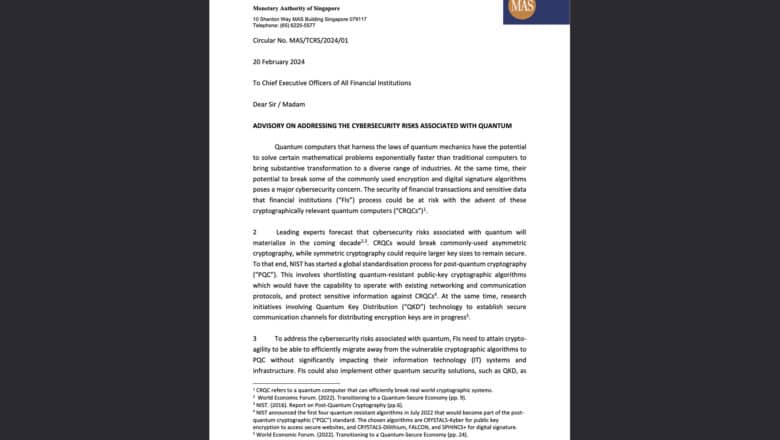
Monetary Authority of Singapore (MAS) Quantum Risk Advisory
On February 20, 2024, the Monetary Authority of Singapore (MAS) issued Circular No. MAS/TCRS/2024/01, titled “Advisory on Addressing the Cybersecurity Risks Associated with Quantum“. Targeted at CEOs of all financial institutions (FIs), the Advisory addresses the emerging cybersecurity challenges posed…
Read More » -
Quantum Security & PQC
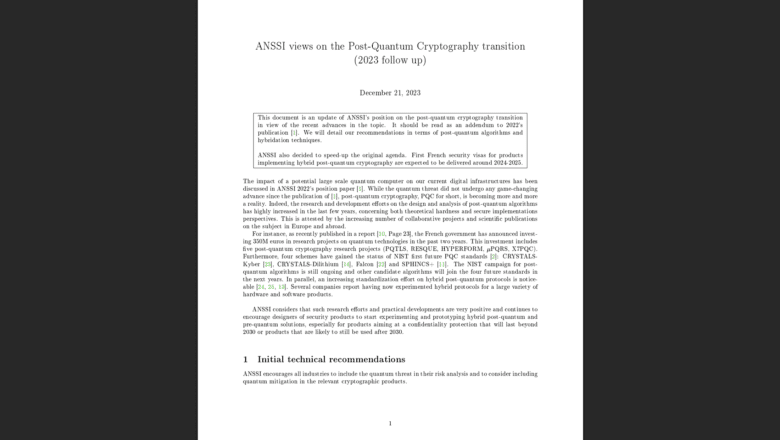
France’s ANSSI Doubles Down on Hybrid PQC and Signals It May Not Follow NIST Exactly
ANSSI's follow-up position paper on PQC doubles down on hybrid cryptography for both key exchange and signatures, a stricter requirement than most allies, and hints that France's accepted algorithm list may not match NIST's exactly.
Read More » -
Post-Quantum, PQC, Quantum Security
Telecom’s Quantum‑Safe Imperative: Challenges in Adopting Post‑Quantum Cryptography
The race is on to quantum‑proof the world’s telecom networks. With cryptographically relevant quantum computers (CRQC) projected to arrive by the 2030s, global communications providers face an urgent mandate to upgrade their security foundations. Today’s mobile and fixed‑line networks rely…
Read More » -
AI Security

Creativity is Not as Uniquely Humans as We Think
For years, creativity has been held up as the last bastion of human uniqueness. A mysterious force that AI could never replicate. Our moat against AI. A defining trait that would forever separate human minds from silicon brains. The idea…
Read More » -
Quantum Networks
Quantum Repeaters: The Key to Long-Distance Quantum Comms
Quantum repeaters are specialized devices in quantum communication networks designed to extend the distance over which quantum information (qubits) can be sent without being lost or corrupted. They tackle a fundamental challenge: photons carrying qubits tend to get absorbed or…
Read More » -
Quantum Computing
Quantum Technologies & Quantum Computing in the UK
The United Kingdom’s quantum technology initiatives have moved from foundational research into a phase of delivery and implementation. The country’s comprehensive approach – supporting research excellence, investing in infrastructure and industry collaboration, and aligning with national goals in security and…
Read More » -
Research
Breakthrough in Quantum Error Correction by Nord Quantique
Sherbrooke, Canada (February 8, 2024) – Nord Quantique, a Canadian quantum computing startup, has announced a breakthrough in quantum error correction using the Gottesman–Kitaev–Preskill (GKP) bosonic code. The company demonstrated, for the first time, an increase of 14% in the…
Read More » -
Industry
NATO publishes first Quantum Technologies Strategy, pledging a “quantum-ready” Alliance and a shift to quantum-safe crypto
NATO has released a public summary of its first Quantum Technologies Strategy, signalling that the Alliance now treats quantum as more than a long-term science project: it’s a near-term driver of military advantage, a cybersecurity risk, and a locus of…
Read More » -
Industry
Origin Quantum’s Wukong: China’s 72-Qubit Processor
In a major milestone for China’s quantum tech ambitions, Hefei-based startup Origin Quantum has unveiled “Wukong,” a 72-qubit superconducting quantum processor. Launched on January 6, 2024, this third-generation quantum computer is China’s first home-grown superconducting quantum computer and the most…
Read More » -
Quantum Computing
The DiVincenzo Criteria: Blueprint for Building a Quantum Computer
Quantum computing promises to revolutionize fields from cybersecurity to drug discovery, but building a functional quantum computer is an immense technical challenge. In the late 1990s, physicist David DiVincenzo outlined a set of conditions - now known as DiVincenzo’s criteria…
Read More » -
Quantum Networks
What is Entanglement-as-a-Service (EaaS)?
Entanglement-as-a-Service is transitioning from a fascinating concept to a nascent reality. Its technical foundations are solidly rooted in quantum physics, its current development is accelerating through global research efforts, and its promise has caught the attention of the telecommunications industry…
Read More » -
Post-Quantum, PQC, Quantum Security
Quantum Computing Risks to Cryptocurrencies – Bitcoin, Ethereum, and Beyond
Cryptocurrencies like Bitcoin and Ethereum derive their security from cryptographic algorithms – mathematical puzzles that are practically impossible for classical computers to solve in any reasonable time. However, the emergence of quantum computing threatens this security assumption. Unlike classical machines,…
Read More » -
Quantum Sovereignty
Quantum Sensing and Navigation as Sovereignty
Quantum sensing leverages quantum phenomena (entanglement, superposition, etc.) to achieve measurement precision beyond classical limits. Importantly, many quantum sensors are nearing deployable maturity, unlike quantum computers that remain experimental. Atomic clocks, quantum optical gyroscopes, gravity sensors and the like are…
Read More » -
AI Security
Marin’s Statement on AI Risks
The rapid development of AI brings both extraordinary potential and unprecedented risks. AI systems are increasingly demonstrating emergent behaviors, and in some cases, are even capable of self-improvement. This advancement, while remarkable, raises critical questions about our ability to control…
Read More »


