
All Post-Quantum, PQC Posts
-
Post-Quantum, PQC, Quantum Security

Key Ceremonies: What They Are, What Good Looks Like, and What PQC Changes
A key ceremony produces the main evidence that a CA key was generated correctly. What the rules require and miss, what a good ceremony looks like, the skills it needs, and what PQC changes.
Read More » -
Post-Quantum, PQC, Quantum Security
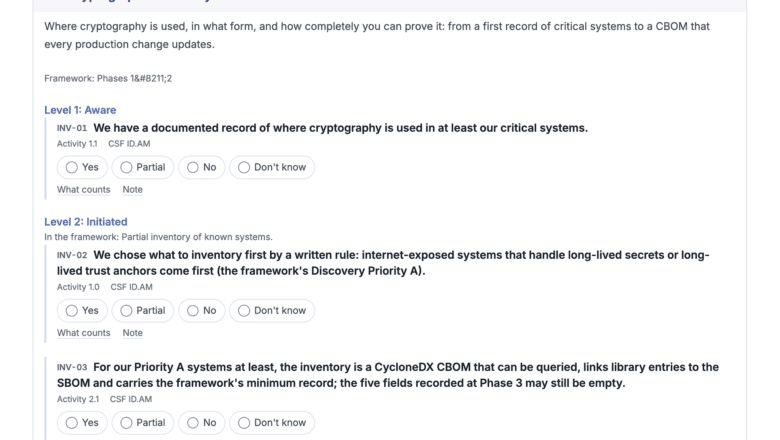
I Rebuilt My Free PQC Readiness Assessment on the PQC Migration Framework v3.0
My PQC readiness scorecard now rates seven domains on the PQC Migration Framework's 0 to 5 scale and takes the weakest as your readiness level. It also lists your regulatory deadlines. Your answers never leave your browser.
Read More » -
Post-Quantum, PQC, Quantum Security
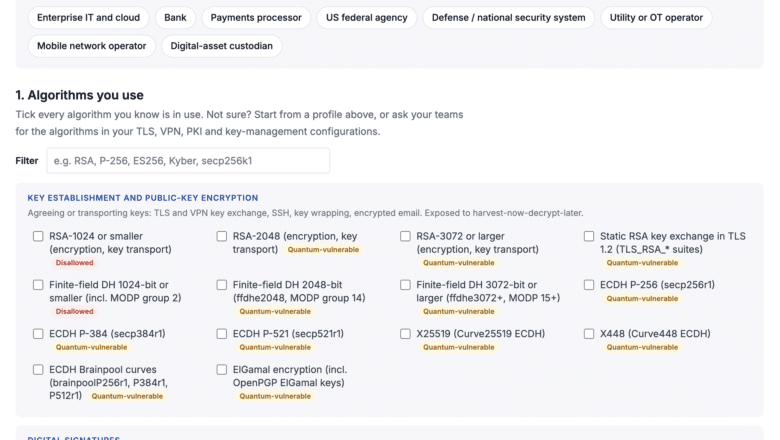
I Rebuilt the PQC Migration Advisor With 63 Algorithms, 18 Protocol Families and 20 Jurisdictions and Regimes
With version 2.0 of my free PQC Migration Advisor, you can compare your migration estimate with your earliest regulatory deadline and export a sourced, four-tier action plan as a PDF, CSV or Markdown file.
Read More » -
Post-Quantum, PQC, Quantum Security

Supervisors Can Measure a Sector’s Cryptographic Exposure Without Collecting Anyone’s Inventory
Under the EU's Cyber Resilience Act, authorities may collect software inventories before anonymizing them. Supervisors measuring cryptographic exposure can skip that step, with federated queries, secure aggregation and private set intersection run against each firm's own CBOM.
Read More » -
Quantum Security & PQC

Michael Saylor’s Quantum Claims About Bitcoin, Checked
Strategy's executive chairman says Bitcoin should wait for a quantum threat before upgrading. Its upgrade record, its draft proposals, the arithmetic of block space and his company's own SEC filings all say otherwise.
Read More » -
Post-Quantum, PQC, Quantum Security
PQC for MSSPs and Consultancies: Opportunity and Risk
Post-quantum migration will keep security consultancies and MSSPs busy for a decade, but the revenue is in PKI, legacy systems, vendors and governance, not in scans. Clients will also check each provider's own cryptography before they buy.
Read More » -
Post-Quantum, PQC, Quantum Security
Crypto-Agility for Digital Assets: Chains Are Planning One Post-Quantum Change When They Will Need Several
Zcash replaced a flawed proof circuit and sealed a pool then worth $1.7 billion within 60 days. Bitcoin and Ethereum are planning one post-quantum change. Crypto-agility means a chain can change its cryptography again, and retire what it replaced.
Read More » -
Post-Quantum, PQC, Quantum Security
Crypto-Agility Is the Goal. The PQC Migration Is Only Its First Test.
Post-quantum algorithm choices are already changing: a NIST candidate was withdrawn the day after an attack went public, and BSI advised against Classic McEliece in new developments. Build a crypto-agility program and make the PQC migration its first test.
Read More »


