
Deep Dive Series
How to Build a Quantum Computer
You can now build a working quantum computer from commercially available vendor components. In March 2026, the Q-PAC consortium in Denver went from concept to cloud-accessible operation in five months, using a QuantWare QPU, Qblox control electronics, a Maybell cryostat, and Q-CTRL calibration software, all assembled by an independent integration team. Similar multi-vendor builds are running at QuTech in Delft and IQM at LRZ in Munich. QuantWare’s $178 million Series B and the construction of KiloFab, a dedicated quantum fabrication facility, confirm that modular quantum computing is no longer an experiment. But the engineering to make it work is anything but simple.
This Deep Dive series is the practical companion to my coverage of quantum computing supply chains and Quantum Open Architecture. Where the supply chain series maps who makes the components and the QOA series explains why modular architecture matters, this series covers what happens when you actually try to integrate them: the facility preparation that most data centers cannot accommodate, the signal chain engineering that determines whether your qubits perform to spec, the control electronics and orchestration software that turn cold hardware into a functioning machine, and the calibration sequences that keep it working. Each major qubit modality gets a dedicated build guide (superconducting, trapped-ion, neutral-atom, photonic, and silicon-spin), and cross-cutting articles cover the cryogenic infrastructure and helium-3 supply chain, the control electronics that drive the qubits, the OS and orchestration layer, the HPC integration, the economics of building and operating, the supply chain geography and concentration risk, and the security hardening decisions that protect the deployment.
The analysis in this series draws on Applied Quantum’s Systems Integration Playbook, the most detailed technical reference for assembling quantum computers from modular components, supplemented by published deployment data from Q-PAC, the IQM/LRZ integration (arXiv:2509.12949), and the QuTech HectoQubit/2 project. For the physics of how each qubit modality works, see the Quantum Computing Modalities Deep Dive.
-
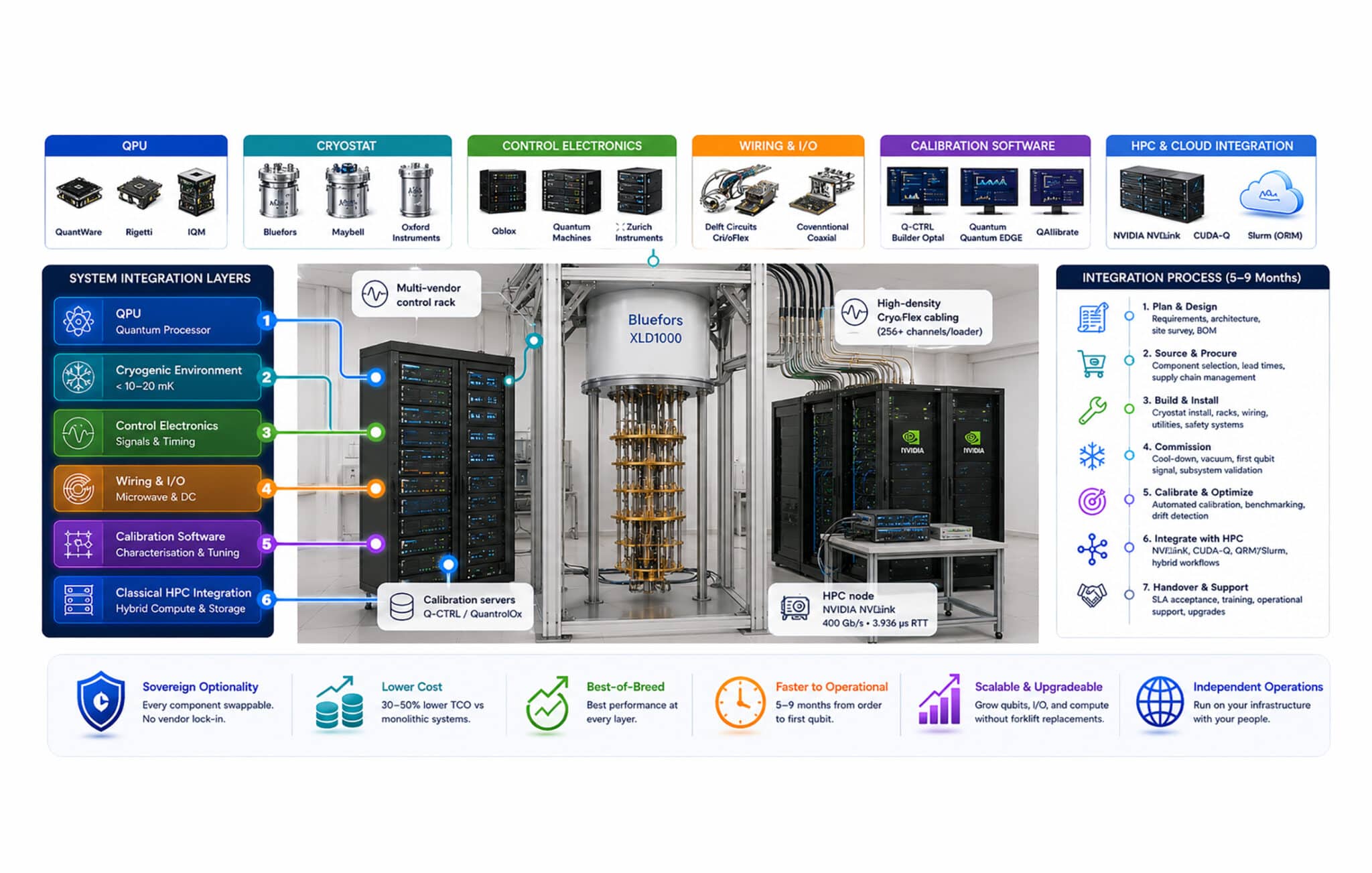
In March 2026, a consortium in Denver assembled a working quantum computer from five different vendors' components in five months. A Dutch QPU, Dutch control electronics, an American cryostat, Australian calibration software, supply chain spanning three continents, integration in Colorado. Three other multi-vendor builds in Delft, Munich, and Naples confirm the pattern. QuantWare's $178 million Series B is funding a 20x production capacity expansion. The Quantum Open Architecture model has moved from conference slides to commercial reality. But the engineering between "we bought the components" and "we have a working quantum computer" is where most organizations underestimate the difficulty. The hard problems are not physics. They are cryogenic systems operating 150 times colder than deep space, a helium-3 supply chain in structural deficit, a cryogenic wiring wall that defines the scaling ceiling more directly than any QPU roadmap, facility requirements that no conventional data center meets, and a real-time error correction pipeline that requires dedicated GPU infrastructure to function. This ten-article series covers the full integration challenge across every major qubit modality: the superconducting build from signal chain engineering through calibration to the troubleshooting data that no one else publishes; the trapped-ion build where the challenge shifts from cryogenics to precision lasers and ultra-high vacuum; the neutral-atom build where the entire cryogenic stack disappears and the system fits in a standard server rack; the photonic and silicon-spin builds at different stages of supply chain maturity; the cryogenic infrastructure and helium-3 economics that dominate cost and schedule; the HPC integration stack; and the full cost picture from a $2 million entry system to $150 million national laboratory installations. The analysis draws on Applied Quantum's Systems Integration Playbook, the most detailed Western technical reference for assembling quantum computers from modular components.
Read More »

-
Building Quantum Computers
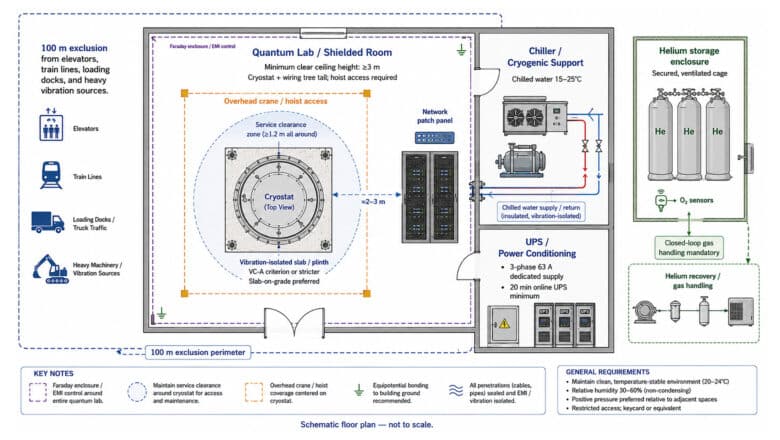
Preparing a Facility for a Quantum Computer
A superconducting quantum computer is not a server rack. This guide covers the facility requirements that most data centers cannot accommodate, from vibration isolation to helium-3 storage, with a reference floor plan.
Read More » -
Building Quantum Computers
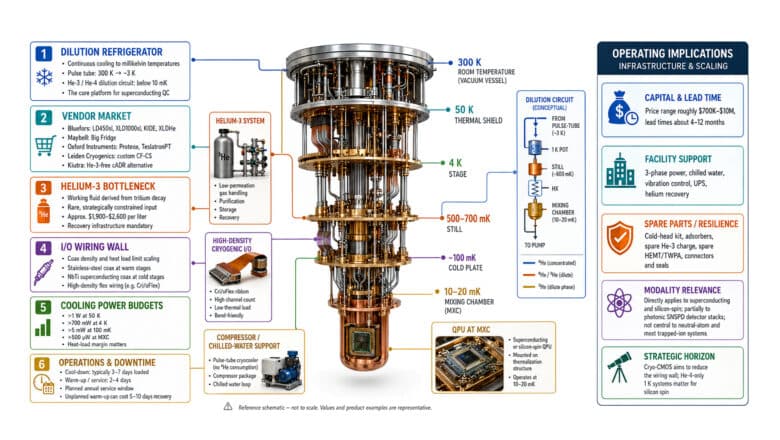
The Cryogenic Infrastructure That Makes (or Breaks) a Quantum Computer
The dilution refrigerator is the most expensive, longest-lead, and physically largest component in a superconducting quantum computer. The helium-3 it runs on comes from nuclear weapons stockpile decay. Both define the scaling ceiling.
Read More » -
Building Quantum Computers
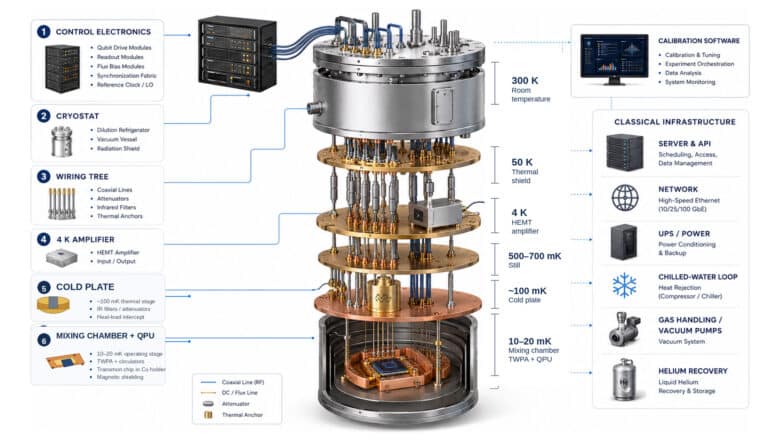
Building a Superconducting Quantum Computer
The complete integration guide for assembling a superconducting quantum computer from modular components. Signal chain engineering, cryostat selection, calibration sequences, and the operational reality of keeping transmon qubits running at 10 millikelvin.
Read More » -
Building Quantum Computers

Building a Trapped-Ion Quantum Computer
Trapped-ion quantum computers trade the cryogenic infrastructure of superconducting systems for a different set of challenges: precision laser systems, ultra-high vacuum, and the QCCD architecture that shuttles ions between functional zones.
Read More » -
Building Quantum Computers
Building a Neutral-Atom Quantum Computer
No dilution refrigerator. No helium-3. No chilled-water plant. Neutral-atom quantum computers run at room temperature in standard server racks, and Pasqal has deployed them into production HPC centers across three continents.
Read More » -
Building Quantum Computers
Building a Photonic Quantum Computer
Photonic quantum computing encodes information in particles of light on silicon chips fabricated at semiconductor foundries. The core processor runs at room temperature. The supply chain is vertically integrated. Here is what that means for builders.
Read More » -
Building Quantum Computers
Building a Silicon-Spin Quantum Computer
Silicon-spin qubits are manufactured on the same 300 mm semiconductor lines that produce classical processors. They operate at 1 K instead of 10 millikelvin. They eliminate helium-3. The supply chain is young but the thesis is compelling.
Read More » -
Building Quantum Computers
Choosing a Quantum Control System: What Actually Drives the Qubits
The control system decides whether your QPU computes or sits cold in a fridge. A procurement guide to the three-vendor superconducting market, the FPGA allocation constraint that slips schedules, and what each modality demands from its electronics.
Read More » -
Building Quantum Computers
The Quantum OS and Orchestration Layer: Assembling the Software That Runs the Machine
No turnkey Western quantum OS exists. A procurement guide to the software layer that turns multi-vendor hardware into a functioning, multi-user machine: the five-layer stack, the calibration decision, and the build-or-buy choice for middleware.
Read More » -
Building Quantum Computers
Integrating a Quantum Computer into HPC Infrastructure
A quantum computer without HPC integration is an isolated experiment. NVQLink, QRMI, and CUDA-Q make QPUs schedulable alongside GPUs in standard Slurm environments. Here is how the integration works and where the software stack falls short.
Read More » -
Building Quantum Computers
What a Quantum Computer Actually Costs to Build and Operate
A 5-qubit research system costs roughly $2 million over five years. A 20-qubit mid-range system costs $10 million. An industrial installation runs $30-150 million. Here is where the money goes, who pays, and what surprises first-time buyers.
Read More » -
Building Quantum Computers
The Quantum Supply Chain: Where Every Component Comes From and What Breaks If It Stops
A handful of countries and companies supply the entire Western quantum hardware stack. Where the concentration risk sits layer by layer, how it materializes in ordinary procurement, and why open architecture is the structural mitigation.
Read More » -
Building Quantum Computers
Securing a Quantum Computer: The Hardening Decisions a Builder Has to Make
Every quantum computer is controlled by classical systems that can be hacked like any other. The security decisions a builder makes during integration: facility hardening, network segmentation, firmware integrity, personnel, and calibration drift as a security signal.
Read More » -
Quantum Computing
Every Headline RSA-2048 Estimate Assumes Qubits That Work. A Sydney Team Measured What Happens When They Don’t.
On a single IBM chip, a distance-5 surface code lost to a distance-3 even after the defective components were routed around. The headline estimates of what breaking RSA-2048 takes assume they all work.
Read More »


