

-
Policy & Sovereignty
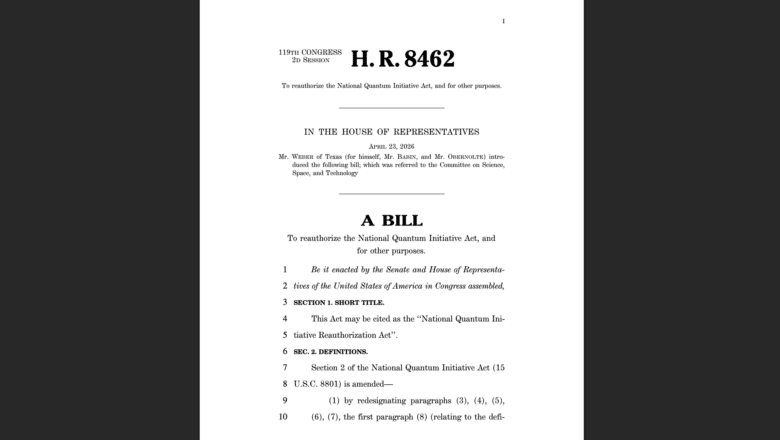
Washington’s Quantum Policy Machine Grinds Forward: NQI Reauthorization, Cybersecurity Preparedness Act, and a Pentagon Migration Guide
Three U.S. policy moves — NQI reauthorization, a quantum cybersecurity bill, and a Pentagon migration guide — show Washington building plumbing for the quantum transition.
Read More » -
The Quantum Utility Map
The Error Correction Revolution: Why qLDPC Codes, Magic State Cultivation, and Algorithmic Fault Tolerance Are Rewriting the Quantum Timeline
The error correction tax decides which applications are reachable on which hardware. Three advances compressed it by an order of magnitude on paper, and 2026 moved the evidence from simulation toward hardware.
Read More » -
Post-Quantum, PQC, Quantum Security
The Signature Supply Chain: How Deep Does Digital Trust Go?
From TPM attestation keys to container image signatures, modern systems depend on dozens of signature layers most security teams have never fully mapped. This deep dive exposes the full anatomy of the trust infrastructure a quantum computer would compromise.
Read More » -
The Quantum Utility Map
Why Quantum Won’t Save Wall Street (Yet): An Honest Assessment of Quantum Computing in Finance
Goldman Sachs' own resource estimates need logical clock rates a thousand times beyond foreseeable hardware. A proven memory advantage now sits next to one of the three signals that would change that, and nobody has costed it.
Read More » -
Post-Quantum, PQC, Quantum Security

PQC Standards Fragmentation: What Multinationals Must Plan For Now
Your New York office runs ML-KEM per NIST. Your Frankfurt office needs ANSSI-recommended hybrids. Your Shanghai office will require Chinese ICCS algorithms. Your Seoul subsidiary uses KpqC. You need one migration plan. This article maps how to build it.
Read More » -
The Quantum Utility Map
Quantum Sovereignty and the Utility Trap
The industries where quantum computing creates the most value are the ones most critical to national security. The hardware serving them is concentrated, and the architectural decisions that settle sovereign or dependent access are being made now.
Read More » -
Quantum Computing
The Decoder Bottleneck: The CRQC Challenge Nobody Is Talking About
Qubit count gets the headlines. Error rates get the analysis. But the classical decoder that must process millions of error signals per second in real time gets almost no attention outside the QEC research community. It may be the capability…
Read More » -
Research
IonQ Publishes Complete Fault-Tolerant Blueprint for Trapped Ions “The Walking Cat Architecture”
IonQ's 110-page preprint details a complete fault-tolerant quantum computer architecture built entirely on qLDPC codes. The numbers are impressive, but every claim rests on hardware that doesn't yet exist at scale.
Read More » -
Quantum Security & PQC
Chinese Researchers Cut ECC Qubit Requirements to 1,333 with Open-Source Circuits
A Tsinghua–Peking University team achieves 1,333 logical qubits for ECC-256 with fully explicit, open-source quantum circuits. The gate count may matter more than the qubit count.
Read More » -
Quantum Commercialization
Why Are Companies and Governments Buying Quantum Computers That Can’t Do Anything Yet?
The quantum computing market hit $1.4 billion in 2025 for machines that deliver no practical advantage over classical computers. Here's why that spending is more rational than it sounds.
Read More » -
Quantum Security & PQC
Coinbase Quantum Paper: What It Gets Right, Wrong, and Misses
Coinbase assembled heavyweights like Scott Aaronson and Dan Boneh to assess quantum threats to crypto. Their paper is serious, measured, and technically sound. But it underestimates how fast the ground is shifting beneath blockchain cryptography.
Read More » -
Research
Nature Reviews Publishes the Definitive CMOS–Spin Qubit Compatibility Assessment
A comprehensive review from Dzurak's team maps exactly where silicon spin qubits align with existing CMOS manufacturing — and where they diverge. The implications for scaling to millions of qubits are more nuanced than the headlines suggest.
Read More » -
Industry
IonQ Photonic Interconnect: First Networked Commercial Quantum Computers
IonQ's photonic interconnect demonstration links two commercial quantum computers via entanglement for the first time. The milestone is real and strategically important - but the absence of fidelity and rate numbers in the announcement demands closer scrutiny.
Read More » -
Research
QuEra Achieves 2:1 Physical-to-Logical Qubit Ratio With Ultra-High-Rate qLDPC Codes
A QuEra–Harvard–MIT collaboration demonstrates qLDPC codes that encode more logical qubits than they consume in overhead — a 2:1 physical-to-logical ratio that enters the Teraquop regime. This is a simulation result, not an experiment. But if it holds up, it…
Read More » -
Post-Quantum, PQC, Quantum Security
Grover’s Algorithm vs AES – Why “Ignore It” Is Almost Right
The consensus says Grover will never break AES-128. The math checks out on today's assumptions. But those assumptions are built on surface codes and superconducting hardware, and the ground is already shifting. Scan the quantum computing coverage of Bitcoin and…
Read More »


