-
Policy & Sovereignty

Quantum Cybersecurity Migration Act: U.S. Senate Ramps Up Push for Post-Quantum Readiness
On July 31, 2025, U.S. Senators Gary Peters (D-Mich.) and Marsha Blackburn (R-Tenn.) introduced the National Quantum Cybersecurity Migration Strategy Act, a bipartisan bill to ensure the federal government prepares for encryption-breaking quantum computers. The legislation directs a White House…
Read More » -
Quantum Sensing

Quantum Sensing and AI for Drone and Nano-Drone Detection
Quantum sensing technologies are emerging as powerful tools to detect and track UASs, including small and nano-drones that often evade conventional sensors. These quantum sensors, such as quantum radars, quantum LiDARs, atomic magnetometers, and Rydberg RF detectors, exploit phenomena like…
Read More » -
Quantum Computing

The Nervous System of Quantum Computing: A Deep Dive into Quantum Control Systems
In July 2025, Keysight Technologies shipped a piece of equipment to a research institute in Tsukuba, Japan, that most people outside the quantum industry had never heard of - yet without it, the 1,000-qubit quantum computer it was destined for…
Read More » -
Post-Quantum, PQC, Quantum Security
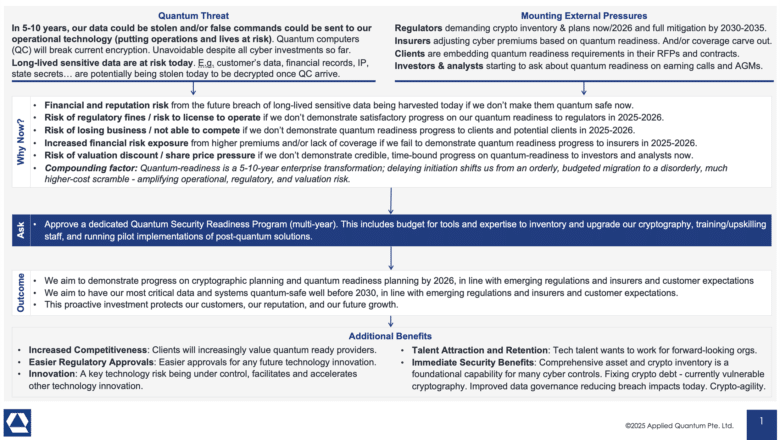
Securing Quantum Readiness Budget Now
From a CISO and business leadership perspective, the ask is clear: we need to secure budget and resources now to begin the multi-year journey of quantum-proofing our organization. This includes funding for risk assessments, cryptographic inventory tools, new encryption software/hardware,…
Read More » -
Quantum Sovereignty

Alliances as “Sovereignty Multipliers”
Turning strategic alignment into real technological capability requires deliberate mechanisms at the alliance level. Formal statements of partnership (like NATO communiqués or bilateral MOUs) only matter if backed by concrete programs and standards. So let's outline key ways alliances can…
Read More » -
Leadership
Board AI Governance and Oversight
AI is reshaping businesses across industries, and corporate boards are increasingly expected to oversee AI strategy, ethics, and risk management. In fact, the number of S&P 500 companies formally assigning AI oversight to a board committee more than tripled in…
Read More » -
Post-Quantum, PQC, Quantum Security
Risk-Driven Strategies for Quantum Readiness When Full Crypto Inventory Isn’t Feasible
Given the practical challenges, organizations may need to begin their quantum-readiness journey with a risk-driven approach rather than a theoretically perfect one. The essence of this strategy is to focus limited resources where they matter most – addressing the highest…
Read More » -
Quantum Computing Companies
Quantum Art
Quantum Art is an Israeli quantum computing startup (spun out of the Weizmann Institute of Science in 2022) focused on developing scalable trapped-ion hardware for quantum computers. The company was born out of decades of ion-trap research at Weizmann and…
Read More » -
Leadership
What is the Quantum Threat? A Guide for C‑Suite Executives and Boards
Boards do not need to dive into the scientific intricacies of qubits and algorithms, but they do need to recognize that this is a strategically important risk – one that can’t be simply delegated away. It requires the same level…
Read More » -
Quantum Security & PQC
Future Encrypted: Post-Quantum Cryptography Tops the Cyber Agenda – Key Insights for CISOs
A new Capgemini Research Institute report, “Future Encrypted: Why Post-Quantum Cryptography Tops the New Cybersecurity Agenda”, reveals that while awareness of the quantum threat is rising at the executive level, organizational readiness is dangerously lagging. Nearly two-thirds of businesses now…
Read More » -
Research
Microsoft’s Majorana‑1 Chip Demonstrates X and Z Loop Parity Measurements
Microsoft’s Azure Quantum team has released a new scientific paper (Distinct Lifetimes for X and Z Loop Measurements in a Majorana Tetron Device) presenting the first experimental evidence of complementary Pauli-X and Pauli-Z parity measurements on a topological qubit. The…
Read More » -
Policy & Sovereignty
Quantum-Readiness Roadmap: BIS Calls Finance to Prepare for the Post-Quantum Era
On July 7, 2025 the Bank for International Settlements (BIS) – often called the “central bank of central banks” – published a major paper titled “Quantum-readiness for the financial system: a roadmap.” This BIS Paper No. 158, authored by experts…
Read More » -
Quantum Computing Companies
Quantum Brilliance
Quantum Brilliance (QB) is an Australian-German quantum computing company (founded in 2019 as a spin-out of Australian National University) developing diamond-based quantum accelerators that operate at room temperature. Their hardware uses nitrogen-vacancy (NV) centers in synthetic diamond as qubits -…
Read More » -
Post-Quantum, PQC, Quantum Security
How CISOs Can Use Quantum Readiness to Secure Bigger Budgets (and Fix Today’s Problems)
Quantum readiness is not an exercise in science fiction – it’s a very practical program that yields benefits immediately. Regulators are pushing us all in this direction, which means boards are willing to fund it. The journey forces you to…
Read More » -
Post-Quantum, PQC, Quantum Security
CRQC Readiness Benchmark – Benchmarking Quantum Computers on the Path to Breaking Cryptography
Benchmarking quantum capabilities for cryptography is both critical and challenging. We can’t rely on any single metric like qubit count to tell us how near we are to breaking RSA-2048. A combination of logical qubit count, error-corrected circuit depth, and…
Read More »