
Latest Quantum Research & Methods News
-
Sep- 2025 -26 SeptemberResearch
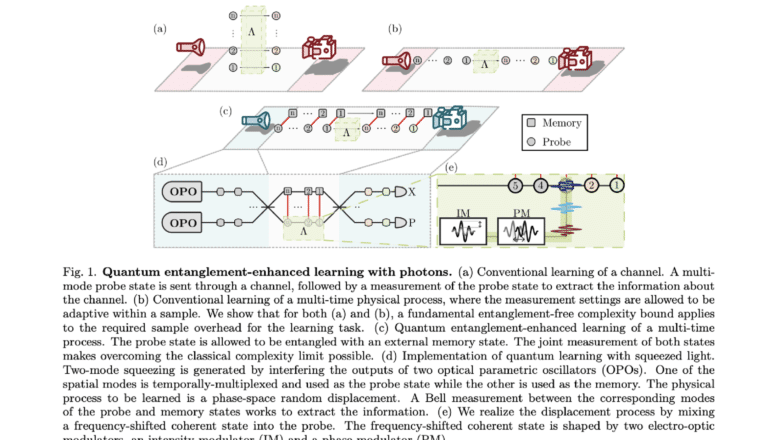
Researchers Demonstrate Quantum Entanglement Can Slash a 20-Million-Year Learning Task Down to Minutes
A team led by the Technical University of Denmark (DTU) has published a milestone paper, “Quantum learning advantage on a scalable photonic platform,” in Science (Sept 25, 2025). Preprint arXiv:2502.07770. The work is the first proven quantum advantage using a photonic system, showing that an optical quantum setup can learn the behavior of a complex system exponentially faster than any…
Read More » -
26 SeptemberResearch
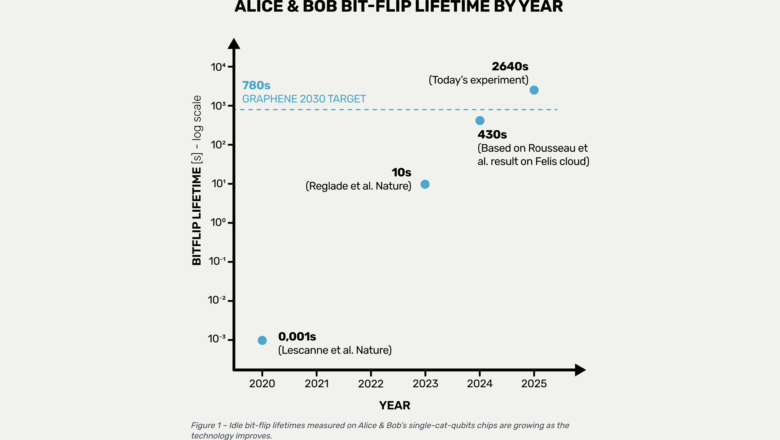
Alice & Bob’s One-Hour “Cat Qubit” Breakthrough – What It Means for Quantum Computing and Q-Day
A new experiment from quantum computing startup Alice & Bob has set a remarkable milestone. In a recent blog post titled”Just Out of the Lab: A Cat Qubit That Jumps Every Hour,” the company revealed that one of its qubits - a special”cat qubit” - remained stable against bit-flip errors for about one hour. This is a record for superconducting…
Read More » -
25 SeptemberResearch
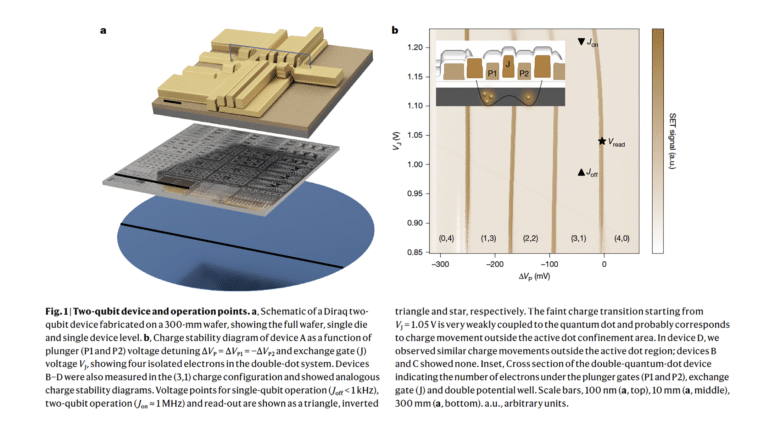
Silicon Spin Qubits Achieve >99% Fidelity in 300‑mm Foundry Fabrication
The race toward large-scale quantum computing just hit a significant milestone. In a new Nature paper “Industry‑compatible silicon spin‑qubit unit cells exceeding 99% fidelity” (open access) a team from Diraq and imec reported that they achieved better than 99% gate fidelity for silicon spin qubits manufactured using standard 300 mm semiconductor fabrication processes. Crucially, this wasn’t a one-off demonstration: four separate…
Read More » -
25 SeptemberResearch

HSBC and IBM’s Quantum-Enabled Bond Trading Breakthrough
HSBC and IBM revealed the world’s first-known quantum-enabled algorithmic trading trial in the bond market. In a collaboration bridging banking and cutting-edge tech, the team demonstrated up to a 34% improvement in predicting whether a customer’s bond trade would go through at a quoted price - a significant leap over standard classical methods. The news, trumpeted in a joint press…
Read More » -
25 SeptemberResearch

New Paper Alert: “Low‑Overhead Transversal Fault Tolerance for Universal Quantum Computation”
A new fault-tolerance framework unveiled by researchers from QuEra, Harvard, and Yale promises to drastically reduce the time overhead of quantum error correction. Published yesterday in Nature as “Low‑Overhead Transversal Fault Tolerance for Universal Quantum Computation” (Zhou et al., 2025), their method - called Transversal Algorithmic Fault Tolerance (AFT) - eliminates the usual slowdown from repeated error-checking cycles. By cutting this…
Read More » -
24 SeptemberResearch
Caltech’s 6,100-Qubit Optical Tweezer Array: A Quantum Leap in Scale and Coherence
In a new quantum computing milestone, Caltech physicists have created the largest qubit array ever assembled: 6,100 atomic qubits held in place by laser “tweezers.” This far exceeds previous neutral-atom arrays, which contained only hundreds of qubits. Even more impressive, these thousands of qubits were kept in a fragile quantum state (superposition) for about 13 seconds - nearly ten times…
Read More » -
16 SeptemberResearch
Harvard & MIT’s Continuous 3,000-Qubit Breakthrough: A New Era of Quantum Operation
A team led by the Technical University of Denmark (DTU) has published a milestone paper, “Quantum learning advantage on a scalable photonic platform,” in Science (Sept 25, 2025). Preprint arXiv:2502.07770. The work is the first proven quantum advantage using a photonic system, showing that an optical quantum setup can learn the behavior of a complex system exponentially faster than any…
Read More » -
13 SeptemberResearch
New Paper Alert: A Relational Critique of Bell Locality
Just a few days ago Waaijer and van Neerven published a paper "A Relational Critique of Bell Locality" in which they analyze Bell experiments through the lens of relational quantum mechanics (RQM). For decades, Bell's theorem has been seen as proof that nature is fundamentally nonlocal. Any theory that respects relativity and allows free choice of measurements must obey the…
Read More » -
13 SeptemberResearch
Electrically Triggered Spin-Photon Device Demonstrated in Silicon
A new research paper titled “Electrically triggered spin-photon devices in silicon” has been published in Nature Photonics on September 11, 2025. In this paper, a team from Simon Fraser University (SFU) and quantum startup Photonic Inc. report the first-ever electrically injected single-photon source built on a silicon chip. This breakthrough marks an important step toward scalable quantum computing hardware, as…
Read More » -
12 SeptemberResearch
First Unconditional Quantum Information Supremacy: 12 Qubits vs 62 Classical Bits
A team of researchers from the University of Texas at Austin and Quantinuum has achieved a landmark result in quantum computing. Just published in Kretschmer et al., “Demonstrating an Unconditional Separation Between Quantum and Classical Information Resources,” arXiv preprint (Sep 2025). They demonstrated a computational task on a 12-qubit trapped-ion quantum system that no classical computer can emulate without using…
Read More » -
5 SeptemberResearch
New Paper Alert: Brace for Impact: New ECDLP Challenge Ladder Benchmarks Quantum Threat to Bitcoin
The “Brace for Impact” ECDLP challenge suite is a great attempt to translate a looming cryptographic crisis into a concrete set of problems we can grapple with today. It provides a much-needed “ruler” to measure where we stand in the race between encryption and quantum decryption. The choice of Bitcoin’s secp256k1 curve for these challenges ties the abstract math to…
Read More » -
Aug- 2025 -15 AugustIndustry
Jiuzhang 4.0: 3,050 Photons, 25.6 Microseconds, and a Direct Answer to the Algorithm That Threatened Photonic Quantum Advantage
15 Aug 2025 - A research team led by Pan Jianwei and Lu Chao-Yang at the University of Science and Technology of China (USTC), in collaboration with Tsinghua University and Jiuzhang Quantum Technology Co. Ltd., has demonstrated the largest photonic quantum advantage experiment ever conducted. Their new processor, Jiuzhang 4.0, injected 1,024 high-efficiency squeezed states of light into a programmable…
Read More » -
12 AugustResearch
Alice & Bob’s New “Unfolded” Code Dramatically Lowers Magic State Overhead
A new research paper from quantum startup Alice & Bob in collaboration with Inria unveils a technique to significantly reduce the cost of magic state generation - a crucial resource for universal fault-tolerant quantum computing. The paper, titled “Unfolded distillation: very low-cost magic state preparation for biased-noise qubits”, describes an error-correction scheme dubbed the “unfolded code” that leverages the unique…
Read More » -
Jul- 2025 -12 JulyResearch
Microsoft’s Majorana‑1 Chip Demonstrates X and Z Loop Parity Measurements
Microsoft’s Azure Quantum team has released a new scientific paper (Distinct Lifetimes for X and Z Loop Measurements in a Majorana Tetron Device) presenting the first experimental evidence of complementary Pauli-X and Pauli-Z parity measurements on a topological qubit. The results, announced by Microsoft Quantum Technical Fellow Chetan Nayak in a LinkedIn update, showcase the ability to “harness a topoconductor…
Read More » -
Jun- 2025 -29 JuneResearch
Quantinuum’s Breakthrough Sets Course for Fault-Tolerant Quantum Computing by 2029
Quantinuum announced a significant technical breakthrough: the company claims to have overcome the “last major hurdle” on the path to scalable, universal fault-tolerant quantum computers. In a press release accompanying two new research papers, Quantinuum declared itself the first to demonstrate a fully error-corrected universal gate set—meaning it can perform all types of quantum operations (Clifford and non-Clifford) with errors…
Read More »


