
Latest Quantum Research & Methods News
-
Apr- 2026 -20 AprilResearch
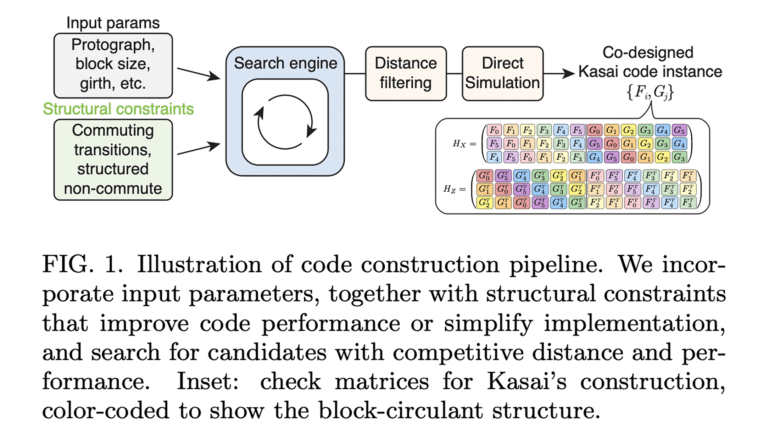
QuEra Achieves 2:1 Physical-to-Logical Qubit Ratio With Ultra-High-Rate qLDPC Codes
A QuEra–Harvard–MIT collaboration demonstrates qLDPC codes that encode more logical qubits than they consume in overhead — a 2:1 physical-to-logical ratio that enters the Teraquop regime. This is a simulation result, not an experiment. But if it holds up, it rewrites the economics of fault-tolerant quantum computing.
Read More » -
11 AprilResearch
Harvard’s Cascade Neural Decoder Cuts Quantum Error Rates 17×, Reveals Waterfall Effect
Harvard's Cascade decoder achieves logical error rates 17× below the best existing decoders on quantum LDPC codes and reveals a "waterfall" regime of error suppression that could reduce the physical qubit count required for a CRQC by 40% or more.
Read More » -
9 AprilQuantum Security & PQC
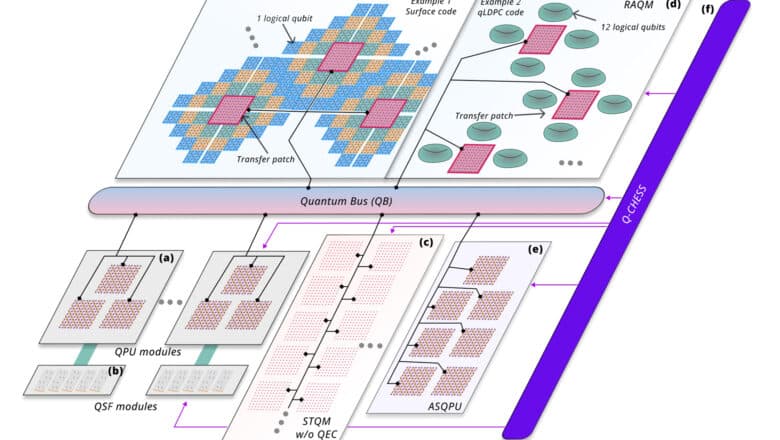
Architecture Matters as Much as the Algorithm: Q-CTRL’s Heterogeneous Quantum Computer Design Cuts RSA-2048 to 190k-381k Qubits
9 Apr 2026 - Researchers at Q-CTRL, a quantum infrastructure software company headquartered in Los Angeles and Sydney, have published a paper introducing Q-NEXUS, a heterogeneous quantum computing architecture that claims to reduce the physical qubit requirements for factoring 2048-bit RSA integers to as few as 190,000 physical qubits — a roughly 4.7× reduction from the current monolithic baseline. The…
Read More » -
5 AprilResearch
QuiX Quantum Achieves First Below-Threshold Error Mitigation in Photonic Quantum Computing
5 Apr 2026 - QuiX Quantum, a Netherlands-based photonic quantum computing company, announced it has demonstrated below-threshold error mitigation on a photonic quantum computer for the first time, in collaboration with NASA's Quantum Artificial Intelligence Laboratory (QuAIL), the University of Twente, and Freie Universität Berlin. The result, described in a pre-print on arXiv currently undergoing peer review, demonstrates a technique…
Read More » -
3 AprilResearch

Gauge Theory Meets Quantum Computing
April 2, 2026 - Dr. Dominic Williamson of the University of Sydney and Theodore Yoder of IBM have published a new method for performing fault-tolerant logical measurements on quantum error-correcting codes that dramatically reduces the physical qubit overhead required. The paper, titled "Low-overhead fault-tolerant quantum computation by gauging logical operators", appears in Nature Physics (DOI: 10.1038/s41567-026-03220-8). The technique treats logical…
Read More » -
Mar- 2026 -31 MarchQuantum Security & PQC
10,000 Qubits to Run Shor’s Algorithm
31 Mar 2026 - On the same day that Google Quantum AI published its landmark ECDLP-256 resource estimates showing fewer than 500,000 superconducting qubits could break cryptocurrency cryptography in minutes, a team from Oratomic, Caltech, and UC Berkeley quietly dropped a paper making an even more startling claim about qubit count: Shor's algorithm can be executed at cryptographically relevant scales…
Read More » -
31 MarchQuantum Security & PQC
Google Quantum AI Achieves 10x Reduction in Resources to Break Bitcoin’s Cryptography
31 Mar 2026 - Google Quantum AI has published a 57-page whitepaper demonstrating that the quantum resources needed to break the elliptic curve cryptography protecting Bitcoin, Ethereum, and virtually every major cryptocurrency are roughly an order of magnitude smaller than previously estimated. The paper, titled "Securing Elliptic Curve Cryptocurrencies against Quantum Vulnerabilities: Resource Estimates and Mitigations" and co-authored with researchers…
Read More » -
24 MarchResearch
Silicon Crosses the Logical Threshold: First Universal Logical Operations Demonstrated in a Silicon Quantum Processor
24 Mar 2026 - In 1998, Bruce Kane published a single-page proposal in Nature that launched an entire subfield of quantum computing. The idea was elegant: use the nuclear spins of individual phosphorus atoms embedded in a silicon crystal as qubits. Silicon offered long coherence times. Phosphorus offered an addressable spin. And the surrounding semiconductor infrastructure — the lithography, the…
Read More » -
21 MarchResearch
The 1,000-Qubit Ceiling That Probably Isn’t
21 Mar 2026 - A curious thing happened in cybersecurity Slack channels and LinkedIn threads over the last few weeks: security professionals who had been dragging their feet on post-quantum cryptography migration suddenly had a new reason to wait. A paper published in the Proceedings of the National Academy of Sciences by Tim Palmer, an emeritus professor of physics at…
Read More » -
18 MarchResearch
Bennett and Brassard Win the Turing Award for Inventing Quantum Cryptography
Charles H. Bennett and Gilles Brassard, who published the BB84 quantum key distribution protocol in 1984, receive the 2025 ACM A.M. Turing Award, four decades after a chance meeting at a 1979 conference in Puerto Rico.
Read More » -
10 MarchResearch
Quantinuum Squeezes 94 Logical Qubits from 98 Physical — But What Does It Actually Mean?
10 Mar 2026 - Quantinuum researchers have demonstrated quantum computations using up to 94 error-detected logical qubits and 48 error-corrected logical qubits on the company's 98-qubit Helios trapped-ion quantum processor. The work, published as a pre-print on arXiv, reports "beyond break-even" performance across multiple benchmarks — meaning the encoded logical qubits outperformed their unencoded physical counterparts. The team used a…
Read More » -
Feb- 2026 -25 FebruaryResearch
Deutsche Telekom and Qunnect Teleport Photonic Qubits Over a 30 km Berlin Fiber Loop Using Commercial Hardware
T-Labs and Qunnect moved a laser-generated qubit onto a telecom photon and sent it around 30 km of Berlin fiber at 90% average fidelity, 86% with a data channel alongside. What they showed, and what a service still needs.
Read More » -
12 FebruaryResearch
Peking University Demonstrates 20-User Chip-Based QKD Network Spanning 3,700 km
12 Feb 2026 - A team led by Jianwei Wang and Lin Chang at Peking University has demonstrated an integrated-photonics twin-field quantum key distribution (TF-QKD) network connecting 20 independent client chips across ten wavelength-multiplexed channels, with each channel surpassing the repeaterless bound at 370 km in spooled fiber. The results, published in Nature, achieve a total networking capability — defined…
Read More » -
5 FebruaryResearch
USTC Demonstrates First Scalable Quantum Repeater Building Block
5 Feb 2026 - A team led by Jian-Wei Pan and Qiang Zhang at the University of Science and Technology of China (USTC) has demonstrated what the field has been waiting for: remote memory-memory entanglement that survives longer than the time it takes to create it. Published in Nature, the result uses trapped calcium-40 ions connected by 10 km of…
Read More » -
Jan- 2026 -29 JanuaryResearch
Silicon Catches Its First Errors
29 Jan 2026 - Quantum error correction is the wall that separates toy quantum computers from useful ones. Every qubit platform must eventually climb it. The first step up that wall is not correcting errors — that requires mid-circuit measurement and real-time feedback, capabilities that push the engineering envelope of any architecture. The first step is detecting them: identifying that…
Read More »


