
Latest Quantum Research & Methods News
-
Jun- 2026 -4 JuneQuantum Security & PQC
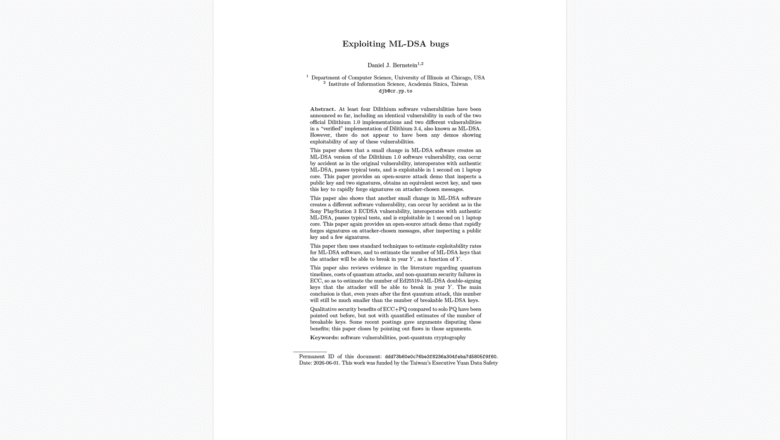
Bernstein Demonstrates ML-DSA Key Recovery in Under One Second, Argues Solo Deployment Damages Security
Daniel J. Bernstein provides the first working attack demos against ML-DSA implementation bugs, recovers equivalent secret keys in under one second, and builds a quantitative case that solo ML-DSA deployment damages security compared to hybrid Ed25519+ML-DSA.
Read More » -
3 JuneIndustry
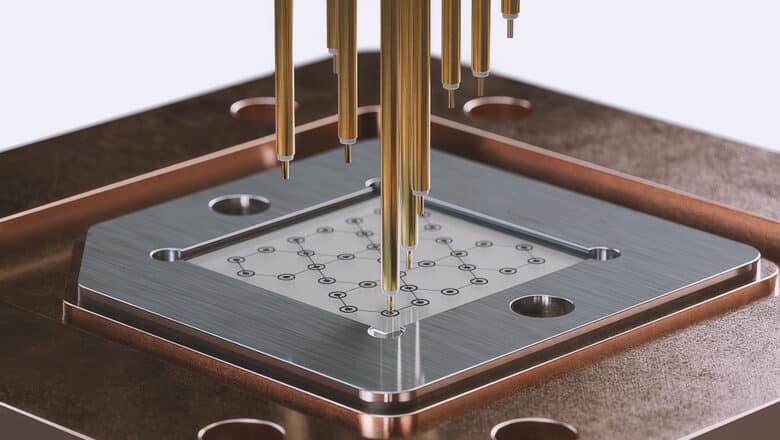
OQC Raises £260M in Europe’s Largest Private Quantum Round — Where the Money Actually Goes
Europe's largest private quantum round lands at £260M, with 38% from the British Business Bank. The money is earmarked for OQC's TITAN system, but the gap between 32 qubits today and 200 logical qubits by 2028 demands closer examination.
Read More » -
3 JuneIndustry
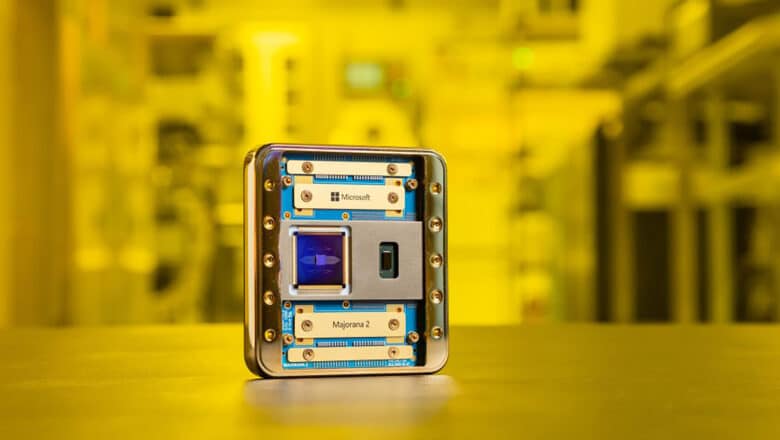
Microsoft’s Majorana 2 Chip Achieves 20-Second Parity Lifetime — But the Topological Qubit Debate Rages On
Microsoft's second topological quantum chip achieves a 1,000-fold improvement in parity lifetime by swapping aluminum for lead. The engineering progress is real. Whether these are topological qubits at all remains fiercely contested.
Read More » -
2 JuneQuantum Security & PQC
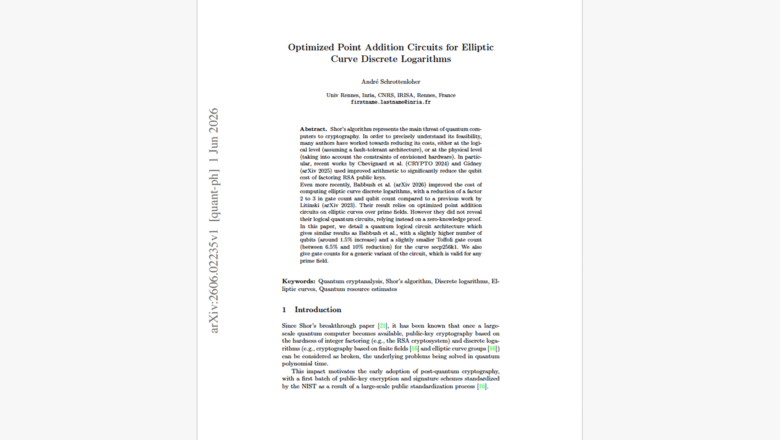
Google’s Secret Quantum Circuits for Breaking ECC Reproduced and Improved in Two Months
A French researcher independently matched Google's secret quantum circuits for breaking elliptic curve cryptography, then improved the gate count. Google's Craig Gidney says the zero-knowledge approach failed and open publication should resume.
Read More » -
1 JuneIndustry

D-Wave Bets Its Future on Gate-Model Quantum Computing with 2032 Fault-Tolerance Roadmap
D-Wave's first Investor Day roadmap targets 100 fault-tolerant logical qubits by 2032 using dual-rail superconducting qubits. The annealing pioneer enters a crowded gate-model race with an unproven architecture and ambitious error-reduction targets.
Read More » -
May- 2026 -29 MayQuantum Security & PQC
ETH Zurich’s “Perfect Randomness”: What Actually Happened
A new preprint series claims to break every major lattice-based NIST PQC standard via an improved CDPR attack. The claim has critical technical gaps that the lattice cryptography community will need to resolve.
Read More » -
25 MayQuantum Security & PQC
A New Paper Claims to Break ML-KEM, Falcon, Hawk, and NTRU. Should You Worry?
A new preprint series claims to break every major lattice-based NIST PQC standard via an improved CDPR attack. The claim has critical technical gaps that the lattice cryptography community will need to resolve.
Read More » -
23 MayResearch
IBM’s Concatenated Gross Code Reaches the Teraquop Regime
IBM's QEC team packages 11 logical qubits into a single high-dimensional qudit and wraps the gross code in quantum Reed-Solomon algebra. The result: a fault-tolerant memory that reaches the teraquop regime the gross code couldn't previously access.
Read More » -
16 MayResearch
Jiuzhang 4.0: China’s 1,024-Input Photonic Processor Claims 10⁵⁴ Speedup
Pan Jian-Wei's team published a rigorous Nature paper showing an order-of-magnitude leap in photonic quantum scale. The engineering is impressive. The "quantum supremacy" framing from state media is a different matter entirely.
Read More » -
13 MayResearch
Theorists Prove Passive Quantum Memory Works in Three Dimensions, Settling a 25-Year-Old Question
A Caltech–UCSD team has constructed a 3D quantum system that can store a qubit for exponential time without active error correction. The result settles a question that has resisted the field's best efforts for a quarter century.
Read More » -
6 MayIndustry
Q-CTRL Achieves Practical Quantum Advantage — and the Business Signal May Be Bigger Than the Physics
Q-CTRL's 120-qubit simulation of the Fermi-Hubbard model achieves quantitative accuracy matching classical benchmarks while completing in minutes rather than days. The "practical quantum advantage" claim deserves scrutiny, but the underlying technical achievement is real.
Read More » -
2 MayResearch
IBM’s Quantum Advantage Claim: What the Heron-Fugaku Experiment Actually Shows
IBM says quantum advantage arrives in 2026. A new Heron-Fugaku experiment provides the evidence. Whether it proves the claim depends on how you define “advantage.”
Read More » -
Apr- 2026 -23 AprilResearch
IonQ Publishes Complete Fault-Tolerant Blueprint for Trapped Ions “The Walking Cat Architecture”
IonQ's 110-page preprint details a complete fault-tolerant quantum computer architecture built entirely on qLDPC codes. The numbers are impressive, but every claim rests on hardware that doesn't yet exist at scale.
Read More » -
23 AprilQuantum Security & PQC
Chinese Researchers Cut ECC Qubit Requirements to 1,333 with Open-Source Circuits
A Tsinghua–Peking University team achieves 1,333 logical qubits for ECC-256 with fully explicit, open-source quantum circuits. The gate count may matter more than the qubit count.
Read More » -
21 AprilResearch
Nature Reviews Publishes the Definitive CMOS–Spin Qubit Compatibility Assessment
A comprehensive review from Dzurak's team maps exactly where silicon spin qubits align with existing CMOS manufacturing — and where they diverge. The implications for scaling to millions of qubits are more nuanced than the headlines suggest.
Read More »


