
Quantum Computing
Quantum computing hardware, modalities, architectures, companies, roadmaps, ecosystem dynamics, and the path to fault tolerance.
-
Quantum Commercialization
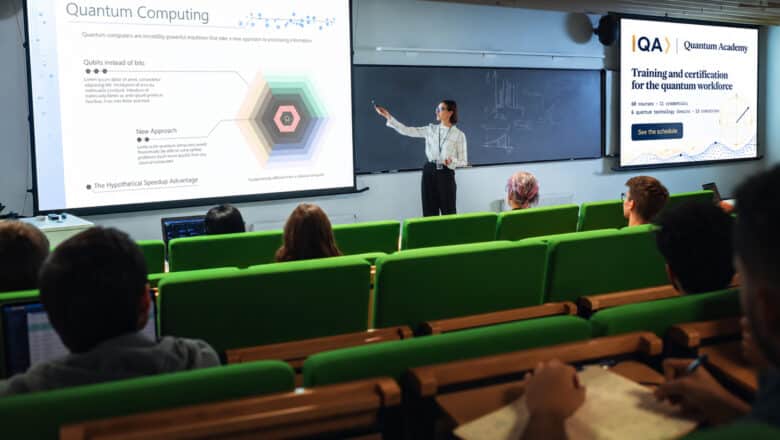
Clients Kept Asking Us to Train Their Teams, So I Started Quantum Academy
Applied Quantum has delivered hundreds of hours of private training, from board briefings to hands-on technical work. Quantum Academy moves that teaching into a separate company, with practitioner instructors, proctored exams and a flagship program for Chief Quantum Officers.
Read More » -
Quantum Computing
What Quantum Computers Are For: A Mathematician’s Map of Quantum Advantage
The mathematician's answer to what quantum computers are for: three problem families where the advantage is real, the theorems that cap combinatorics at quadratic, and the open problems stated in your notation.
Read More » -
Quantum Computing
Quantum Computing for Mathematicians: From Four Axioms to Shor’s Algorithm
Everything a mathematician needs to understand quantum computing: the four axioms, why "trying all answers at once" is wrong, how interference powers Shor and Grover, and where mathematicians are needed next.
Read More » -
Quantum Computing

Several Vendors Now Supply Quantum Error Correction’s Classical Loop. The Qubits Are Still the Hard Part.
Riverlane, Qblox, Altera, Xanadu, AMD, NVIDIA and IonQ spent September turning error correction's classical loop into parts with published interfaces and measured latencies. What they tested, on what data, and how I now read fault-tolerance timelines.
Read More » -
Quantum Commercialization

Nobody Checked the Physics: How Venture Due Diligence Went Missing Where the Checks Are Largest
On Carta's platform the median startup waits 774 days for a Series A. The hottest deep-tech deals close in days on no product. Between those numbers is where nobody can see the physics checked, and quantum is paying for it.
Read More » -
Quantum Computing
Data Centers in Space Don’t Work. Quantum AI Data Centers in Space Are an Absurdity.
An investor asked me to evaluate a pitch for quantum AI data centers in orbit. The physics, the engineering, and the economics all say the same thing: no.
Read More » -
Quantum Computing
Every Headline RSA-2048 Estimate Assumes Qubits That Work. A Sydney Team Measured What Happens When They Don’t.
On a single IBM chip, a distance-5 surface code lost to a distance-3 even after the defective components were routed around. The headline estimates of what breaking RSA-2048 takes assume they all work.
Read More » -
Quantum Computing
Google’s Multiverse Claim Was a Serious Argument Attached to the Wrong Experiment
Google attached a serious interpretation of quantum mechanics to a benchmark every standard interpretation predicted, and whose headline run was never directly verified. Ten months later the same lab kept the interference and left the metaphysics out.
Read More » -
Quantum Computing
Everything Called a Decoder in Quantum
A syndrome decoder has to keep pace with a microsecond syndrome stream. A syndrome decoding problem has to stay infeasible forever. Same two words, opposite requirements, and coverage that routinely cannot tell them apart.
Read More » -
Quantum Computing
The GSMA’s Telco Quantum Playbook Misreports the McKinsey Report It Cites
A trade body published a vendor-contributed document, and the one exhibit anyone could verify turned out to misreport the report it names. What that costs the operators who will quote it in board papers.
Read More » -
Quantum Computing
The Merchant QPU Market – Who Will Actually Sell You a Quantum Processor
Strip away cloud access and turnkey machines and the number of companies that will sell a quantum processor for third-party integration drops to six. An audit of the merchant market, with prices, specs, and the gaps.
Read More » -
Quantum Computing
I Set Five Tests for Silicon Spin in March. One of Them Was Too Weak.
Two cleared, one partial, one open, and one that HRL passed as written while leaving the thing it was meant to measure exactly where it was in March.
Read More » -
Post-Quantum, PQC, Quantum Security
Two QFT Records in Four Months. Neither Gets You Closer to Breaking RSA.
Two compilation teams claimed the largest quantum Fourier transform ever run, four months apart, on the same IBM chip. Their circuits and metrics are not comparable, and the gate counts explain why.
Read More » -
Quantum Computing
Quantum Careers in 2026 (No PhD Required)
An updated map of quantum careers: what each role involves day to day, who hires for it, what employers screen for, and how to judge whether a specialization will still exist in ten years.
Read More » -
Quantum Computing
DARPA’s Most Rigorous Quantum Evaluation Is Led by Its Least Proven Contenders
Neither Stage C company has publicly demonstrated a logical qubit on the architecture DARPA is evaluating. One may not have demonstrated a physical qubit. That outcome tells you more about the program's design than about the technology.
Read More »


