
Quantum Computing
Quantum computing hardware, modalities, architectures, companies, roadmaps, ecosystem dynamics, and the path to fault tolerance.
-
Quantum Computing Modalities
Quantum Computing Modalities: Silicon-Spin
Silicon spin qubits bring quantum computing onto the same fabrication lines that produce every classical processor on Earth. The first logical operations arrived in 2026. Here's the technology, the vendors, the CMOS thesis, and what it means for the path…
Read More » -
Quantum Computing Modalities
Quantum Computing Modalities: Measurement-Based Quantum Computing (MBQC)
Measurement-Based Quantum Computing (MBQC), also known as the one-way quantum computer, is a paradigm where quantum computation is driven entirely by measurements on an entangled resource state. Instead of applying a sequence of unitary gates to a register of qubits,…
Read More » -
Quantum Computing Modalities
Quantum Computing Modalities: Neutral Atom (Rydberg)
Neutral-atom quantum computers operate at room temperature, scale to thousands of qubits, and hold the record for verified logical qubits. Here's the technology, the vendors, and why this modality is closing the gap on superconducting hardware faster than anyone expected.
Read More » -
Quantum Computing Modalities
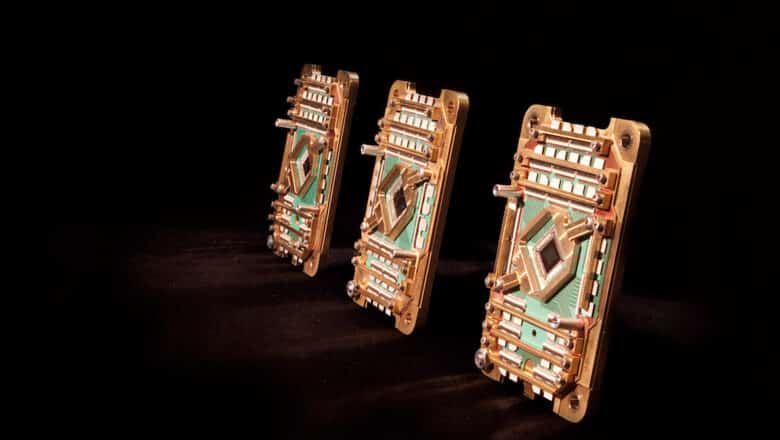
Quantum Computing Modalities: Quantum Annealing (QA)
Quantum annealing (QA) is a special-purpose quantum computing paradigm designed to solve optimization problems by exploiting quantum tunneling and the adiabatic principle. It's a special case of Adiabatic Quantum Computing (AQC). The idea is to encode a problem (typically an…
Read More » -
Quantum Computing Modalities

Quantum Computing Modalities: Quantum Walk QC
Quantum walks are the quantum-mechanical counterparts of classical random walks. In a classical random walk, a "walker" (such as a particle or an agent) moves step by step in a certain space (like a line or a graph) with some…
Read More » -
Quantum Computing Modalities
Quantum Computing Modalities: Fibonacci Anyons
Fibonacci anyons are a type of non-Abelian anyon – exotic quasiparticles that can exist in two-dimensional systems and have exchange statistics beyond bosons or fermions. When two non-Abelian anyons like Fibonacci anyons are exchanged (braided) in space, the quantum state…
Read More » -
Quantum Computing Modalities
Quantum Computing Modalities: QA With Digital Boost (“Bang-Bang” Annealing)
Digital Boost (“Bang-Bang” Annealing) refers to augmenting or replacing the continuous, gradual annealing schedule with discrete pulses or abrupt changes in the control parameters – essentially applying bang–bang control to quantum annealing. In control theory, a bang–bang controller is one…
Read More » -
Quantum Computing Modalities
Quantum Computing Modalities: Dissipative QC (DQC)
Dissipative Quantum Computing (DQC) is a model of quantum computation that leverages open quantum system dynamics – in other words, it uses controlled dissipation (interaction with an environment and irreversible processes) as a resource for computing.
Read More » -
Quantum Computing Modalities
Quantum Computing Modalities: Majorana Qubits
Majorana qubits promise hardware-level error protection through topological physics. Microsoft has spent over a decade and billions of dollars pursuing them. Here's the physics of how they're supposed to work, the full experimental history, and why the evidence remains contested.
Read More » -
Quantum Computing Modalities
Quantum Computing Modalities: Biological QC
Biological Quantum Computing refers to speculative ideas that biological systems might perform quantum computations or that we could harness biological processes to implement quantum computing. This paradigm is highly exploratory and not yet realized in any form, lying at the…
Read More » -
Quantum Computing Modalities
Quantum Computing Modalities: Boson Sampling QC (Gaussian & Non-Gaussian)
Boson Sampling is a specialized, non-universal model of quantum computation where the goal is to sample from the output distribution of indistinguishable bosons (typically photons) that have passed through a passive linear interferometer. In simpler terms, one prepares multiple photons,…
Read More » -
Quantum Computing Modalities
Quantum Computing Modalities: Quantum Cellular Automata (QCA)
Quantum Cellular Automata are an abstract paradigm of quantum computing where space and time are discrete and quantum information processing happens in many parallel identical cells interacting with neighbors under a uniform rule. It’s a quantum counterpart to classical cellular…
Read More » -
Quantum Computing Modalities
Quantum Computing Modalities: Time Crystals’ Potential QC Use
Time crystals are an exotic state of matter that spontaneously breaks time-translation symmetry, meaning the system’s lowest-energy state exhibits periodic motion in time. This is analogous to how ordinary crystals break spatial translation symmetry by arranging atoms in a repeating…
Read More » -
Quantum Computing Modalities
Quantum Computing Modalities: DNA-Based QIP
DNA-based quantum information processing envisions using DNA – the molecule of life – in roles within a quantum computer. This could mean DNA acting as qubits, facilitating quantum interactions, or serving as a structural scaffold for other qubits. It's an…
Read More » -
Quantum Computing Modalities
Quantum Computing Modalities: One-Clean-Qubit Model (DQC1)
The One-Clean-Qubit model, also known as Deterministic Quantum Computation with One Qubit (DQC1), is a restricted quantum computing paradigm where only a single qubit starts in a pure (or “clean”) state while all other qubits are in a completely mixed…
Read More »


