
Latest Quantum Industry & Ecosystem News
-
May- 2026 -22 MayIndustry

Washington Isn’t Funding Quantum Research. It’s Building Quantum Factories.
Washington's $2 billion CHIPS Act quantum package isn't a research program. It's industrial policy — the U.S. is building quantum fabs, and that changes the calculus for everyone tracking the CRQC timeline.
Read More » -
16 MayResearch
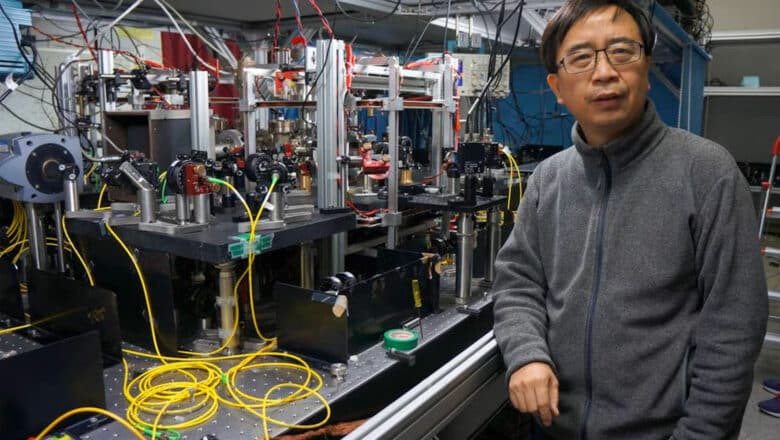
Jiuzhang 4.0: China’s 1,024-Input Photonic Processor Claims 10⁵⁴ Speedup
Pan Jian-Wei's team published a rigorous Nature paper showing an order-of-magnitude leap in photonic quantum scale. The engineering is impressive. The "quantum supremacy" framing from state media is a different matter entirely.
Read More » -
10 MayIndustry
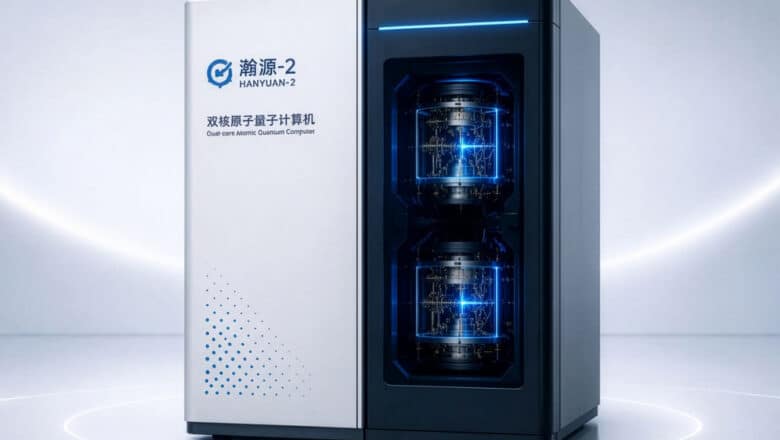
China’s Hanyuan-2 “Dual-Core” Quantum Computer: Clever Marketing, Missing Benchmarks
CAS Cold Atom Technology's Hanyuan-2 uses two rubidium isotope arrays and calls itself the world's first dual-core quantum computer. The framing is clever. The missing performance data tells a different story.
Read More » -
9 MayIndustry
Cisco Introduces a Universal Quantum Switch — and It Works at Room Temperature
Cisco’s research prototype can route quantum information across encoding modalities at room temperature on standard telecom fiber.
Read More » -
7 MayIndustry

Project Eleven Publishes 110-Page Quantum Threat Report for Blockchains — Rigorous Analysis Amid a Season of Denial
Two days after pseudoscience was pitched from Bitcoin's biggest stage to deny the quantum threat, Project Eleven published 110 pages of rigorous analysis showing exactly why that denial is dangerous.
Read More » -
6 MayIndustry
QuantWare Raises $178M Series B — What It Means for Quantum Open Architecture
QuantWare's $178M Series B is the largest private round ever raised by a dedicated quantum processor company. With Intel Capital and IQT on board, the bet is clear: the quantum industry's future is modular, open, and manufactured at scale.
Read More » -
6 MayIndustry
Q-CTRL Achieves Practical Quantum Advantage — and the Business Signal May Be Bigger Than the Physics
Q-CTRL's 120-qubit simulation of the Fermi-Hubbard model achieves quantitative accuracy matching classical benchmarks while completing in minutes rather than days. The "practical quantum advantage" claim deserves scrutiny, but the underlying technical achievement is real.
Read More » -
6 MayIndustry
Fujitsu Surveyed 300 Executives. Cryptography Finished Last.
Fujitsu and FT Longitude surveyed 300 executives. Belief in quantum computing was near-universal, and the one readiness task carrying a legal deadline in all six countries surveyed finished last.
Read More » -
6 MayIndustry
Quantum Computing Simulates 12,635-Atom Protein — Largest Ever
Using two IBM Heron processors, the Fugaku supercomputer, and a refined embedding workflow, researchers modeled protein-ligand complexes in solution at a scale 40 times larger than their previous result — four months earlier.
Read More » -
Apr- 2026 -27 AprilIndustry
IonQ and Florida LambdaRail Plan a 100-Mile Quantum Key Distribution Corridor
IonQ and Florida LambdaRail signed a master service agreement for a three-node QKD corridor over existing research fiber from Palm Beach County to Miami-Dade, the first phase of a planned statewide network.
Read More » -
20 AprilIndustry
IonQ Photonic Interconnect: First Networked Commercial Quantum Computers
IonQ's photonic interconnect demonstration links two commercial quantum computers via entanglement for the first time. The milestone is real and strategically important - but the absence of fidelity and rate numbers in the announcement demands closer scrutiny.
Read More » -
20 AprilIndustry
McKinsey Quantum Technology Monitor 2026: “A Commercial Tipping Point” — But the Numbers Deserve Scrutiny
McKinsey’s 2026 Quantum Technology Monitor declares a “commercial tipping point.” The market analysis is useful, but the investment figures still deserve scrutiny.
Read More » -
20 AprilIndustry
QED-C Reports $1.9 Billion Quantum Market as Venture Capital Nearly Triples and Workforce Pivots to Commerce
QED-C's State of the Global Quantum Industry 2026 report shows $1.9 billion in total quantum revenue, venture capital up 192%, and a workforce shifting from research roles to operations and sales.
Read More » -
15 AprilIndustry
NVIDIA Ising: Open AI Models for Quantum Calibration and Error Correction
NVIDIA's Ising family brings AI-driven automation to quantum calibration and error correction decoding — two bottlenecks standing between today's noisy qubits and fault-tolerant quantum computers. The strategic play underneath matters more than the benchmarks.
Read More » -
14 AprilIndustry
DARPA Launches HARQ Program to Build Heterogeneous Quantum Architectures
DARPA has launched the HARQ program with 19 teams working to combine different qubit types into unified systems — the same heterogeneous vision that I was writing about many times.
Read More »


