
All Quantum Computing Posts
-
The Quantum Utility Map
Why Quantum Won’t Save Wall Street (Yet): An Honest Assessment of Quantum Computing in Finance
Goldman Sachs' own resource estimates need logical clock rates a thousand times beyond foreseeable hardware. A proven memory advantage now sits next to one of the three signals that would change that, and nobody has costed it.
Read More » -
Quantum Computing
The Decoder Bottleneck: The CRQC Challenge Nobody Is Talking About
Qubit count gets the headlines. Error rates get the analysis. But the classical decoder that must process millions of error signals per second in real time gets almost no attention outside the QEC research community. It may be the capability that determines the CRQC timeline.
Read More » -
China's Quantum Ambition
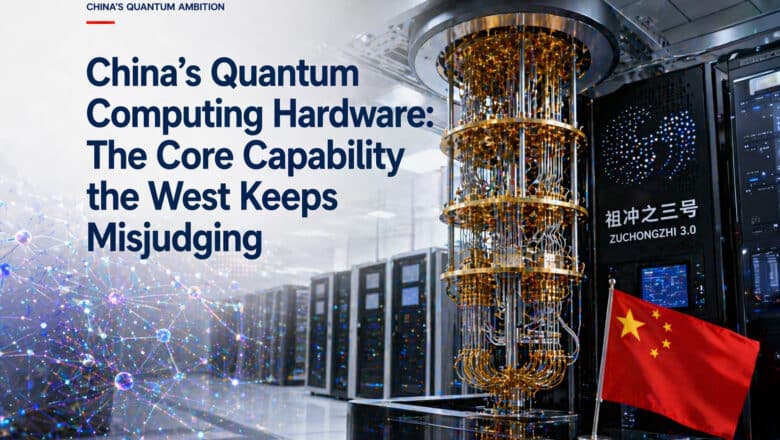
China’s Quantum Computing Hardware: The Core Capability the West Keeps Misjudging
The published record suggests China trails the US by about a year. The actual gap may be narrower — or it may already be closed. In December 2025, a team at the University of Science and Technology of China quietly posted a paper to Physical Review Letters demonstrating something only one other laboratory on Earth had achieved: quantum error correction operating below the surface code…
Read More » -
Post-Quantum, PQC, Quantum Security
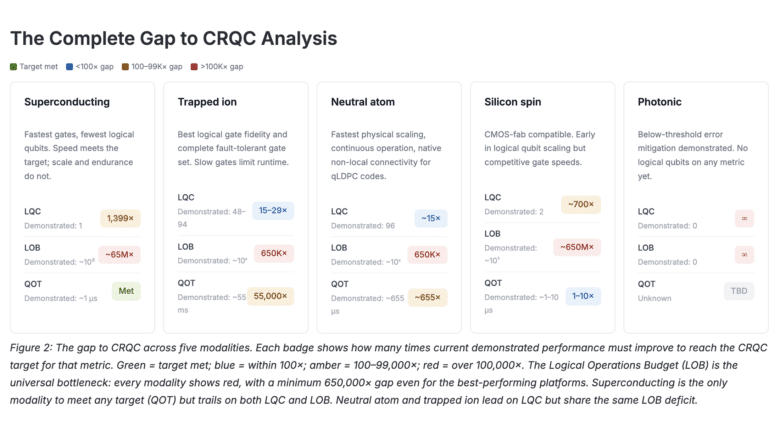
The CRQC Scorecard: How Close Is Each Quantum Modality to Breaking Your Encryption?
Yesterday, two papers landed that set social media on fire. Google Quantum AI published a landmark resource estimate showing that fewer than 500,000 superconducting qubits could break Bitcoin's elliptic curve cryptography in under nine minutes. Hours later, a team from Oratomic, Caltech, and UC Berkeley — including some of the most credible names in fault-tolerant quantum computing — dropped a paper claiming that Shor's algorithm…
Read More » -
Quantum Computing

The Dark Horse: How Silicon Quietly Assembled Every Building Block for Fault-Tolerant Quantum Computing
The quantum computing modality race has had a clear narrative for most of the past decade. Superconducting qubits were the frontrunners — Google's quantum supremacy demonstration in 2019, IBM's steadily growing processor roadmap, the first below-threshold surface code results in 2024. Trapped ions were the precision contenders — the highest individual gate fidelities of any platform, with companies like Quantinuum and IonQ pushing toward commercial…
Read More » -
Quantum Computing
Three Bets on Silicon: Donor Qubits, Quantum Dots, and the Foundry Path Compared
When people say "silicon quantum computing," they often speak as if it is one thing. It is not. It is at least three distinct approaches, built on the same material but employing different physics, different fabrication methods, and different strategies for reaching fault-tolerant scale. Understanding these differences — and the tradeoffs each makes — is essential for anyone tracking which version of silicon quantum computing…
Read More » -
Quantum Computing
China’s Quantum OS Play: Origin Pilot and the Battle for the Integration Layer
China's Origin Pilot isn't just another quantum SDK — it's a top-down systems integration layer that challenges the West's bottom-up approach to quantum open architecture.
Read More » -
Quantum Computing
Quantum Low-Density Parity-Check (qLDPC) Codes
Quantum Low-Density Parity-Check (qLDPC) codes are an emerging class of quantum error-correcting codes that promise to significantly reduce the overhead required for fault-tolerant quantum computing. Much like their classical LDPC counterparts, qLDPC codes are defined by sparse parity-check constraints: each check (stabilizer) acts on only a small number of qubits, and each qubit participates in only a few checks. This sparse structure can enable more…
Read More »


