

-
Research
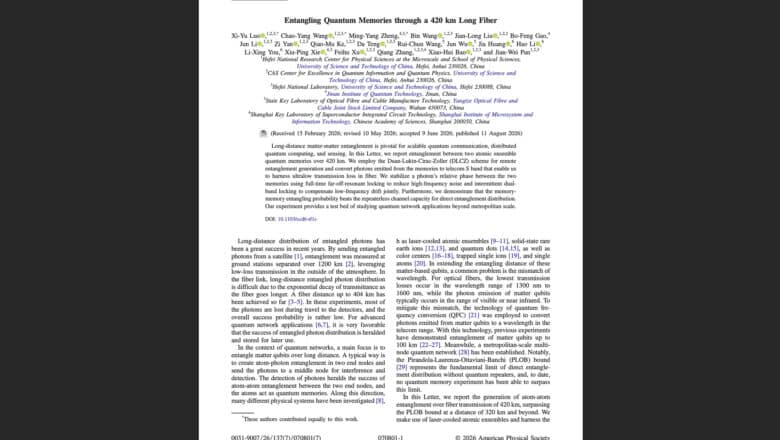
China Set a 420 km Quantum-Memory Entanglement Record. The Two Ends Were in One Lab.
Pan Jianwei's group heralded entanglement between two rubidium memories across 420 kilometers of fiber, published in Physical Review Letters on August 11. The concurrence at that distance sits about 2.1 times its own quoted uncertainty above zero.
Read More » -
Quantum Security & PQC
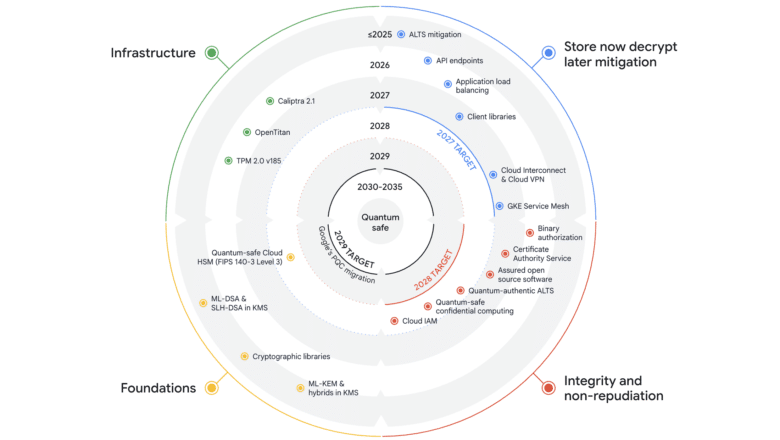
Google Cloud Put Dates on Its PQC Migration. Signatures Trail Confidentiality by a Year.
Google Cloud has attached target years to 19 service-level roadmap entries running through 2029. Store-now-decrypt-later mitigation is due in 2027, signatures and key-management foundations in 2028.
Read More » -
Quantum Computing
I Set Five Tests for Silicon Spin in March. One of Them Was Too Weak.
Two cleared, one partial, one open, and one that HRL passed as written while leaving the thing it was meant to measure exactly where it was in March.
Read More » -
Post-Quantum, PQC, Quantum Security

Six Teams Shipped the Same ZK Verifier Bug. Quantum Doesn’t Get a Patch.
Zcash closed a 3.66 million ZEC pool to new deposits after a soundness bug surfaced in a Shielded Labs audit. A quantum verifier migration is harder, and no regulator can schedule the fork.
Read More » -
Post-Quantum, PQC, Quantum Security

When Two Cryptographers Independently Confirm a Break, Ask Which Model They Used
Two proofs of the same result landed three hours apart from the same model, and Simon's DCP claim is now being taken apart by humans and models working together. Separate names no longer establish separate failure modes.
Read More » -
Quantum Security & PQC
A New Classic McEliece Distinguisher Undercuts Generic Decoding. It Is Not a Break.
No security claim has fallen and the scheme is not broken. What fell is the quantitative argument that made structural attacks easy to set aside, because one now costs less than generic decoding on every NIST parameter set.
Read More » -
Quantum Security & PQC
RFC 10024 Finalizes Hybrid Post-Quantum TLS — The Standard the Internet Was Already Running
RFC 10024 standardizes the hybrid post-quantum key agreement mechanisms for TLS 1.3 that browsers and CDNs have been running since late 2024. The "still a draft" objection to X25519MLKEM768 is now gone.
Read More » -
Post-Quantum, PQC, Quantum Security
Two QFT Records in Four Months. Neither Gets You Closer to Breaking RSA.
Two compilation teams claimed the largest quantum Fourier transform ever run, four months apart, on the same IBM chip. Their circuits and metrics are not comparable, and the gate counts explain why.
Read More » -
Quantum Security & PQC
A Peer-Reviewed CRYPTO 2026 Paper Just Gave ML-KEM’s Foundation a New Quantum Target
Wen and Zheng prove Module-LWE quantum-polynomially equivalent to a structured dihedral problem and reduce it to EDCP. The result maps ML-KEM's mathematical foundation into territory three research groups are actively probing with quantum algorithms.
Read More » -
Quantum Security & PQC
Daniel Simon Claims a Polynomial-Time Quantum Algorithm for Lattice Problems. And a CRYPTO 2026 Paper Connects It to ML-KEM
Daniel Simon has posted a preliminary polynomial-time algorithm for the Dihedral Coset Problem, and a peer-reviewed CRYPTO 2026 result supplies the Module-LWE link. Neither one breaks ML-KEM. Together they change the risk conversation.
Read More » -
Industry
Qarakal’s Pangaea Architecture Shrinks the Routing Region Tenfold, Not the Machine
The preprint behind the announcement is careful work with a real result. The result is a saving of under two times on a 50-logical-qubit machine, and the tenfold figure on the wire counts something narrower.
Read More » -
Research
D-Wave’s First Gate-Model Nature Paper: Why Error Structure Can Beat Error Rate
D-Wave's first gate-model Nature paper demonstrates a dual-rail erasure qubit entangling gate that preserves the noise hierarchy needed for efficient error correction. Simplified surface-code simulations show why structured errors can offset a higher aggregate error rate.
Read More » -
Quantum Computing
Quantum Careers in 2026 (No PhD Required)
An updated map of quantum careers: what each role involves day to day, who hires for it, what employers screen for, and how to judge whether a specialization will still exist in ten years.
Read More » -
Quantum Security & PQC
Allianz Quantum Risk Report Gets the Capital Thesis Right and the Cryptanalysis Wrong
Allianz Research published a technically serious quantum risk assessment for finance. Its capital-flow analysis is unusually effective. Its cryptanalytic chart and threat model need corrections that matter for anyone using it to plan.
Read More » -
Quantum Security & PQC
First External Operators Apply to Chrome’s Post-Quantum Certificate Test Program
TrustAsia filed the first known CA application for Chrome's Merkle Tree Certificate test root store. The filing implements two recently standardized mechanisms from the IETF PLANTS draft, adding concrete evidence that post-quantum web PKI infrastructure is moving from draft to…
Read More »


