

-
Quantum Security & PQC

Cognition’s Devin Built a GPU Number Field Sieve and Factored RSA-260, Cutting the Price of Breaking RSA-1024 to $30 Million
Eric Lu of Cognition had the Devin agent build a GPU version of CADO-NFS and factored the 862-bit RSA-260 on idle cluster capacity, for about $400,000 of GPU time. Factoring RSA-1024 would cost about $30 million, by his estimate.
Read More » -
Quantum Security & PQC
G7 Tells Every Organization to Start PQC Migration – But the Procurement Signal Matters More Than the Headline
The G7 Cybersecurity Working Group's September 2026 call to action urges all organizations to begin PQC migration. The document is guidance, not regulation, but its procurement and supply chain language carries real consequences for enterprises and their vendors.
Read More » -
Industry
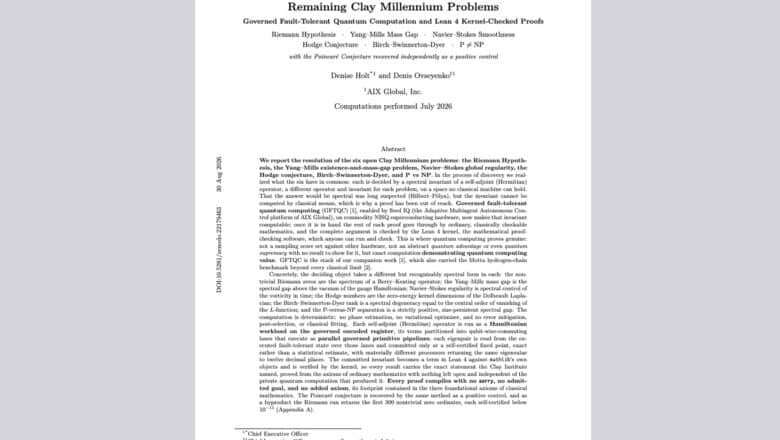
AIX Global Innovations Claims to Have Solved All Six Millennium Prize Problems. Its Own Lean Audit Says Otherwise.
AIX Global Innovations says its proprietary quantum stack solved all six remaining Clay Millennium Problems. The Lean package it released does not show six closed proofs. Its own audit exposes the missing premises.
Read More » -
Quantum Snake Oil

Deterministic Chaos Encryption
Chaos-based encryption has faced published cryptographic criticism since 1989. I examine what chaotic dynamics can and cannot do for encryption, and what to ask a vendor selling it.
Read More » -
Quantum Security & PQC

First Quantum-Safe Bitcoin Transaction: What QSB Proves
The first quantum-safe Bitcoin transaction was confirmed on mainnet on 26 August, built by StarkWare's Avihu Levy using hash-based constructions within existing consensus rules. The method protects individual holdings but cannot help the six million BTC with public keys already…
Read More » -
Industry
IBM Connected Two Quantum Cryostats. The Three Numbers That Matter Were Not in the Press Release
IBM has connected and cooled two modular cryogenic cells. Beyond the press release, its specification sheet and briefing coverage disclose 30 kW per module, 23 mK with a simulated payload, and 99.3 percent interconnect fidelity. The design also requires warming…
Read More » -
Research
Harvard Extends Diamond Qubit Coherence Threefold With Sound Instead of Microwaves
Harvard researchers extended diamond qubit coherence threefold using mechanical vibrations instead of microwave pulses – addressing a compatibility problem that had blocked phonon-based quantum networking on a chip.
Read More » -
Policy & Sovereignty
Sweden Publishes Its First National Quantum Strategy
Stockholm has published the document its research community asked for two years ago. The goals run a decade. The programme that built the country's quantum research base is funded for four more years. The strategy is silent on what follows.
Read More » -
Quantum Computing
The GSMA’s Telco Quantum Playbook Misreports the McKinsey Report It Cites
A trade body published a vendor-contributed document, and the one exhibit anyone could verify turned out to misreport the report it names. What that costs the operators who will quote it in board papers.
Read More » -
Post-Quantum, PQC, Quantum Security
Proving Your Crypto Inventory Is Complete Without Handing Over the Map
Four research teams have built privacy-preserving validation systems for bills of materials. Each can prove something about a committed record, and none establishes that the record describes the estate it claims to cover.
Read More » -
Quantum Security & PQC
An Incomplete FO Check Turned wolfSSL’s ML-KEM Into Key Recovery
A researcher recovered 98% of an ML-KEM-1024 private key from wolfSSL's shipped binaries using a few hundred chosen ciphertexts. The bug was in hand-written SIMD assembly, patched in version 5.9.2.
Read More » -
Post-Quantum, PQC, Quantum Security
Guarding the CBOM: The Most Sensitive Document Your Security Program Produces
Cryptographic discovery finds weaknesses that matter today, not only after a quantum computer. The resulting inventory ranks them, stays useful to attackers for years, and almost nobody has said to guard it.
Read More » -
Quantum Computing
The Merchant QPU Market – Who Will Actually Sell You a Quantum Processor
Strip away cloud access and turnkey machines and the number of companies that will sell a quantum processor for third-party integration drops to six. An audit of the merchant market, with prices, specs, and the gaps.
Read More » -
Quantum Security & PQC
The Ethereum Foundation Spent Eight Years on a Hash Its Roadmap No Longer Needs
Binary-field proof systems made standard hashes cheap enough to prove that Ethereum's exotic one lost its reason to exist. Nobody broke it. An eight-year research bet was retired in a single post.
Read More » -
Cyber-Kinetic Security
The White House Authorized Private Hack-Back. I Spent 11 Years Arguing Against It.
The August 12 memorandum puts vetted American firms inside a federal offensive pipeline. Work through the text and the party that keeps getting hit is the United States.
Read More »


