

-
Quantum Sensing

Ethical and Privacy Implications of Quantum Sensing
Quantum sensing sits at a crossroads of promise and peril. On one hand, it embodies the awe-inspiring potential of quantum technology – offering us new eyes and ears to perceive the world in richer detail than ever before. It could…
Read More » -
Research

New Hybrid Quantum Monte Carlo Algorithm
Researchers Xiaosi Xu and Ying Li have developed a “quantum-assisted” Monte Carlo method that uses a small quantum processor to boost the accuracy of classical simulations. The breakthrough, published in Quantum in 2023, addresses the notorious sign problem in quantum…
Read More » -
Policy & Sovereignty
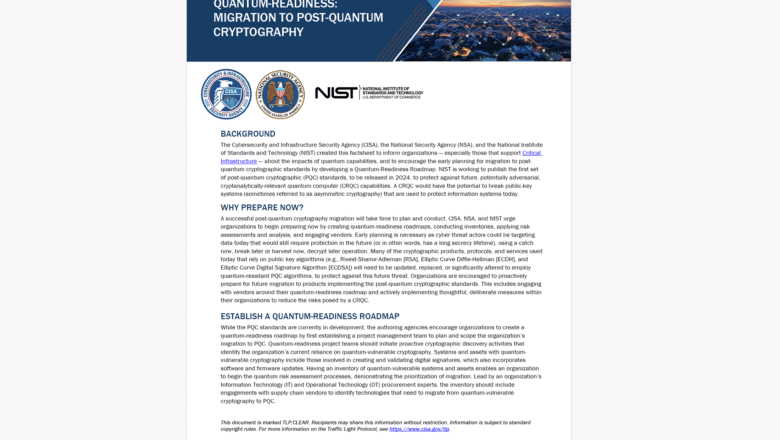
CISA’s “Quantum-Readiness” Fact Sheet: A Call to Prepare for Post-Quantum Cryptography
The Cybersecurity and Infrastructure Security Agency (CISA) together with the NSA and NIST released a joint cybersecurity factsheet titled “Quantum-Readiness: Migration to Post-Quantum Cryptography.” This document was created to inform organizations - “especially those that support Critical Infrastructure” - about…
Read More » -
Q-Day

Q-Day Predictions: Anticipating the Arrival of CRQC
While CRQCs capable of breaking current public key encryption algorithms have not yet materialized, technological advancements are pushing us towards what is ominously dubbed 'Q-Day'—the day a CRQC becomes operational. Many experts believe that Q-Day, or Y2Q as it's sometimes…
Read More » -
AI Security

AI and Canada: Pioneering Innovation, Searching for Homegrown Success
It’s easy to forget, amid the hype around Silicon Valley’s AI giants, that many of the foundational breakthroughs of modern AI were born in Canada. In fact, two of the three “godfathers of AI” - Yoshua Bengio and Geoffrey Hinton…
Read More » -
AI Security
Homomorphic Encryption for ML: What the Overhead Buys
Homomorphic encryption lets an untrusted server compute on data it cannot read. The overhead is severe enough that the set of machine learning workloads where that trade is correct is small, specific and worth naming precisely.
Read More » -
Post-Quantum, PQC, Quantum Security
Quantum Readiness for Mission-Critical Communications (MCC)
Mission-critical communications (MCC) networks are the specialized communication systems used by “blue light” emergency and disaster response services (police, fire, EMS), military units, utilities, and other critical operators to relay vital information when lives or infrastructure are at stake. These…
Read More » -
AI Security
What 250 Poisoned Documents Actually Proved
Two hundred and fifty documents planted the same backdoor in models from 600M to 13B parameters. What it planted was gibberish on a trigger word. The poisoning that should worry defenders is somewhere else entirely.
Read More » -
AI Security
Semantic Adversarial Attacks: Leaving the Perturbation Budget Behind
A semantic attack changes the lighting, the hair colour or the phrasing. The result is enormous in pixel distance, obviously the same thing to a person, and outside the set of inputs any robustness guarantee was written about.
Read More » -
AI Security
The AI Alignment Problem
The AI alignment problem sits at the core of all future predictions of AI’s safety. It describes the complex challenge of ensuring AI systems act in ways that are beneficial and not harmful to humans, aligning AI goals and decision-making…
Read More » -
Quantum Computing Modalities
Quantum Computing Modalities: Acoustic (Phononic) Quantum Systems
Quantum acoustic quantum computing refers to using quantized mechanical vibrations – phonons – to store and process quantum information. Instead of relying on photons (particles of light) or electronic states of atoms, this modality leverages units of sound (vibrations in…
Read More » -
Research
Intel’s Tunnel Falls: 24,000 Quantum Chips Per Wafer and the Manufacturing Argument Made Real
22 Jun 2023 - Every conversation about silicon spin qubits eventually arrives at the same claim: because these qubits are essentially single-electron transistors, they can be manufactured using the same processes that produce billions of classical transistors every year. The…
Read More » -
Quantum Computing
Fidelity in Quantum Computing
Fidelity in quantum computing measures the accuracy of quantum operations, including how effectively a quantum computer can perform calculations without errors. In quantum systems, noise and decoherence can degrade the coherence of quantum states, leading to errors and reduced computational…
Read More » -
Quantum Computing
Quantum Technology Use Cases in Supply Chain & Logistics
Quantum computing is on the cusp of reshaping the supply chain and logistics sector. Its ability to process information in fundamentally new ways holds the promise of solving the longstanding puzzles of logistics – from finding optimal delivery routes and…
Read More » -
Quantum Security & PQC
BIS Project Leap: Quantum‑Proofing Payments With Hybrid PQC Is Feasible – Now Comes the Hard Part
The Bank for International Settlements (BIS) has released a report under Project Leap demonstrating - via a realistic central‑bank payments connectivity experiment - that post‑quantum cryptography (PQC) can be deployed today in a hybrid mode without breaking core operational expectations for secure inter‑site connectivity.…
Read More »


