

-
Quantum Threat to Cryptocurrencies
How Close Is the Quantum Threat? Resource Estimates for Breaking Blockchain Cryptography
Resource estimates for breaking blockchain cryptography have collapsed by orders of magnitude in half a decade. Two parallel hardware paths, fast-clock superconducting and slow-clock neutral atom, are converging on the same target from opposite directions.
Read More » -
Quantum Threat to Cryptocurrencies
The Quantum Threat to Cryptocurrencies: What’s Real, What’s Hype, and What to Do About It
Google Quantum AI estimates that breaking the 256-bit elliptic curve cryptography protecting Bitcoin and Ethereum would require fewer than 500,000 physical qubits and roughly nine minutes of runtime on a superconducting architecture. The same day that paper landed, a separate…
Read More » -
Quantum Security & PQC
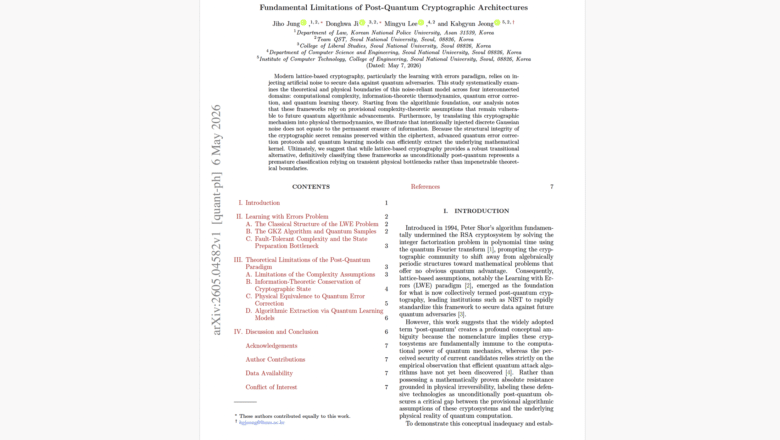
A Viral Paper Claims Lattice-Based PQC Has “Fundamental Limitations” — The Arguments Are Old and the Conclusion Is Wrong
A Seoul National University paper arguing lattice-based cryptography has "fundamental limitations" is generating alarming headlines. The theoretical points are valid but well-known. What the paper actually demonstrates is why PQC migration should accelerate, not stall.
Read More » -
Industry
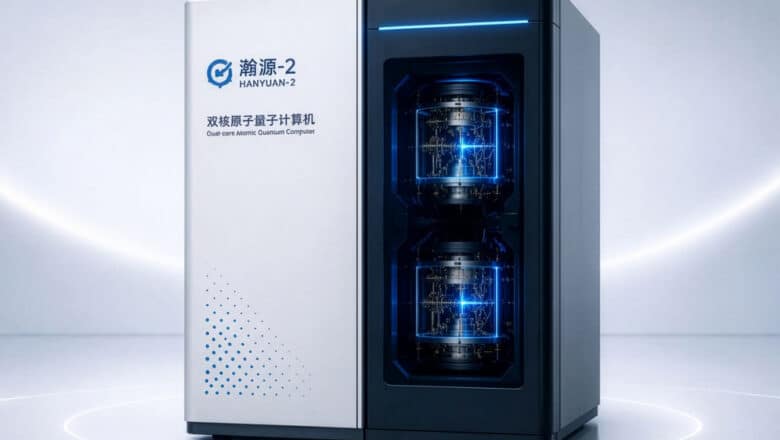
China’s Hanyuan-2 “Dual-Core” Quantum Computer: Clever Marketing, Missing Benchmarks
CAS Cold Atom Technology's Hanyuan-2 uses two rubidium isotope arrays and calls itself the world's first dual-core quantum computer. The framing is clever. The missing performance data tells a different story.
Read More » -
Post-Quantum, PQC, Quantum Security

Pick One Layer: How to Choose the Post-Quantum Migration That Protects the Most
Recent research proves one post-quantum layer can protect all payload confidentiality. But which layer should you migrate first? Six enterprise architecture scenarios analyzed.
Read More » -
Industry
Cisco Introduces a Universal Quantum Switch — and It Works at Room Temperature
Cisco’s research prototype can route quantum information across encoding modalities at room temperature on standard telecom fiber.
Read More » -
Quantum Security & PQC
IonQ’s Q-Day Claim: What the Earnings Call Actually Said vs. the Panic It’s Feeding
IonQ's CEO told investors the company will reach the logical qubit count to "challenge RSA-2048" by 2028–2029. That's not the same as breaking encryption, and the Q-FUD machine is already running at full speed.
Read More » -
Industry
Project Eleven Publishes 110-Page Quantum Threat Report for Blockchains — Rigorous Analysis Amid a Season of Denial
Two days after pseudoscience was pitched from Bitcoin's biggest stage to deny the quantum threat, Project Eleven published 110 pages of rigorous analysis showing exactly why that denial is dangerous.
Read More » -
Industry
QuantWare Raises $178M Series B — What It Means for Quantum Open Architecture
QuantWare's $178M Series B is the largest private round ever raised by a dedicated quantum processor company. With Intel Capital and IQT on board, the bet is clear: the quantum industry's future is modular, open, and manufactured at scale.
Read More » -
Industry
Q-CTRL Achieves Practical Quantum Advantage — and the Business Signal May Be Bigger Than the Physics
Q-CTRL's 120-qubit simulation of the Fermi-Hubbard model achieves quantitative accuracy matching classical benchmarks while completing in minutes rather than days. The "practical quantum advantage" claim deserves scrutiny, but the underlying technical achievement is real.
Read More » -
Industry
Fujitsu Surveyed 300 Executives. Cryptography Finished Last.
Fujitsu and FT Longitude surveyed 300 executives. Belief in quantum computing was near-universal, and the one readiness task carrying a legal deadline in all six countries surveyed finished last.
Read More » -
The Quantum Utility Map
The Quantum Utility Ladder: What Fault-Tolerant Quantum Computers Will Actually Be Used For
Every major fault-tolerant quantum algorithm resource estimate, mapped to the problem it solves and the machine it needs. The ladder is lumpier than the roadmaps suggest, and cryptanalysis does not sit at the top of it.
Read More » -
The Quantum Utility Map
Quantum Chemistry’s Honest Ledger: What the Resource Estimates Actually Say About Drug Discovery, Catalysis, and Materials Design
Quantum computing earns a real advantage on strongly correlated chemistry and on little else. The applications are concrete, the estimates are falling, and the translation gap between a simulated number and a decision is unmeasured.
Read More » -
The Quantum Utility Map
The Narrow Advantage: Why Quantum Computing Will Transform Five Industries and Disappoint Twenty
Hundreds of papers and six articles later, the map is narrow. Five industries have resource estimates, identified problems, and plausible hardware timelines. Twenty have marketing. This is the capstone synthesis of the series.
Read More » -
The Quantum Utility Map
Quantum Computing by 2033: Which Industries Win, Which Wait, and Why
Pharma, chemicals, batteries and advanced materials get real competitive separation from a 2,000-logical-qubit machine. Finance and logistics hit a quadratic-speedup barrier, and machine learning's new advantage has no costed path. A strategic briefing on where your industry sits.
Read More »


