

-
Quantum Security & PQC
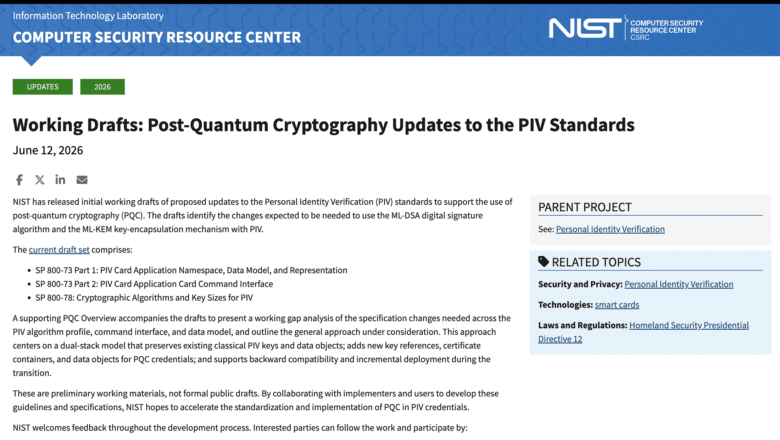
NIST Begins Wiring Post-Quantum Cryptography Into Federal PIV Credentials
NIST published working drafts that would add ML-DSA and ML-KEM support to the federal Personal Identity Verification standards. The dual-stack approach preserves existing classical credentials while adding PQC key references, certificate containers, and data objects for incremental deployment.
Read More » -
Post-Quantum, PQC, Quantum Security

Nobody Should Be Buying Proprietary Post-Quantum Cryptography (PQC) Algorithms
Five LinkedIn pitches in one day, each promising provably unbreakable encryption. A tour through cryptography's graveyard shows why unvetted algorithms fail, and how to check any vendor's claims in one afternoon.
Read More » -
Quantum Security & PQC
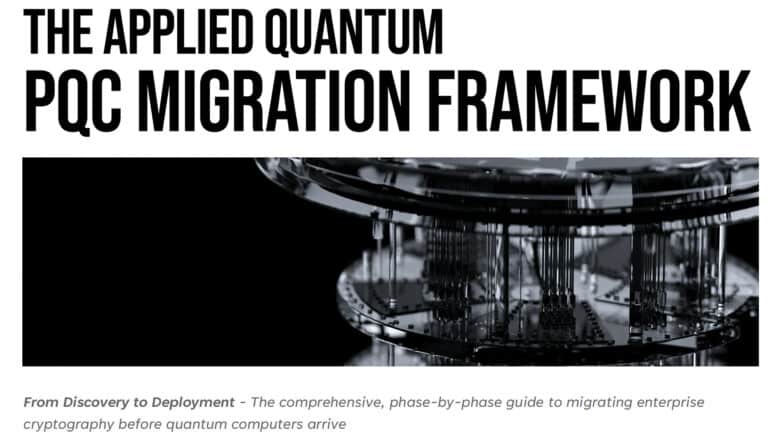
PQC Migration Framework v2.0 Released: What Changed, Why It Matters, and a Note on Attribution
The PQC migration problem shifted from "how do we prepare?" to "how do we deploy?" between March and June 2026. Version 2.0 of the Applied Quantum PQC Migration Framework responds with the operational depth that no other published methodology provides.
Read More » -
Post-Quantum, PQC, Quantum Security

The GRC Playbook for Quantum Security
Quantum risk sits awkwardly in most enterprise risk frameworks — too long-horizon for the security team, too technical for the risk committee, too uncertain for the actuaries. This article gives GRC teams the KRIs, governance structures, and regulatory monitoring processes…
Read More » -
Post-Quantum, PQC, Quantum Security

The SOC Quantum Playbook: Detection Rules, Threat Intelligence, and Incident Response
Your SOC already monitors for TLS downgrades and data exfiltration. Quantum security extends those capabilities with new detection rules, threat intelligence requirements, and incident response playbooks that most teams have not yet built.
Read More » -
Post-Quantum, PQC, Quantum Security
The PQC Migration Framework Is Free. Attribution Is Not Optional.
The Applied Quantum PQC Migration Framework is the first published methodology covering the complete PQC migration lifecycle at operational depth. It is free under CC BY 4.0. Some consulting firms have stripped the attribution and presented it as proprietary work.…
Read More » -
Post-Quantum, PQC, Quantum Security
PQC Migration Frameworks: What Changed Between March and June 2026
The PQC migration conversation shifted from "how do we prepare?" to "how do we deploy?" between March and June 2026. Google set a 2029 completion target, Let's Encrypt committed to Merkle Tree Certificates for post-quantum Web PKI, and the FIPS…
Read More » -
Quantum Security & PQC
Let’s Encrypt Commits to Merkle Tree Certificates for Post-Quantum HTTPS
The world's largest certificate authority has committed to Merkle Tree Certificates as its post-quantum path. With 54% of all public TLS certificates, Let's Encrypt's decision effectively sets the migration timeline for the entire web.
Read More » -
Research
IonQ Demonstrates qLDPC Breakeven on Trapped Ions — and the Flexibility Argument Just Got Harder to Ignore
IonQ's 40-ion trapped-ion device runs nine different error-correcting codes with zero hardware changes and hits breakeven on qLDPC codes — beating the only superconducting comparison by up to 9×. The real story is what this means for the qubit-efficient architectures…
Read More » -
Post-Quantum, PQC, Quantum Security
Canada’s PQC Framework: Sound Design, Stalled Execution — What the Bill C-8 Senate Debate Reveals
Four years after Bill C-26 was introduced, its successor Bill C-8 has finally passed the Senate. Quantum got one question in the debate. The enforcement layer that makes Canada's PQC framework work remains years away from addressing quantum risk.
Read More » -
Research
Atom Computing Demonstrates Quantum Error Correction With Toric Code, a First for Neutral Atoms
Atom Computing's toric code demonstration is the first sustained quantum error correction on a neutral-atom platform, running 90 syndrome extraction rounds with continuous atom reloading.
Read More » -
Post-Quantum, PQC, Quantum Security
The PQC Migration’s Biggest Risk Isn’t Quantum Computers
The largest cryptographic transition in history is replacing battle-tested code with brand-new implementations under deadline pressure. Hybrid ECC+PQ deployment is the engineering-prudent response, and the ML-DSA bug evidence now quantifies the cost of skipping it.
Read More » -
Quantum Security & PQC
Bernstein Demonstrates ML-DSA Key Recovery in Under One Second, Argues Solo Deployment Damages Security
Daniel J. Bernstein provides the first working attack demos against ML-DSA implementation bugs, recovers equivalent secret keys in under one second, and builds a quantitative case that solo ML-DSA deployment damages security compared to hybrid Ed25519+ML-DSA.
Read More » -
Industry
OQC Raises £260M in Europe’s Largest Private Quantum Round — Where the Money Actually Goes
Europe's largest private quantum round lands at £260M, with 38% from the British Business Bank. The money is earmarked for OQC's TITAN system, but the gap between 32 qubits today and 200 logical qubits by 2028 demands closer examination.
Read More » -
Quantum Security & PQC
OP_CHECKSHRINCS: Blockstream’s Stateful Bet on a Hash-Based Post-Quantum Bitcoin
Blockstream Research wants Bitcoin's quantum defense built from the hash function it already trusts. The signatures are startlingly small, the statefulness trade is real, and the deployable numbers tell a more careful story than the 324-byte headline.
Read More »


