Deep Dive Series
Quantum Computing Companies & Roadmaps
Every major quantum hardware company publishes a roadmap: projected qubit counts, target error rates, fault-tolerance milestones, and dates that always seem to arrive five years from now. Read them individually and each sounds compelling. Read sixty of them together and patterns emerge that no single roadmap reveals — about which modalities have real commercial momentum, where the industry’s centre of gravity sits geographically, how promises compare to demonstrated results, and what all of this means for the path to fault-tolerant and eventually cryptographically relevant quantum computing.
This Deep Dive series profiles every major quantum hardware company with detailed analysis of their technology, roadmap, competitive position, and CRQC relevance. The capstone article provides the cross-cutting strategic analysis; the individual company profiles go deeper on each player; and the companion database lets you search, filter, and compare them all in one place.

-
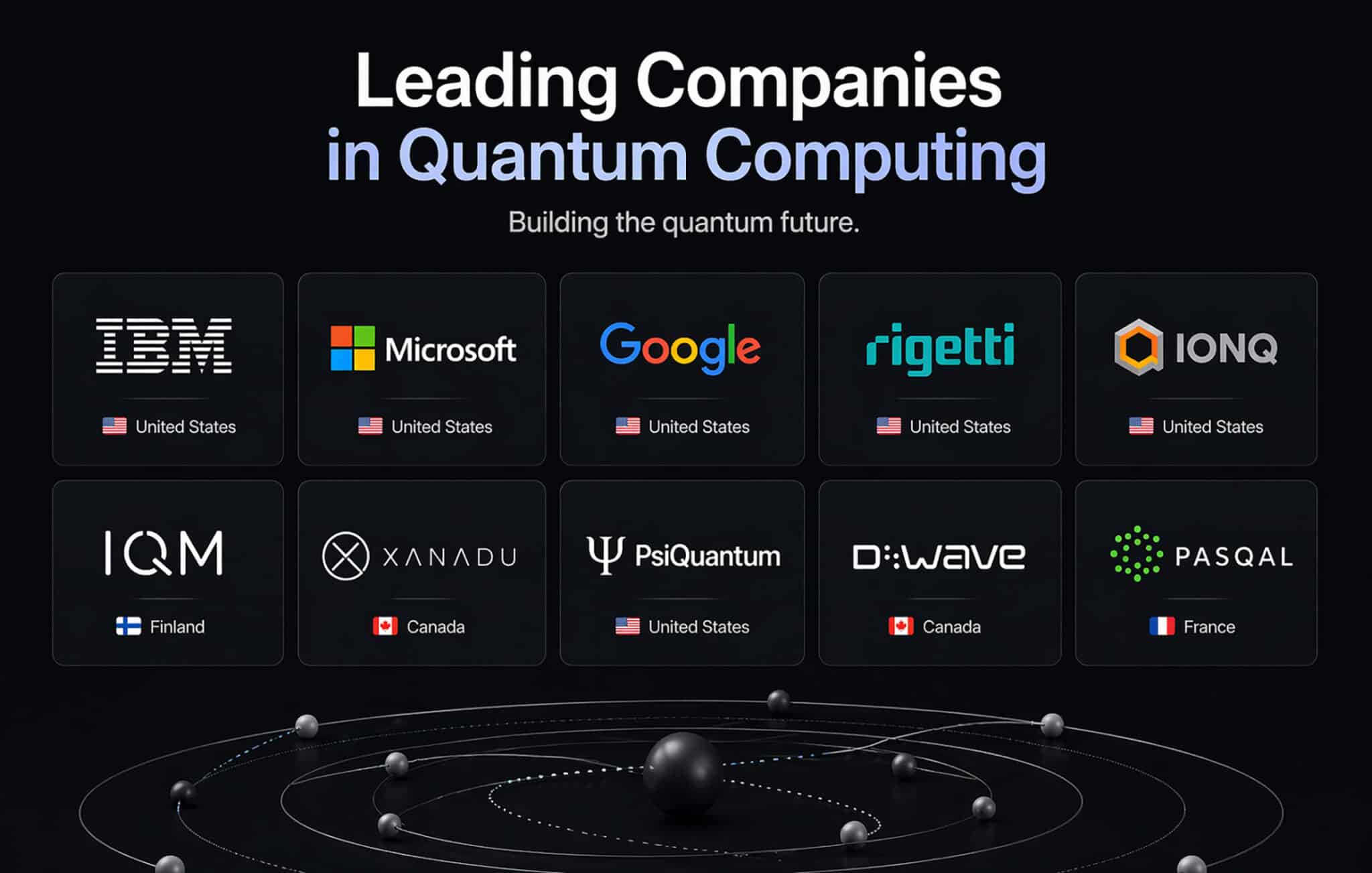
What do 60+ quantum hardware roadmaps tell us when you read them together instead of one at a time? This capstone article synthesizes the quantum computing company landscape into strategic insight: which modalities have the most commercial momentum, where the industry's centre of gravity sits geographically, how roadmap promises compare to demonstrated milestones, and what all of this means for the timeline to fault-tolerant and eventually cryptographically relevant quantum computing. Superconducting qubits dominate in funding but the field is diversifying fast. Roadmaps are converging on late-2020s fault-tolerance demonstrations. The gap between promise and reality is shrinking. And a structural divide is emerging between vertically integrated full-stack builders and modular component specialists — a divide that maps directly to the Quantum Open Architecture thesis. The companion database provides a searchable, filterable reference for every company, profiled with their modality, scale, roadmap, funding, and CRQC relevance. The individual company articles go deeper on each player. This article provides the cross-cutting patterns that only become visible when you look at the landscape as a whole.
Read More »
-
Quantum Computing Companies

IQM
IQM Quantum Computers is a Finland‑based hardware company building superconducting (transmon) quantum processors with a distinctly European strategy: deliver on‑premises systems tightly integrated with high‑performance computing (HPC) centers while co-designing architectures for error correction and, ultimately, fault tolerance. Rather than focus on cloud-only access or headline qubit counts, IQM emphasizes deployable machines, open low-level control for researchers, and chip topologies tailored to quantum error-correcting codes.…
Read More » -
Quantum Computing Companies

IonQ
IonQ is a publicly traded leader in trapped‑ion quantum computing whose strategy is to reach useful fault tolerance with fewer physical qubits by maximizing fidelity, connectivity, and modularity. Rather than racing raw qubit counts in noisy regimes, IonQ’s thesis is that very clean ions (identical atomic qubits with long coherence and native all-to-all coupling) can slash error‑correction overhead and bring logical qubits online earlier. That…
Read More » -
Quantum Computing Companies

Intel
Intel’s quantum computing program has carved a distinctive path, marrying cutting-edge quantum research with the might of advanced silicon manufacturing. Over the past several years, Intel progressed from superconducting qubit test chips (17 and 49 qubits) to a focus on silicon spin qubits, culminating in the 12-qubit Tunnel Falls chip in 2023. Alongside qubit chips, Intel engineered a unique cryo-control architecture: the Horse Ridge I/II…
Read More » -
Quantum Computing Companies
Infleqtion
Infleqtion (formerly known as ColdQuanta) is a leading quantum technology company focused on gate-based quantum computing built on neutral atoms. By leveraging optically trapped atomic qubits, Infleqtion aims to deliver scalable, high-fidelity quantum processors with a clear path toward fault-tolerance and commercial utility. The company’s approach emphasizes large 2D qubit arrays and Rydberg-mediated entangling gates, achieving record gate fidelities and integrating advanced software control to…
Read More » -
Quantum Computing Companies
Aegiq
Aegiq is a UK-based quantum technology startup (spun out from the University of Sheffield in 2019) that focuses on building full-stack photonic quantum computing systems. The company initially gained recognition for its work in quantum networking and quantum key distribution (QKD), leveraging a proprietary single-photon and integrated quantum optics platform. Today, Aegiq’s ambitions extend beyond secure communications - it is actively developing both quantum hardware…
Read More » -
Quantum Computing Companies
IBM
IBM has laid out one of the most detailed and aggressive quantum computing roadmaps in the industry. Over the past few years, IBM Quantum has consistently hit its interim milestones, expanding both the scale of its processors and the sophistication of its approach to quantum computing. As a long-time pioneer in quantum computing, IBM was the first to put real quantum hardware on the cloud…
Read More » -
Quantum Computing Companies
Google
Google is a frontrunner in the quest to build practical quantum computers. The company made headlines in 2019 by achieving quantum supremacy – using its 53-qubit Sycamore processor to perform in about 200 seconds a task that was estimated to require 10,000 years on a top supercomputer. This dramatic demonstration marked a milestone in computing and signaled Google’s emergence as a leader in quantum hardware.…
Read More » -
Quantum Computing Companies
Diraq
Diraq is an Australian quantum computing startup (founded in 2022 as a spin-off from UNSW Sydney by Professor Andrew Dzurak) focused on building large-scale quantum processors based on silicon-based spin qubits. The company’s strategy is to leverage standard silicon CMOS manufacturing - using modified transistor structures that act as quantum bits - to achieve practical and scalable quantum computing. Diraq’s qubits are single-electron spins confined…
Read More »