Deep Dive Series
Quantum Computing Companies & Roadmaps
Every major quantum hardware company publishes a roadmap: projected qubit counts, target error rates, fault-tolerance milestones, and dates that always seem to arrive five years from now. Read them individually and each sounds compelling. Read sixty of them together and patterns emerge that no single roadmap reveals — about which modalities have real commercial momentum, where the industry’s centre of gravity sits geographically, how promises compare to demonstrated results, and what all of this means for the path to fault-tolerant and eventually cryptographically relevant quantum computing.
This Deep Dive series profiles every major quantum hardware company with detailed analysis of their technology, roadmap, competitive position, and CRQC relevance. The capstone article provides the cross-cutting strategic analysis; the individual company profiles go deeper on each player; and the companion database lets you search, filter, and compare them all in one place.

-
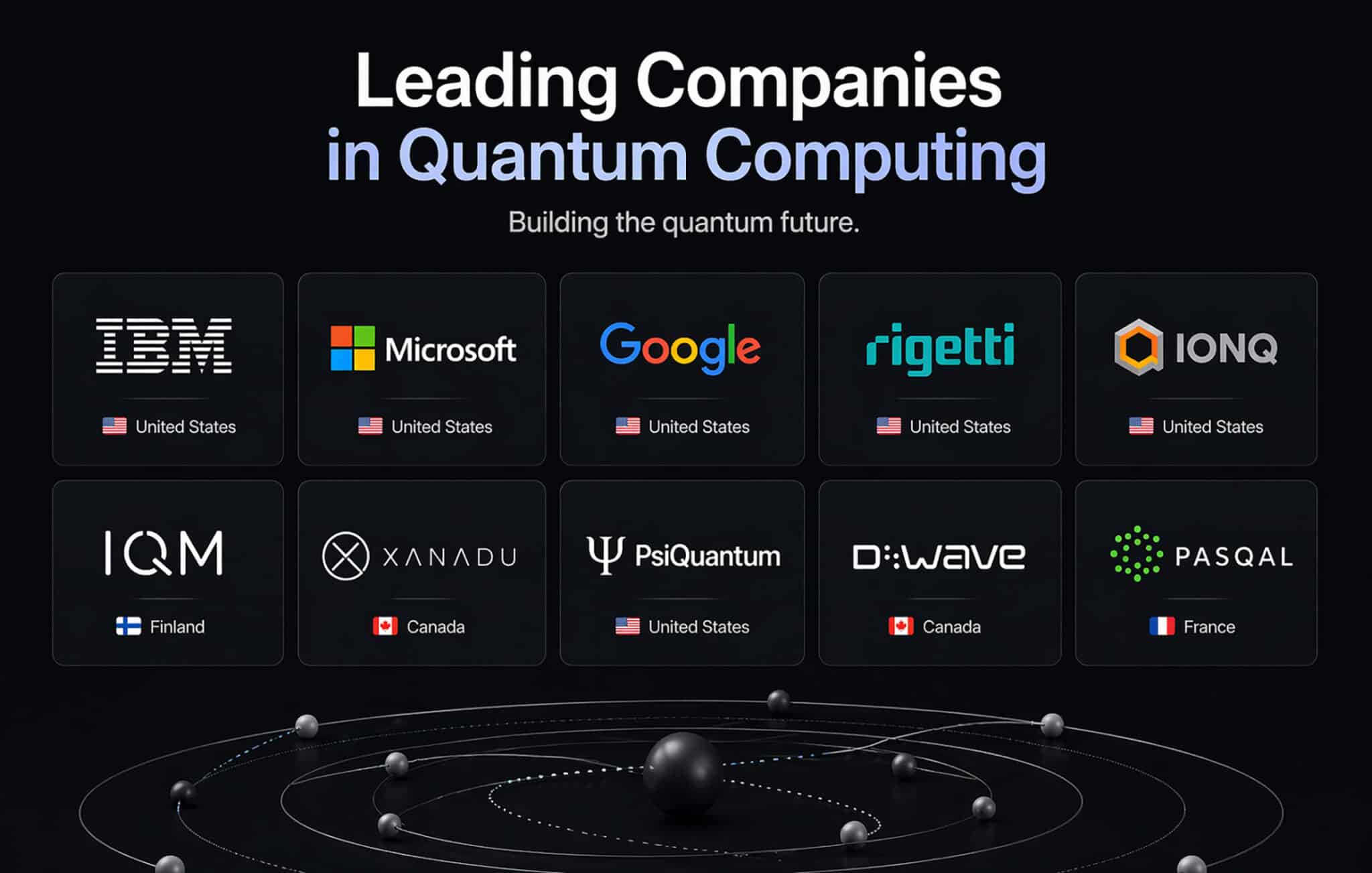
What do 60+ quantum hardware roadmaps tell us when you read them together instead of one at a time? This capstone article synthesizes the quantum computing company landscape into strategic insight: which modalities have the most commercial momentum, where the industry's centre of gravity sits geographically, how roadmap promises compare to demonstrated milestones, and what all of this means for the timeline to fault-tolerant and eventually cryptographically relevant quantum computing. Superconducting qubits dominate in funding but the field is diversifying fast. Roadmaps are converging on late-2020s fault-tolerance demonstrations. The gap between promise and reality is shrinking. And a structural divide is emerging between vertically integrated full-stack builders and modular component specialists — a divide that maps directly to the Quantum Open Architecture thesis. The companion database provides a searchable, filterable reference for every company, profiled with their modality, scale, roadmap, funding, and CRQC relevance. The individual company articles go deeper on each player. This article provides the cross-cutting patterns that only become visible when you look at the landscape as a whole.
Read More »
-
Quantum Computing Companies

Xanadu
Xanadu is a Toronto-based quantum computing company pioneering photonic (light-based) quantum processors. Founded in 2016 by CEO Christian Weedbrook, the venture has quickly become a leader in continuous-variable photonic quantum computing hardware and software. Xanadu’s approach leverages squeezed-light photons as qubits - allowing operations at room temperature and compatibility with existing fiber-optic networks - in contrast to the cryogenic setups required by superconducting or trapped-ion…
Read More » -
Quantum Computing Companies

Fujitsu
Fujitsu, a Japanese IT and computing giant, has emerged as a serious player in quantum computing through a multi-pronged strategy spanning cutting-edge quantum hardware and quantum-inspired annealing solutions. The company is pursuing one of the most ambitious quantum roadmaps to date - developing a 10,000+ qubit superconducting quantum computer by 2030 - with a focus on achieving practical advantage using fault-tolerant logical qubits. Fujitsu’s approach…
Read More » -
Quantum Computing Companies

Rigetti
Rigetti Computing is a full-stack quantum hardware company specializing in superconducting qubit processors. Rigetti’s qubits are implemented as Josephson-junction-based circuits (transmons) operated at milli-Kelvin temperatures inside dilution refrigerators. This platform offers extremely fast gate speeds (on the order of tens of nanoseconds) and leverages mature semiconductor-fabrication techniques for scalability. Rigetti’s strategy centers on scaling up superconducting qubit counts while improving fidelity and pursuing quantum error…
Read More » -
Quantum Computing Companies
QuEra Computing
QuEra Computing is a Boston-based quantum computing company pioneering neutral-atom quantum processors. Built on research from Harvard and MIT, QuEra operates the world’s largest publicly accessible quantum computer (the 256-qubit Aquila system on Amazon Braket) and is aggressively pursuing fault-tolerant architectures. In early 2025 QuEra secured a major $230 million financing (with investors like Google and SoftBank) to accelerate development of a “useful” fully-fledged quantum computer…
Read More » -
Quantum Computing Companies
PsiQuantum
PsiQuantum is a Silicon Valley-based startup taking a fundamentally different approach: photonic quantum computing. Their goal from the outset has been to build a large-scale, fault-tolerant quantum computer using photons, and they famously stated they need on the order of 1 million physical qubits (photons) for this and intend to achieve that by the late 2020s. While extremely secretive, some information has emerged through their…
Read More » -
Quantum Computing Companies
Pasqal
Pasqal is a French pioneer in neutral-atom quantum computing, building large, reconfigurable arrays of laser‑trapped Rydberg atoms and delivering them as on‑prem accelerators for HPC centers and industrial labs. Unlike many peers that separate “today’s NISQ” from “tomorrow’s FTQC,” Pasqal’s strategy is explicitly continuous: ship useful analog/digital processors now, and upgrade the same platform - via photonic‑integrated control, higher fidelities, and modular scaling - into…
Read More » -
Quantum Computing Companies
Nord Quantique
Nord Quantique is a Canadian quantum computing startup (founded in 2020 in Sherbrooke, Quebec) focused on building fault-tolerant quantum computers through innovative hardware design. The company’s mission centers on overcoming the main bottleneck in quantum computing - quantum error correction - by integrating error resilience directly into the hardware architecture. Unlike conventional approaches that require large numbers of physical qubits to encode a single logical…
Read More » -
Quantum Computing Companies
Microsoft
Microsoft’s quantum program is defined by a long‑bet on topological qubits - Majorana‑based devices designed to suppress errors at the hardware level - paired with a near-term, market-facing push through Azure Quantum. Publicly, Microsoft frames its roadmap in three phases: Foundational (prove and control Majorana modes), Resilient (demonstrate error-corrected logical qubits on a small system), and Scale (manufacture at CMOS-like volumes to reach millions of…
Read More »