

-
Post-Quantum, PQC, Quantum Security
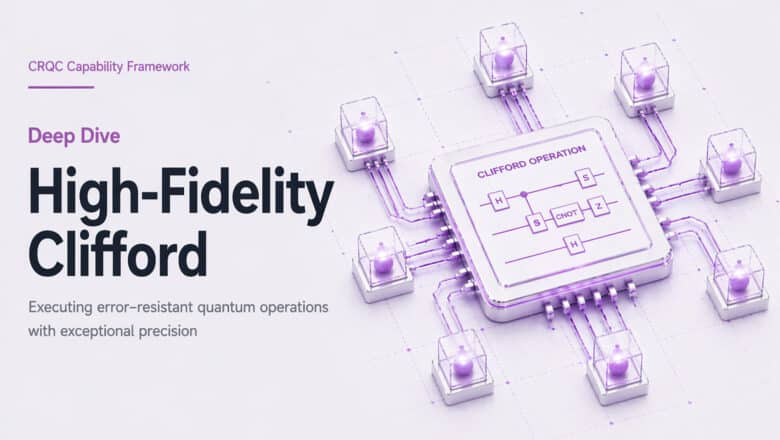
Capability C.1: High-Fidelity Logical Clifford Gates
Cryptographically Relevant Quantum Computers (CRQCs) will rely on a suite of core capabilities - and high-fidelity logical Clifford gates are among the most essential. This capability refers to performing the fundamental set of quantum logic operations (the Clifford gates: Pauli…
Read More » -
Post-Quantum, PQC, Quantum Security
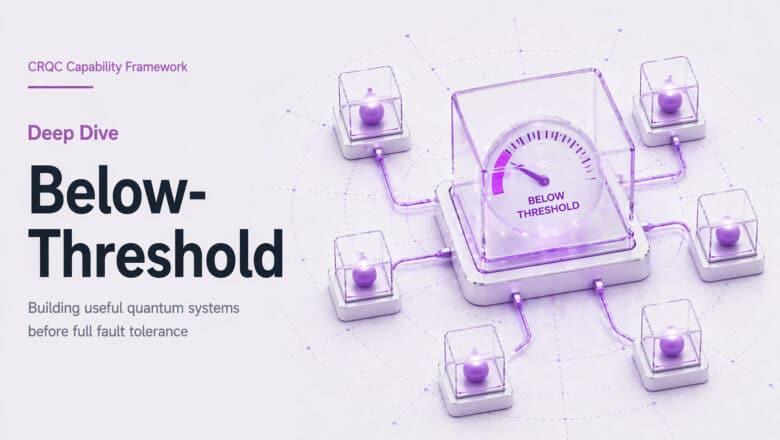
Capability B.3: Below-Threshold Operation & Scaling
“Below-threshold operation” refers to running a quantum processor at error rates below the critical threshold of a quantum error-correcting code. In simple terms, there is a tipping point in error rates: if each quantum gate and qubit has an error…
Read More » -
Post-Quantum, PQC, Quantum Security
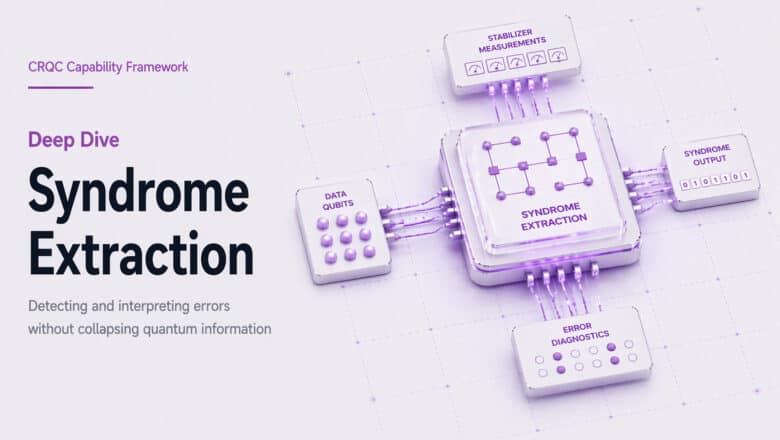
Capability B.2: Syndrome Extraction (Error Syndrome Measurement)
Quantum syndrome extraction - also called error syndrome measurement - is the process of measuring collective properties of qubits to detect errors without destroying the encoded quantum information. It is essentially the sensor mechanism of a quantum error-correcting code, analogous…
Read More » -
Post-Quantum, PQC, Quantum Security
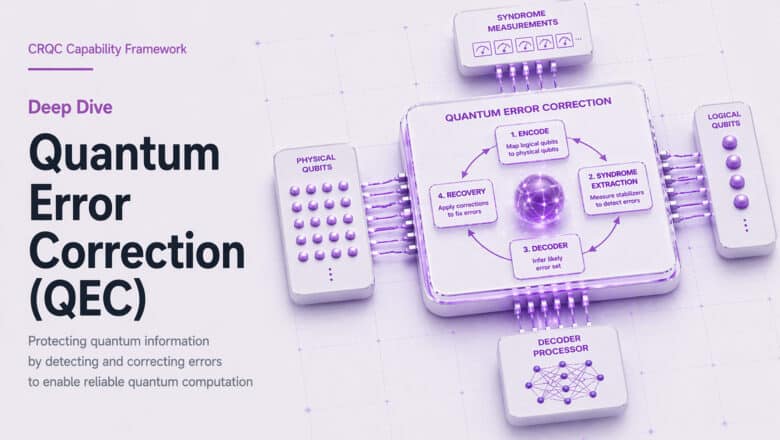
Capability B.1: Quantum Error Correction (QEC)
Quantum Error Correction (QEC) is the first and arguably most critical capability in the roadmap toward a cryptographically relevant quantum computer (CRQC). Without QEC, a large-scale quantum computer cannot reliably perform the billions of operations needed to break modern encryption…
Read More » -
Cyber-Kinetic Security

Stuxnet and the Birth of Cyber-Kinetic Weapons
Stuxnet was the first true cyber-kinetic weapon, designed to cripple the Iranian – and perhaps also the North Korean – nuclear weapon programs. It succeeded in slowing the Iranian program, although it was discovered before it could deal the program…
Read More » -
Leadership
Leadership in the Age of Artificial Intelligence (AI)
AI’s effect on the workplace will not be limited merely to repetitive, production line-type jobs. Increasingly, it also enters the realm of highly trained knowledge workers. It will also affect those who manage workers currently employed in such jobs. AI…
Read More » -
5G Security
How Telecom Operators Can Strike Back with IoT, Fog & Cyber
Telecom operators sat back as the new over-the-top (OTT) service providers, internet and tech companies slowly ate away at their business, particularly in the B2C space. A combination of institutional laziness and poor execution on promising initiatives gave these new…
Read More » -
Cyber-Kinetic Security
Navigating a Safe Course Through Maritime Cyberattacks
The open seas have long attracted those who yearned for adventure. The risk of pitting oneself against a vast and unforgiving sea has tested sailors’ mettle for millennia. It’s not surprising that the maritime industry is one that thrives on…
Read More » -
Cyber-Kinetic Security
Our Smart Future and the Threat of Cyber-Kinetic Attacks
A growing number of today’s entertainment options show protagonists battling cyber-attacks that target the systems at the heart of our critical infrastructure whose failure would cripple modern society. It’s easy to watch such shows and pass off their plots as…
Read More » -
Society 5.0
Whispering Buildings and Things That Listen to Us in the Night
How important privacy is for building smart cities and embracing the IoT In the 60s cartoon The Jetsons, the family lived in a futuristic city with flying cars, a robotic housekeeper, and even a watch that let you do video…
Read More » -
Post-Quantum, PQC, Quantum Security
Shor’s Algorithm: A Quantum Threat to Modern Cryptography
Shor’s Algorithm is more than just a theoretical curiosity – it’s a wake-up call for the security community. By understanding its principles and implications, we can appreciate why the cryptographic landscape must evolve. The goal of this guide is to…
Read More » -
Quantum Computing
Quantum Fourier Transform (QFT)
Quantum Fourier Transform (QFT), like a physical Fourier transform, takes a time-domain wave and represents it in the frequency domain. In the quantum case, the “time-domain” is the computational basis amplitude distribution, and the “frequency-domain” is another basis where the…
Read More » -
Post-Quantum, PQC, Quantum Security
Grover’s Algorithm and Its Impact on Cybersecurity
Grover’s algorithm was one of the first demonstrations of quantum advantage on a general problem. It highlighted how quantum phenomena like superposition and interference can be harnessed to outperform classical brute force search. Grover’s is often described as looking for…
Read More » -
Quantum Computing
Hadamard Gate: The Gateway to Superposition
The Hadamard gate takes a qubit and puts it into an equal superposition of “0” and “1” (with a relative phase of + or -). It has a simple matrix but a profound impact: it enables parallelism and interference in…
Read More » -
Post-Quantum, PQC, Quantum Security
The Hidden Subgroup Problem (HSP): One Framework to Break Them All
Every public-key cryptosystem deployed today - RSA, Diffie-Hellman, and elliptic curve cryptography - falls to a single mathematical framework called the Hidden Subgroup Problem (HSP). This is not a coincidence: Shor's algorithm, in each of its variants, works by exploiting…
Read More »


