

-
Industry

IBM Osprey: A 433-Qubit Quantum Leap
IBM has announced Osprey, a superconducting quantum processor with a record-breaking 433 qubits – by far the largest of its kind as of its 2022 debut. Revealed at the IBM Quantum Summit in November 2022, Osprey more than triples the…
Read More » -
AI Security

“Magical” Emergent Behaviours in AI: A Security Perspective
Emergent behaviours in AI have left both researchers and practitioners scratching their heads. These are the unexpected quirks and functionalities that pop up in complex AI systems, not because they were explicitly trained to exhibit them, but due to the…
Read More » -
Policy & Sovereignty
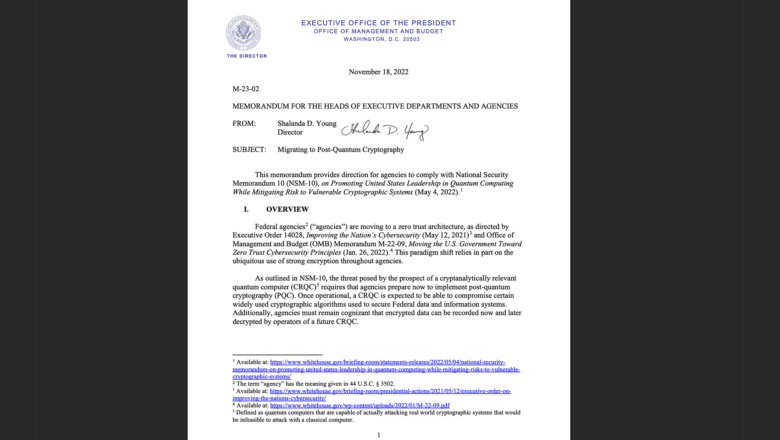
White House Memo Urges Federal Agencies to Prepare for Post-Quantum Cryptography
November 20, 2022 - The White House Office of Management and Budget (OMB) has issued a new memorandum that could reshape federal cybersecurity for the coming quantum era. OMB Memorandum M-23-02, titled "Migrating to Post-Quantum Cryptography," was released on November…
Read More » -
Quantum Networks

Entanglement Distribution Techniques in Quantum Networks
Quantum entanglement is a unique resource that enables new forms of communication and computation impossible with classical means. Distributing entanglement between distant locations is essential for applications such as quantum key distribution (QKD), quantum teleportation, and connecting quantum computers for…
Read More » -
5G Security

Can we afford to keep ignoring Open RAN security?
I’m skeptical of ‘futurists’. Work closely enough with the development of technology solutions and you’ll know that the only certain thing about the future is that it’s constantly changing. For example, few ‘futurists’ predicted the Covid-19 outbreak that brought the…
Read More » -
Crypto Security
How Blockchain Security Differs From Traditional Cybersecurity – 3 – User Security
This article is the third in a four-part series exploring the differences between traditional IT security and blockchain security. Check out the first two articles in the series exploring the differences for node operators and application developers. This article explores…
Read More » -
Crypto Security
How Blockchain Security Differs From Traditional Cybersecurity – 2 – Smart Contract Developers
This article is the second in a four-part series discussing the differences between traditional IT security / cybersecurity and blockchain security. Check out the first article in the series discussing the differences for node operators. This article focuses on the…
Read More » -
AI Security
Dynamic Data Masking Protects the View, Not the Model
Masking rewrites what a query returns and leaves the stored data alone. Whoever builds your training set either reads through the mask or under it, and neither outcome gives the resulting model any privacy property at all.
Read More » -
AI Security
Every Thumbs-Up Can Become a Training Label
Flipping 0.3% of preference labels reached a near-perfect attack success rate against safety alignment. The old defence advice assumes a labelled dataset you can audit, and that is not where labels live now.
Read More » -
Quantum Computing
The Toffoli Gate: The Unsung Workhorse in Quantum Codebreaking
Understanding the Toffoli gate’s role isn’t just an academic exercise – it has real implications for when and how quantum computers might break our cryptography. Each Toffoli gate isn’t a single physical operation on today’s hardware; it has to be…
Read More » -
Quantum Computing
Wave Function Collapse: When Quantum Possibilities Become Reality
Wave function collapse is the idea that a quantum system, described by a wave function embodying several possible states at once, suddenly reduces to a single state when observed. In simple terms, before you measure it, a quantum object can…
Read More » -
Crypto Security
Proof of Reserve vs. Proof of Liability vs. Proof of Solvency
Recent events like the FTX meltdown have sparked interest and conversations about how the incident could have been prevented. In the case of FTX, the primary problem was that the platform did not hold sufficient assets to cover its user…
Read More » -
Crypto Security
How Blockchain Security Differs From Traditional Cybersecurity – 1 – Node Operators
Blockchain is a rapidly-evolving technology with a great deal of interest and investment. Decentralized Finance (DeFi), in particular, has a great deal of money invested in it as well as a growing number of high-profile and expensive hacks. Beyond DeFi,…
Read More » -
Crypto Security
The 12 Biggest Hacking Incidents in the History of Crypto
The most comprehensive ranked list of the biggest crypto hacks in history (Up until November 1, 2022. I suspect a larger one is just behind the corner) It wasn’t easy digging through the entire history of cybercrime involving cryptocurrencies, but…
Read More » -
Industry
Switzerland and United States Forge Quantum Cooperation
In October 2022, Switzerland and the U.S. signed a Joint Statement on Cooperation in Quantum Information Science and Technology, pledging to deepen collaboration between the countries’ researchers and institutions. The agreement, signed in Washington D.C. by Switzerland’s State Secretary for…
Read More »


