

-
Policy & Sovereignty
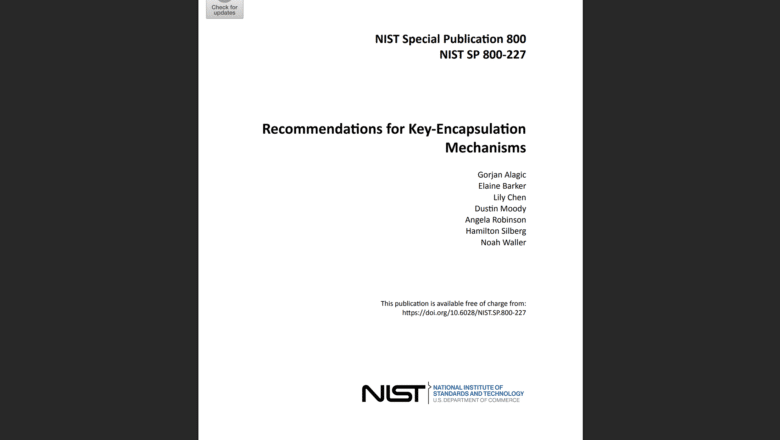
NIST Releases NIST SP 800-227 Recommendations for Key-Encapsulation Mechanisms
NIST has just released the initial public draft of CSWP 48, part of its Migration to Post-Quantum Cryptography project: "Mappings of Migration to PQC Project Capabilities to NIST Cybersecurity Framework 2.0 and to Security and Privacy Controls for Information Systems…
Read More » -
Policy & Sovereignty
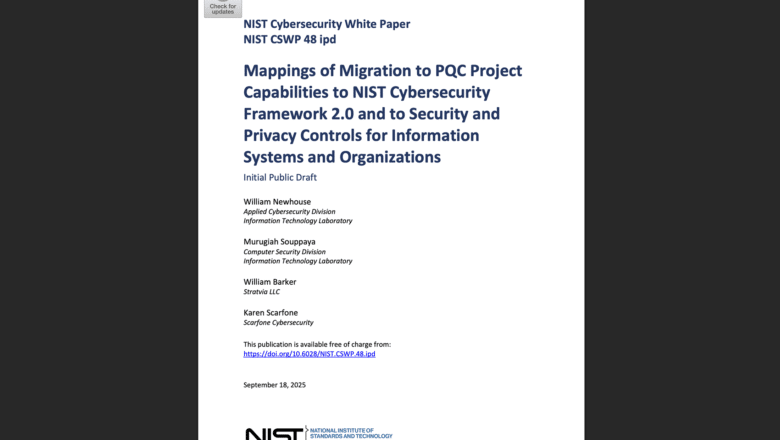
NIST Releases NIST CSWP 48 IPD – Mapping of Migration to PQC Project to NIST CSF 2.0
NIST has just released the initial public draft of CSWP 48, part of its Migration to Post-Quantum Cryptography project: "Mappings of Migration to PQC Project Capabilities to NIST Cybersecurity Framework 2.0 and to Security and Privacy Controls for Information Systems…
Read More » -
Research
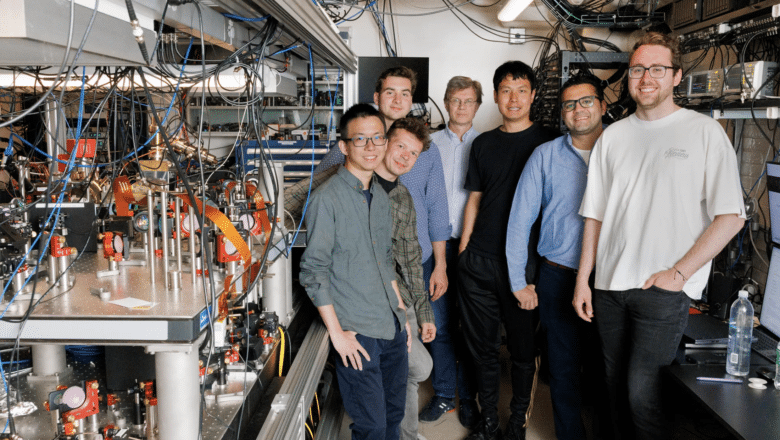
Harvard & MIT’s Continuous 3,000-Qubit Breakthrough: A New Era of Quantum Operation
A team led by the Technical University of Denmark (DTU) has published a milestone paper, “Quantum learning advantage on a scalable photonic platform,” in Science (Sept 25, 2025). Preprint arXiv:2502.07770. The work is the first proven quantum advantage using a…
Read More » -
Quantum Computing
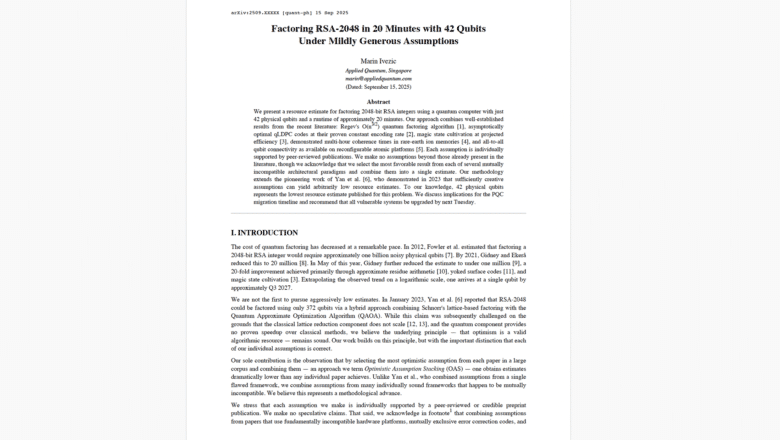
Factoring RSA-2048 in 20 Minutes with 42 Qubits
We present a resource estimate for factoring 2048-bit RSA integers using a quantum computer with just 42 physical qubits and a runtime of approximately 20 minutes. Our approach combines well-established results from the recent literature: Regev's O(n3/2) quantum factoring algorithm…
Read More » -
Research

New Paper Alert: A Relational Critique of Bell Locality
Just a few days ago Waaijer and van Neerven published a paper "A Relational Critique of Bell Locality" in which they analyze Bell experiments through the lens of relational quantum mechanics (RQM). For decades, Bell's theorem has been seen as…
Read More » -
Q-Day
Forget Q-Day Predictions – Regulators, Insurers, Investors, Clients Are Your New Quantum Clock
Whether you personally believe Q-Day will come in 5 years or 50, the world around you isn’t taking chances - and neither can you. As a CISO, you’re now being implicitly (and sometimes explicitly) told by every corner of your…
Read More » -
Research
Electrically Triggered Spin-Photon Device Demonstrated in Silicon
A new research paper titled “Electrically triggered spin-photon devices in silicon” has been published in Nature Photonics on September 11, 2025. In this paper, a team from Simon Fraser University (SFU) and quantum startup Photonic Inc. report the first-ever electrically…
Read More » -
Research
First Unconditional Quantum Information Supremacy: 12 Qubits vs 62 Classical Bits
A team of researchers from the University of Texas at Austin and Quantinuum has achieved a landmark result in quantum computing. Just published in Kretschmer et al., “Demonstrating an Unconditional Separation Between Quantum and Classical Information Resources,” arXiv preprint (Sep…
Read More » -
Quantum Computing Companies
What 60+ Quantum Hardware Roadmaps Actually Tell Us
What do 60+ quantum hardware roadmaps tell us when you read them together instead of one at a time? This capstone article synthesizes the quantum computing company landscape into strategic insight: which modalities have the most commercial momentum, where the…
Read More » -
Research
New Paper Alert: Brace for Impact: New ECDLP Challenge Ladder Benchmarks Quantum Threat to Bitcoin
The “Brace for Impact” ECDLP challenge suite is a great attempt to translate a looming cryptographic crisis into a concrete set of problems we can grapple with today. It provides a much-needed “ruler” to measure where we stand in the…
Read More » -
Quantum Security & PQC
Review Paper: Fewer Than 5% of Enterprises Have a Quantum Transition Plan
An arXiv review of enterprise readiness puts organizations with a formal quantum transition plan below 5%. The figure comes from ISACA's 2025 poll, and banks and telecoms are the only sectors budgeting at scale.
Read More » -
Quantum Computing
The Easiest Job in Quantum Computing – Being a Cynic
Don’t mistake the noise of cynicism for the signal of intelligence. If someone validates themselves as a useless cynic - unwilling to provide anything beyond scoffs and derision - don’t waste your energy getting dragged into their performative pessimism. Instead, direct…
Read More » -
Post-Quantum, PQC, Quantum Security
Stop Asking What Number a Quantum Computer Factored. Ask These Five Questions Instead
One of the laziest talking points in quantum security is that quantum computing has “gone nowhere” because people still talk about factoring 15. That confuses an early proof-of-concept with the real engineering path to a cryptographically relevant quantum computer. The…
Read More » -
Industry
New Paper Alert: Mapping Quantum Industry Demands to Education
A new peer-reviewed study - “Mapping quantum industry demands to education: a critical analysis of skills, qualifications, and modalities,” by Devendrababu et al. has just been published in EPJ Quantum Technology (2025). The paper takes a data-driven look at what…
Read More » -
Industry
Japan Launches First Homegrown Quantum Computer, Marking a Quantum Sovereignty Milestone
Japan has officially switched on its first quantum computer built entirely with homegrown technology. The new superconducting system went live on July 28, 2025 at Osaka University’s Center for Quantum Information and Quantum Biology (QIQB) - a landmark achievement that…
Read More »


