

-
Research
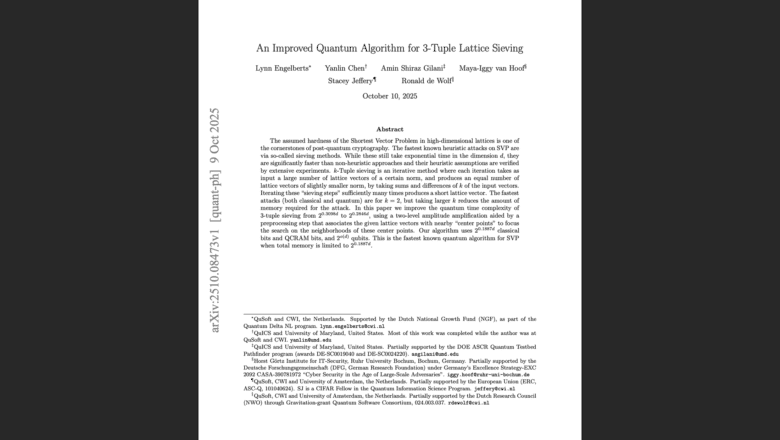
Quantum Sieving Breakthrough: Lattice Attack Exponent Slashed by 8%
A Dutch-led research team has achieved a significant breakthrough in quantum cryptanalysis of lattices. In an October 2025 paper "An Improved Quantum Algorithm for 3-Tuple Lattice Sieving" on arXiv, the authors report reducing the time complexity exponent for a key…
Read More » -
Policy & Sovereignty
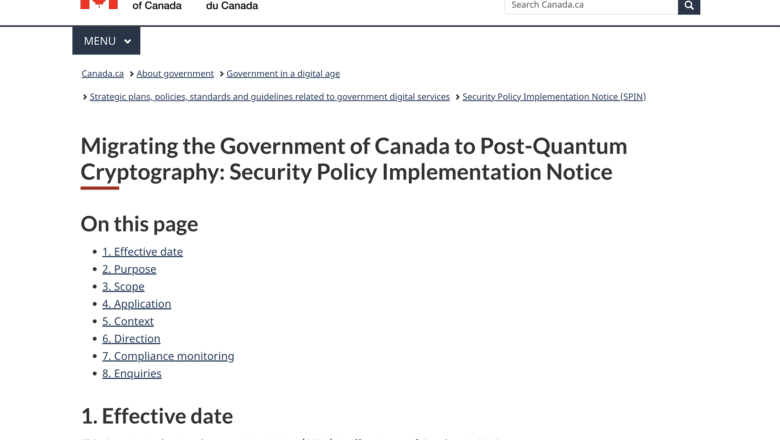
Treasury Board’s PQC SPIN: Canada Turns Post‑Quantum Migration Into Dated, Auditable Requirements
Treasury Board of Canada Secretariat has now formalized PQC migration as a measurable federal IT obligation via a Security Policy Implementation Notice (SPIN) titled “Migrating the Government of Canada to Post‑Quantum Cryptography.” It is both published and effective on October 9,…
Read More » -
Post-Quantum, PQC, Quantum Security

Trust Now, Forge Later (TNFL) – The Overlooked Quantum Threat
What is "Trust Now, Forge Later" (TNFL)? Most discussions about quantum computing threats focus on “Harvest Now, Decrypt Later” (HNDL) - the idea that adversaries can collect encrypted data today and store it, hoping a future quantum computer will break…
Read More » -
Post-Quantum, PQC, Quantum Security

Quantum Readiness Is Not (Just) a Vendor Problem
In the recent IBM's “Secure the Post-Quantum Future” report 62% of executives admitted that their organization is waiting for vendors to make them quantum‑safe. In other words, they expect cloud providers, network equipment makers and software vendors to embed post‑quantum…
Read More » -
Industry

Quantum Tunnelling on a Chip: Why the 2025 Nobel Prize in Physics Matters for Quantum Tech
The 2025 Nobel Prize in Physics went to John Clarke, Michel Devoret and John Martinis for a deceptively simple yet profound experiment. They built a superconducting circuit - two superconductors separated by an insulating barrier known as a Josephson junction - and showed…
Read More » -
Industry
IBM’s “Secure the Post-Quantum Future” Report
A new 2025 report from IBM’s Institute for Business Value (IBV), in collaboration with the Cloud Security Alliance (CSA), paints a stark picture of enterprise readiness for the quantum era. Titled ”Secure the post-quantum future,” the study surveyed 750 executives…
Read More » -
Quantum Computing
Predicting Quantum Computing Winning 2025 Nobel Physics Prize
Announcements of 2025 Nobel Prize winners start tomorrow. With announcements for Nobel Prize for Physics scheduled for Tuesday 7 October. Every autumn I indulge in a guilty pleasure: browsing speculative lists of Nobel Prize contenders and trying to guess who…
Read More » -
Research
Above 1 K Qubits
A new peer-reviewed study in Physical Review X reports a breakthrough in quantum computing hardware: researchers at the startup EeroQ have successfully trapped and controlled individual qubits at 1.1 kelvin - over 100 times hotter than the ~10 millikelvin temperatures used by…
Read More » -
Research
Capturing Uncertainty
A team of researchers led by Dr. Mohammed Th. Hassan at the University of Arizona has published a new paper titled “Attosecond quantum uncertainty dynamics and ultrafast squeezed light for quantum communication” (Sennary et al., 2025) in Light: Science &…
Read More » -
Policy & Sovereignty
Canada’s PQC Procurement Playbook: ITSM.00.501 Moves Post-Quantum From Strategy to Contract Language
10 Oct 2025 - The Canadian Centre for Cyber Security’s newly released ITSM.00.501 is the most procurement-ready PQC artifact Canada has published so far: it translates “migrate to PQC” into contract clauses that vendors can actually quote, negotiate, and commit…
Read More » -
Policy & Sovereignty
FCA’s Latest Research Note Explores Quantum Computing in Financial Services
The UK’s Financial Conduct Authority (FCA) has released a new Research Note titled “Quantum Computing Applications in Financial Services” authored by Charlie Markham (FCA) and Ross Grassie (formerly of the UK Quantum Software Lab). FCA Research Notes are designed to…
Read More » -
Industry
Italy’s Largest Quantum Computer Built on Open Architecture Debuts in Naples
The University of Naples Federico II unveiled the country’s most powerful quantum computer - a 64-qubit system assembled using a revolutionary modular design. Powered by a Tenor quantum processing unit (QPU) from Dutch startup QuantWare, this machine now stands as…
Read More » -
Post-Quantum, PQC, Quantum Security
Getting Started With Quantum Security and PQC Migration
Your complete roadmap to quantum-proofing your organization — from boardroom mandate to operational crypto-agility. This practitioner-curated Deep Dive series collects the PostQuantum.com articles you need to launch and run a quantum-readiness program, organized along the lifecycle most teams actually follow:…
Read More » -
Quantum Ecosystem
The Fab’s Hidden Supply Chain: Who Really Wins If Photonic Quantum Computing Wins
In February 2025, a team of more than ninety researchers published a paper in Nature describing something the photonic quantum computing community had been waiting a decade to see: a complete quantum photonic technology stack - single-photon sources, superconducting detectors,…
Read More » -
Quantum Security & PQC
U.S. Federal Reserve Warns of Quantum Threat to Bitcoin
The U.S. Federal Reserve is sounding the alarm that future quantum computers could pose a serious threat to the security of cryptocurrencies like Bitcoin. In a new study titled “Harvest Now, Decrypt Later,” Fed analysts warn that once sufficiently powerful…
Read More »


