

-
China's Quantum Ambition
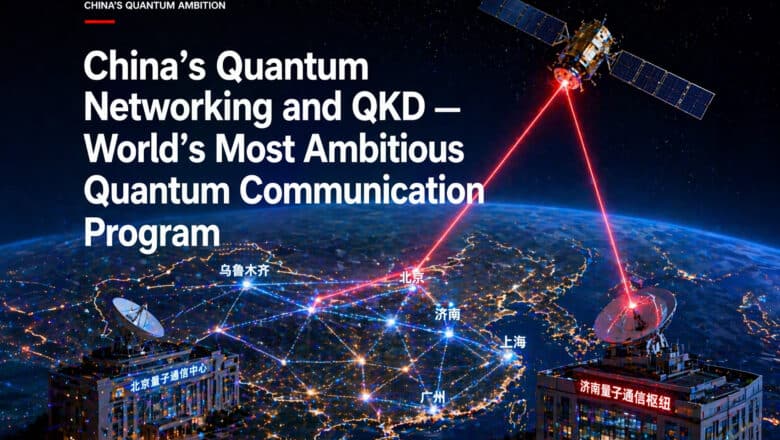
China’s Quantum Networking and QKD — World’s Most Ambitious Quantum Communication Program
On September 29, 2017, a video call connected two men separated by 7,600 kilometres. On one end, in Beijing, Bai Chunli, president of the Chinese Academy of Sciences. On the other, in Vienna, Anton Zeilinger, the physicist who would later…
Read More » -
Quantum Security & PQC

Cloudflare Joins Google: Two Internet Giants Now Say 2029 for Post-Quantum Migration
7 Apr 2026 – Cloudflare, the infrastructure company that handles a significant share of global internet traffic, today announced it is accelerating its post-quantum cryptography roadmap and targeting 2029 for full post-quantum security — including, critically, post-quantum authentication. The announcement,…
Read More » -
China's Quantum Ambition
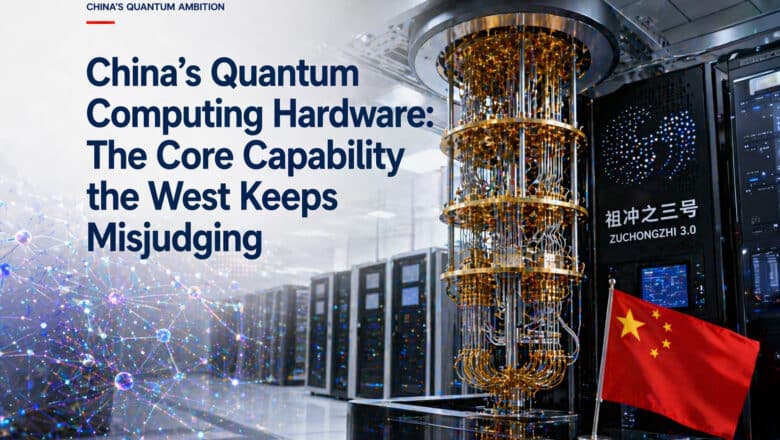
China’s Quantum Computing Hardware: The Core Capability the West Keeps Misjudging
The published record suggests China trails the US by about a year. The actual gap may be narrower — or it may already be closed. In December 2025, a team at the University of Science and Technology of China quietly…
Read More » -
Research
QuiX Quantum Achieves First Below-Threshold Error Mitigation in Photonic Quantum Computing
5 Apr 2026 - QuiX Quantum, a Netherlands-based photonic quantum computing company, announced it has demonstrated below-threshold error mitigation on a photonic quantum computer for the first time, in collaboration with NASA's Quantum Artificial Intelligence Laboratory (QuAIL), the University of…
Read More » -
China's Quantum Ambition

China’s Quantum Talent Ecosystem: Building a Superpower’s Workforce
In 1996, a 26-year-old physics student from the University of Science and Technology of China arrived in Vienna to begin doctoral work under Anton Zeilinger, one of the world's leading quantum experimentalists. Five years later, he went home. That decision…
Read More » -
Quantum Security & PQC
Quantum Threat Timeline Report 2025: Record Predictions, But Can the Survey Keep Up?
5 Apr 2026 - The Global Risk Institute (GRI) and evolutionQ Inc. have published the seventh edition of their annual Quantum Threat Timeline Report, the longest-running expert survey dedicated to estimating when a quantum computer will be capable of breaking…
Read More » -
China's Quantum Ambition
China’s Hefei National Laboratory: The Nerve Center of a Quantum Superpower
On April 26, 2016, Xi Jinping walked into USTC's Advanced Technology Research Institute in Hefei and listened to a physicist named Pan Jianwei describe the future of quantum information science. What Xi said next — "Very promising, very important… the…
Read More » -
China's Quantum Ambition
The $15.3 Billion Number That Everyone Cites and Nobody Can Verify
In October 2023, I was on a call with a European defense ministry official who wanted to discuss quantum threats. Within the first five minutes, he cited it. "China has invested $15.3 billion in quantum technology - nearly double the…
Read More » -
Research
Gauge Theory Meets Quantum Computing
April 2, 2026 - Dr. Dominic Williamson of the University of Sydney and Theodore Yoder of IBM have published a new method for performing fault-tolerant logical measurements on quantum error-correcting codes that dramatically reduces the physical qubit overhead required. The…
Read More » -
China's Quantum Ambition
China’s 15th Five-Year Plan Makes Quantum an Industrial Imperative — Not Just a Research Priority
When China's National People's Congress approved the 15th Five-Year Plan on March 12, 2026, it completed a journey that had been building for over a decade. Quantum technology, once buried deep in academic research budgets, emerged at the top of…
Read More » -
Post-Quantum, PQC, Quantum Security
What Is MDI-QKD and Why It Matters Now
Measurement-device-independent QKD eliminates the detector vulnerabilities that have plagued commercial QKD systems. From Dutch ports to Chinese backbones, it is now operational infrastructure, and its twin-field descendant holds the 1,002 km distance record.
Read More » -
Quantum Systems Integration
Will Magnetic Cooling Replace the Dilution Refrigerator? What the Numbers Say
Adiabatic demagnetization already reaches millikelvin without helium-3. But reaching a temperature and running a quantum computer at that temperature are different problems. I quantify the cooling-power gap and assess when cADR catches up.
Read More » -
Quantum Security & PQC
QuantumShield360 AI Achieves World’s First Complete Post-Quantum Cryptography Migration — Full Quantum Resilience Across All Enterprise Systems
Scottsdale, AZ — April 1, 2026 — QuantumShield360 AI, a next-generation quantum-resilient cybersecurity platform leveraging AI-powered lattice synergies, today announced it has completed a full, end-to-end migration to post-quantum cryptographic standards across its entire technology stack — becoming the first…
Read More » -
Quantum Systems Integration
Mining the Moon for Helium-3: How It Would Work, What It Would Cost, and Whether the Math Closes
Lunar helium-3 mining is attracting real contracts from real companies. I walk through the physics of why He-3 is on the Moon, how you'd get it out, what the numbers say, and whether any of it survives contact with the…
Read More » -
Quantum Systems Integration
Helium-3 and Quantum Computing’s Coldest Problem: Physics, Scarcity, and the Moon
Helium-3 sits at the center of the quantum cryogenics debate, and most of what circulates about it is muddled. I separate the irreplaceable physics from the inflated demand, and ask whether the Moon makes any sense.
Read More »


