
Latest Quantum Security, PQC, Post-Quantum, Crypto-Agility News
-
Jun- 2026 -2 JuneQuantum Security & PQC
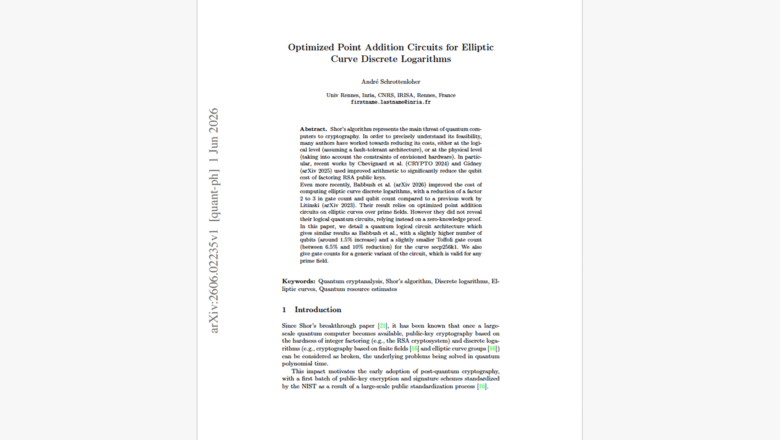
Google’s Secret Quantum Circuits for Breaking ECC Reproduced and Improved in Two Months
A French researcher independently matched Google's secret quantum circuits for breaking elliptic curve cryptography, then improved the gate count. Google's Craig Gidney says the zero-knowledge approach failed and open publication should resume.
Read More » -
May- 2026 -29 MayQuantum Security & PQC
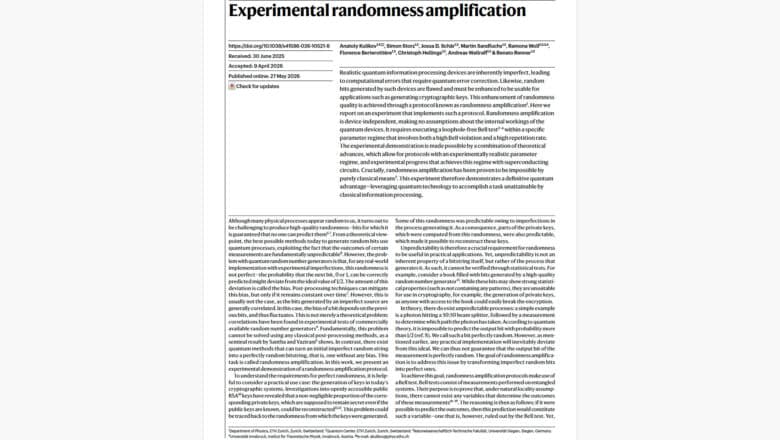
ETH Zurich’s “Perfect Randomness”: What Actually Happened
A new preprint series claims to break every major lattice-based NIST PQC standard via an improved CDPR attack. The claim has critical technical gaps that the lattice cryptography community will need to resolve.
Read More » -
25 MayQuantum Security & PQC
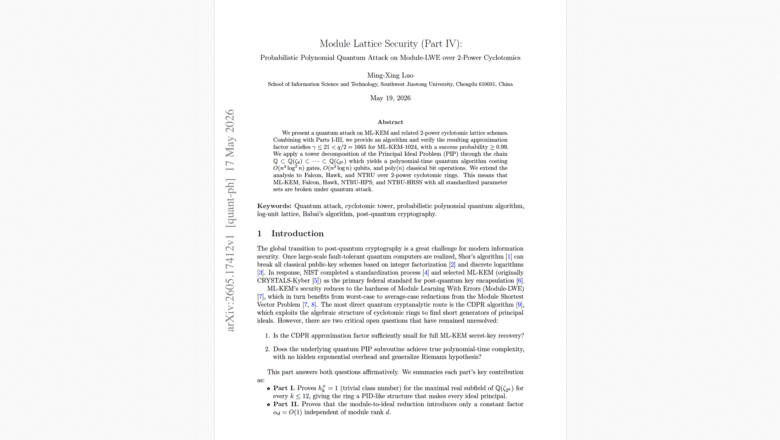
A New Paper Claims to Break ML-KEM, Falcon, Hawk, and NTRU. Should You Worry?
A new preprint series claims to break every major lattice-based NIST PQC standard via an improved CDPR attack. The claim has critical technical gaps that the lattice cryptography community will need to resolve.
Read More » -
15 MayQuantum Security & PQC
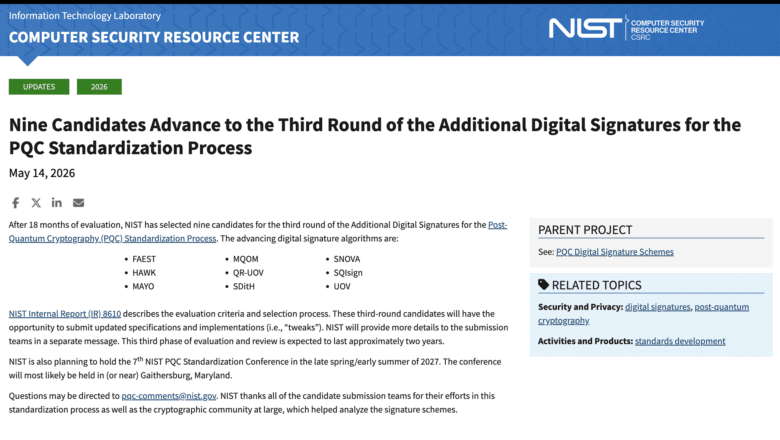
NIST Narrows the Field: Nine Post-Quantum Signature Candidates Advance to the Third Round
NIST just narrowed 14 post-quantum signature candidates to nine. The survivors span four distinct mathematical families, from isogeny-based compact signatures to multivariate schemes under active cryptanalytic fire. Here's what each candidate is, why NIST kept it, and what this means for your PQC migration planning.
Read More » -
15 MayQuantum Security & PQC

India Finalizes Quantum-Safe Roadmap: CII Migration by 2029, Testing Labs by 2026
India's finalized quantum-safe roadmap adds Preferential Market Access mandates, a detailed four-level certification framework, and sector-specific technology guidance. The timelines hold — but the execution gap just got harder to ignore.
Read More » -
10 MayQuantum Security & PQC
A Viral Paper Claims Lattice-Based PQC Has “Fundamental Limitations” — The Arguments Are Old and the Conclusion Is Wrong
A Seoul National University paper arguing lattice-based cryptography has "fundamental limitations" is generating alarming headlines. The theoretical points are valid but well-known. What the paper actually demonstrates is why PQC migration should accelerate, not stall.
Read More » -
7 MayQuantum Security & PQC
IonQ’s Q-Day Claim: What the Earnings Call Actually Said vs. the Panic It’s Feeding
IonQ's CEO told investors the company will reach the logical qubit count to "challenge RSA-2048" by 2028–2029. That's not the same as breaking encryption, and the Q-FUD machine is already running at full speed.
Read More » -
Apr- 2026 -30 AprilQuantum Security & PQC
Cloudflare Ships Post-Quantum IPsec With Cisco and Fortinet Interoperability
Cloudflare made hybrid ML-KEM generally available for IPsec site-to-site tunnels, with Cisco 8000 routers and FortiOS 7.6.6 interoperating, four years after post-quantum key exchange reached TLS.
Read More » -
30 AprilQuantum Security & PQC
Scott Aaronson Sounds the Alarm: “This Post Is Your Warning”
The inventor of BosonSampling and new NAS member says reputable QC hardware experts now tell him a cryptanalytic quantum computer should be possible by around 2029.
Read More » -
23 AprilQuantum Security & PQC
Chinese Researchers Cut ECC Qubit Requirements to 1,333 with Open-Source Circuits
A Tsinghua–Peking University team achieves 1,333 logical qubits for ECC-256 with fully explicit, open-source quantum circuits. The gate count may matter more than the qubit count.
Read More » -
21 AprilQuantum Security & PQC
Coinbase Quantum Paper: What It Gets Right, Wrong, and Misses
Coinbase assembled heavyweights like Scott Aaronson and Dan Boneh to assess quantum threats to crypto. Their paper is serious, measured, and technically sound. But it underestimates how fast the ground is shifting beneath blockchain cryptography.
Read More » -
18 AprilQuantum Security & PQC
Meta Publishes Its PQC Migration Playbook. And It’s the Most Detailed Hyperscaler Account Yet
Meta’s PQC migration playbook introduces “Migration Levels” as an operating model and describes post-quantum protections already live across internal traffic.
Read More » -
12 AprilQuantum Security & PQC
Cisco Research Proves That One Post-Quantum Layer Can Protect Payload Confidentiality — But Authentication Requires Migrating Every Layer
A Cisco Research paper proves that one post-quantum layer suffices for payload confidentiality but every layer must migrate for authentication — and that upgrading to WPA3 worsened quantum security.
Read More » -
9 AprilQuantum Security & PQC
Architecture Matters as Much as the Algorithm: Q-CTRL’s Heterogeneous Quantum Computer Design Cuts RSA-2048 to 190k-381k Qubits
9 Apr 2026 - Researchers at Q-CTRL, a quantum infrastructure software company headquartered in Los Angeles and Sydney, have published a paper introducing Q-NEXUS, a heterogeneous quantum computing architecture that claims to reduce the physical qubit requirements for factoring 2048-bit RSA integers to as few as 190,000 physical qubits — a roughly 4.7× reduction from the current monolithic baseline. The…
Read More » -
8 AprilQuantum Security & PQC
Anthropic’s Mythos Preview and the End of a Twenty-Year Cybersecurity Equilibrium
8 Apr 2026 – Anthropic yesterday announced Claude Mythos Preview, a frontier AI model that can autonomously discover and exploit zero-day vulnerabilities in every major operating system and every major web browser. Alongside the model, Anthropic launched Project Glasswing, a defensive coalition including Amazon Web Services, Apple, Broadcom, Cisco, CrowdStrike, Google, JPMorganChase, the Linux Foundation, Microsoft, NVIDIA, and Palo Alto…
Read More »


