Quantum Computing
PostQuantum.com – Industry news and blog on Quantum Computing, Quantum Security, PQC, Post-Quantum, Quantum Tech
-

Quantum Supremacy vs. Quantum Advantage
In the ever-accelerating world of quantum computing, two terms have emerged as the darlings of headlines and conference keynotes: quantum supremacy and quantum advantage. If you've followed the news, you might think they're interchangeable buzzwords celebrating the dawn of a new computing era. But dig a little deeper, and you'll…
Read More » -
Early History of Quantum Computing
Since the early 2000s, the field of quantum computing has seen significant advancements, both in technological development and in commercialization efforts. The experimental demonstration of Shor's algorithm in 2001 proved to be one of the key catalyzing events, spurring increased interest and investment from both the public and private sectors.
Read More » -
The Controlled-NOT (CNOT) Gate in Quantum Computing
The CNOT gate is to quantum circuits what the XOR gate is to classical circuits: a basic building block for complex operations. By learning how the CNOT gate works and why it matters, cybersecurity experts can better appreciate how quantum computers process information, how they might break cryptography, and how…
Read More » -
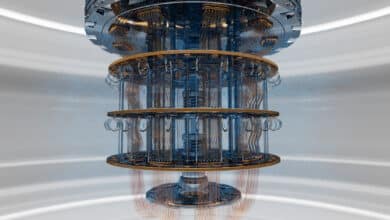
Random Circuit Sampling (RCS) Benchmark
At its core, Random Circuit Sampling (RCS) is a way to test how well a quantum computer can generate the output of a complex quantum circuit. Compare the results to what an ideal quantum computer should produce. If the quantum computer’s output closely matches the theoretical expectations, it demonstrates that…
Read More » -
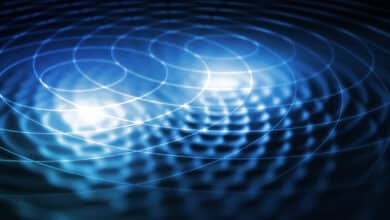
Schrödinger’s Wave Equation
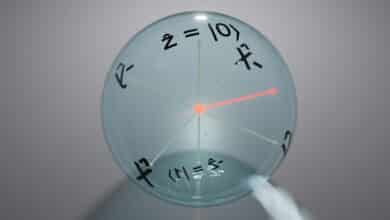
Schrödinger’s equation is essentially the master instruction set for quantum systems – the quantum-world analogue of Newton’s famous F=ma in classical physics. In short, Schrödinger’s equation is to quantum mechanics what Newton’s second law is to classical mechanics: a fundamental law of motion describing how a physical system will change…
Read More » -
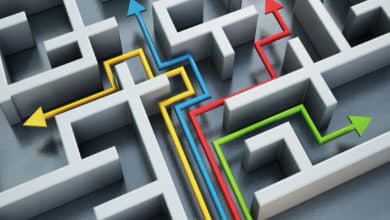
Beyond “Many Paths at Once”: The True Power of Quantum Computers
Quantum computers are often described with a mind-bending metaphor: they explore multiple paths simultaneously to find an answer. You might have heard people excitedly say that a quantum computer can "try all solutions at once" thanks to quantum magic. This popular explanation isn’t exactly wrong - it’s a handy metaphor…
Read More » -
What’s the Deal with Quantum Computing: Simple Introduction
Quantum computing holds the potential to revolutionize fields where classical computers struggle, particularly in areas involving complex quantum systems, large-scale optimization, and cryptography. The power of quantum computing lies in its ability to leverage the principles of quantum mechanics—superposition and entanglement—to perform certain types of calculations much more efficiently than…
Read More » -
Feynman and the Early Promise of Quantum Computing
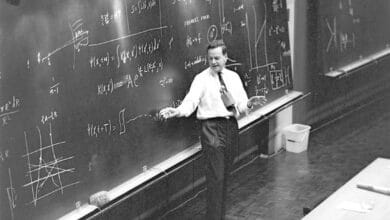
In the early 1980s, the legendary physicist Richard Feynman imagined a new kind of computer - one that operates on the weird rules of quantum mechanics rather than classical physics. Frustrated by how clumsy ordinary computers were at simulating the subatomic world, Feynman famously declared: “Nature isn’t classical, dammit, and…
Read More » -
Quantum Parallelism in Quantum Computing: Demystifying the “All-at-Once” Myth
Quantum parallelism is often described in almost mystical terms – exponential computations happening in parallel in the multiverse! – but as we’ve explored, it boils down to the concrete physics of superposition and interference. A quantum computer superposes many states and processes them together, leveraging the wave-like nature of quantum…
Read More » -
Why Do Quantum Computers Look So Weird?
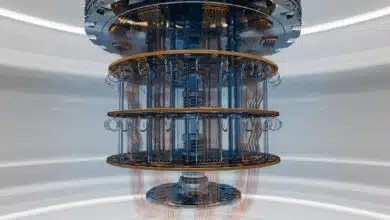
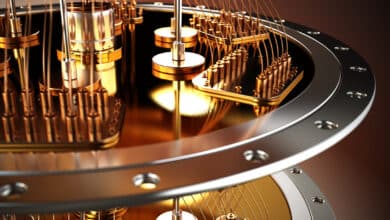
The intricate giant chandelier of copper tubes, wires, and shielding often leaves people puzzled and curious. This image of a quantum computer is quite striking and unlike any classical computer we've seen before. This unique appearance is not just for show; it's a direct result of the specific technological requirements…
Read More » -
Quantum Computing Use Cases
In the early 1900s, when theoretical physicist Max Planck first introduced the idea of quantized energy levels, he probably didn’t foresee his work eventually leading to machines that could solve problems faster than a caffeine-fueled mathematician on a deadline. Legend has it that Planck embarked on his quantum journey after…
Read More » -
A Comprehensive Guide to Quantum Gates
In quantum computing, the role of logic gates is played by quantum gates – unitary transformations on one or more qubits. These are the elementary “moves” that a quantum computer can perform on quantum data. Just as classical gates compose to implement arbitrary Boolean functions, quantum gates compose to implement…
Read More » -
Quantum Fourier Transform (QFT)
Quantum Fourier Transform (QFT), like a physical Fourier transform, takes a time-domain wave and represents it in the frequency domain. In the quantum case, the “time-domain” is the computational basis amplitude distribution, and the “frequency-domain” is another basis where the basis states correspond to different phase gradients across the original…
Read More » -
Hadamard Gate: The Gateway to Superposition
The Hadamard gate takes a qubit and puts it into an equal superposition of “0” and “1” (with a relative phase of + or -). It has a simple matrix but a profound impact: it enables parallelism and interference in quantum algorithms. Historically rooted in Hadamard matrices from mathematics, it…
Read More » -
Quantum Superposition: How Qubits Live in Many States at Once
Quantum computing promises to solve problems that stump even the fastest classical supercomputers. At the heart of this promise is a mind-bending phenomenon: quantum superposition. In simple terms, superposition allows quantum bits—or qubits—to occupy multiple states at the same time, unlike ordinary bits which are firmly either 0 or 1.…
Read More »