Quantum Computing
PostQuantum.com – Industry news and blog on Quantum Computing, Quantum Security, PQC, Post-Quantum, Quantum Tech
-

China’s Quantum Computing Hardware: The Core Capability the West Keeps Misjudging
The published record suggests China trails the US by about a year. The actual gap may be narrower — or it may already be closed. In December 2025, a team at the University of Science and Technology of China quietly posted a paper to Physical Review Letters demonstrating something only…
Read More » -
China’s Hefei National Laboratory: The Nerve Center of a Quantum Superpower
On April 26, 2016, Xi Jinping walked into USTC's Advanced Technology Research Institute in Hefei and listened to a physicist named Pan Jianwei describe the future of quantum information science. What Xi said next — "Very promising, very important… the country will definitely support this" — set in motion the…
Read More » -
The $15.3 Billion Number That Everyone Cites and Nobody Can Verify
In October 2023, I was on a call with a European defense ministry official who wanted to discuss quantum threats. Within the first five minutes, he cited it. "China has invested $15.3 billion in quantum technology - nearly double the EU and four times the United States." He said it…
Read More » -
The CRQC Scorecard: How Close Is Each Quantum Modality to Breaking Your Encryption?
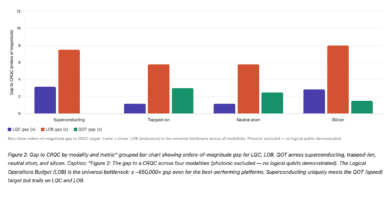
Yesterday, two papers landed that set social media on fire. Google Quantum AI published a landmark resource estimate showing that fewer than 500,000 superconducting qubits could break Bitcoin's elliptic curve cryptography in under nine minutes. Hours later, a team from Oratomic, Caltech, and UC Berkeley — including some of the…
Read More » -
The Dark Horse: How Silicon Quietly Assembled Every Building Block for Fault-Tolerant Quantum Computing
The quantum computing modality race has had a clear narrative for most of the past decade. Superconducting qubits were the frontrunners — Google's quantum supremacy demonstration in 2019, IBM's steadily growing processor roadmap, the first below-threshold surface code results in 2024. Trapped ions were the precision contenders — the highest…
Read More » -
Three Bets on Silicon: Donor Qubits, Quantum Dots, and the Foundry Path Compared
When people say "silicon quantum computing," they often speak as if it is one thing. It is not. It is at least three distinct approaches, built on the same material but employing different physics, different fabrication methods, and different strategies for reaching fault-tolerant scale. Understanding these differences — and the…
Read More » -
China’s Quantum OS Play: Origin Pilot and the Battle for the Integration Layer
China's Origin Pilot isn't just another quantum SDK — it's a top-down systems integration layer that challenges the West's bottom-up approach to quantum open architecture.
Read More » -
Quantum Low-Density Parity-Check (qLDPC) Codes
Quantum Low-Density Parity-Check (qLDPC) codes are an emerging class of quantum error-correcting codes that promise to significantly reduce the overhead required for fault-tolerant quantum computing. Much like their classical LDPC counterparts, qLDPC codes are defined by sparse parity-check constraints: each check (stabilizer) acts on only a small number of qubits,…
Read More » -
Engineering the Quantum Operating System (OS) Stack: From Nanosecond Pulse Control to System-Level Orchestration
The argument for quantum computing's "PC moment" has become surprisingly compelling. QuantWare ships superconducting QPUs to customers in 22 countries. Qblox sells modular control stacks to over 100 labs. Bluefors has installed 1,800 cryogenic systems worldwide. The Quantum Open Architecture movement and reference designs like the Quantum Utility Block are…
Read More » -
Quantum Open Architecture (QOA): The “PC Moment” of Quantum Computing
Today, a sea change is underway. Quantum Open Architecture (QOA) is doing for quantum computing what the PC revolution did for classical computing - opening up the ecosystem. Just as the computing world shifted from monolithic mainframes to modular PCs with swappable parts, quantum tech is embracing modularity and specialization.…
Read More » -
Silicon’s Hidden Advantage: How Biased Noise Could Slash the Cost of Quantum Error Correction
When people say "silicon quantum computing," they often speak as if it is one thing. It is not. It is at least three distinct approaches, built on the same material but employing different physics, different fabrication methods, and different strategies for reaching fault-tolerant scale. Understanding these differences — and the…
Read More » -
What It Takes to Build a Quantum Computer: Mapping the Hidden Supply Chains Behind Every Modality
A map of the hidden supply chains behind every major quantum computing modality — and a guide to where value, risk, and strategic leverage actually sit. The headlines go to the companies designing quantum processors, but behind every qubit sits an ecosystem of enabling technologies without which the processor is…
Read More » -
How the EU Can Capture the Benefits of Quantum Computing
The European Union has entered the global quantum race with determination - aiming not just to excel in research, but to translate breakthroughs into economic and strategic benefits. In July 2025, the European Commission unveiled the Quantum Europe Strategy, a roadmap to make Europe a “quantum industrial powerhouse” by 2030.…
Read More » -
Experimental Quantum Error Correction Below Threshold
When Harvard’s neutral-atom team quietly dropped their new paper on a fault-tolerant architecture for universal quantum computation, a few days ago, it felt like the field had crossed an invisible line. For years we’ve had impressive pieces of the puzzle - better qubits here, a clever code there, some elegant…
Read More » -
A Quantum Contrarian Con Artist
In the growing spotlight on quantum technology, a new kind of opportunist is taking the stage - the contrarian con artist. These are not the honest skeptics who ask hard questions in good faith. They are bad-faith actors cloaking themselves in “skepticism” to hijack the discourse around quantum computing and…
Read More »