Quantum Computing
Quantum computing hardware, modalities, architectures, companies, roadmaps, ecosystem dynamics, commercialization, and the path from NISQ experiments to fault-tolerant machines.
-

What’s the Deal with Quantum Computing: Simple Introduction
Quantum computing holds the potential to revolutionize fields where classical computers struggle, particularly in areas involving complex quantum systems, large-scale optimization, and cryptography. The power of quantum computing lies in its ability to leverage the principles of quantum mechanics—superposition and…
Read More » -
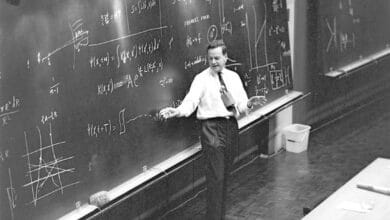
Feynman and the Early Promise of Quantum Computing
In the early 1980s, the legendary physicist Richard Feynman imagined a new kind of computer - one that operates on the weird rules of quantum mechanics rather than classical physics. Frustrated by how clumsy ordinary computers were at simulating the…
Read More » -
Quantum Parallelism in Quantum Computing: Demystifying the “All-at-Once” Myth
Quantum parallelism is often described in almost mystical terms – exponential computations happening in parallel in the multiverse! – but as we’ve explored, it boils down to the concrete physics of superposition and interference. A quantum computer superposes many states…
Read More » -
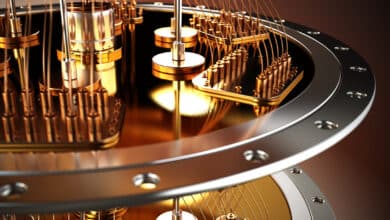
Why Do Quantum Computers Look So Weird?
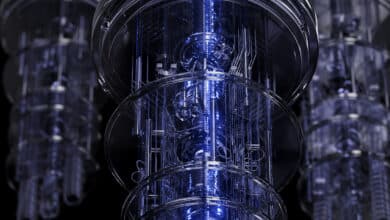
The intricate giant chandelier of copper tubes, wires, and shielding often leaves people puzzled and curious. This image of a quantum computer is quite striking and unlike any classical computer we've seen before. This unique appearance is not just for…
Read More » -
Quantum Computing Use Cases
In the early 1900s, when theoretical physicist Max Planck first introduced the idea of quantized energy levels, he probably didn’t foresee his work eventually leading to machines that could solve problems faster than a caffeine-fueled mathematician on a deadline. Legend…
Read More » -
A Comprehensive Guide to Quantum Gates
In quantum computing, the role of logic gates is played by quantum gates – unitary transformations on one or more qubits. These are the elementary “moves” that a quantum computer can perform on quantum data. Just as classical gates compose…
Read More » -
Quantum Fourier Transform (QFT)
Quantum Fourier Transform (QFT), like a physical Fourier transform, takes a time-domain wave and represents it in the frequency domain. In the quantum case, the “time-domain” is the computational basis amplitude distribution, and the “frequency-domain” is another basis where the…
Read More » -
Hadamard Gate: The Gateway to Superposition
The Hadamard gate takes a qubit and puts it into an equal superposition of “0” and “1” (with a relative phase of + or -). It has a simple matrix but a profound impact: it enables parallelism and interference in…
Read More » -
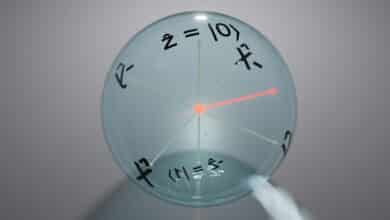
Quantum Superposition: How Qubits Live in Many States at Once
Quantum computing promises to solve problems that stump even the fastest classical supercomputers. At the heart of this promise is a mind-bending phenomenon: quantum superposition. In simple terms, superposition allows quantum bits—or qubits—to occupy multiple states at the same time,…
Read More » -
Colliding Waves: How Quantum Interference Powers Quantum Computing
Quantum interference remains the cornerstone of quantum computing’s promise. It’s the feature that distinguishes quantum computation from just a random quantum jumble. A quantum computer is not powerful simply because it can have many states at once – if that…
Read More » -
Understanding “Polynomial Time” – Why Faster Algorithms Matter
Quantum computing has emerged as a new frontier of great-power competition in the 21st century. Nations around the world view advanced quantum technologies as strategic assets—keys to future economic prowess, military strength, and technological sovereignty. Governments have already poured over…
Read More » -
Key Principles and Theorems in Quantum Computing and Networks
The landscape of quantum computing and quantum networks is an exciting frontier where physics and cybersecurity intersect. We’re witnessing the early days of this quantum revolution. As quantum hardware scales and quantum protocols move from labs to real-world deployment, security…
Read More » -
Qubits: A Brief Introduction for Cybersecurity Professionals
A qubit is the quantum analog of a classical bit – it’s the basic unit of quantum information. However, unlike a classical bit that can only be 0 or 1 at any given time, a qubit can exist in a…
Read More » -
Bell States: An Introduction for Cybersecurity Professionals
Bell states are a set of four specific quantum states of two qubits (quantum bits) that are entangled. In simple terms, an entangled pair of qubits behaves as one system, no matter how far apart they are. Bell states are…
Read More » -
Kuperberg’s Algorithm and its Impact on Post-Quantum Cryptography (PQC)
Kuperberg’s algorithm is an impressive quantum algorithmic achievement that expands the boundary of what quantum computers might do beyond the original realm of Shor’s algorithm. It demonstrates that even some non-trivial group problems (like the dihedral hidden subgroup problem) are…
Read More »