Quantum Computing
Quantum computing hardware, modalities, architectures, companies, roadmaps, ecosystem dynamics, commercialization, and the path from NISQ experiments to fault-tolerant machines.
-

Cat Qubits 101
Bosonic “cat qubits” are quantum bits encoded in the states of bosonic oscillators (e.g. modes of a microwave cavity) that resemble Schrödinger’s famous alive/dead cat superposition. Instead of relying on a single two-level quantum element, a cat qubit stores information…
Read More » -
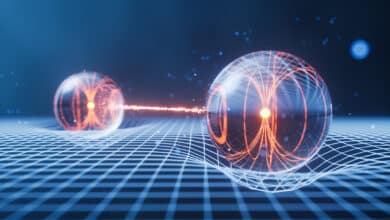
Quantum Entanglement: The “Spooky” Glue Uniting Qubits and Beyond
From enabling quantum supercomputers to securing communications and teleporting quantum states, entanglement is the thread weaving through all of quantum technology. What once struck Einstein as a paradox is today routinely observed and harnessed in labs – the “spooky action”…
Read More » -
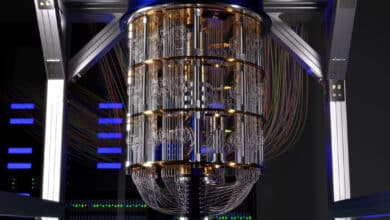
Transmon Qubits 101
Transmon qubits are a type of superconducting qubit designed to mitigate charge noise by shunting a Josephson junction with a large capacitor. In other words, a transmon is a superconducting charge qubit that has reduced sensitivity to charge fluctuations. The…
Read More » -
Glossary of Quantum Computing Terms
Glossary of Quantum Computing, Quantum Networks, Quantum Mechanics, and Quantum Physics Terms for Cybersecurity Professionals.
Read More » -
Information-Triggered Collapse (ITC): An Information-Theoretic Approach to Wavefunction Reduction
We propose a new theoretical framework, Information-Triggered Collapse (ITC), which suggests that quantum wavefunction collapse occurs when the information content or complexity of a quantum system and its environment reaches a critical threshold. This idea is motivated by the growing…
Read More » -
Lattice Surgery
Quantum computing promises to solve complex problems far beyond the reach of classical machines, but today's quantum hardware is plagued by short-lived qubits and error rates that make long computations infeasible. Quantum error correction (QEC) is essential to stabilize qubits…
Read More » -
Adiabatic Quantum Computing (AQC) and Impact on Cyber
Adiabatic Quantum Computing (AQC), and its variant Quantum Annealing, are another model for quantum computation. It's a specialized subset of quantum computing focused on solving optimization problems by finding the minimum (or maximum) of a given function over a set…
Read More » -
Routing Quantum Information: SWAP, iSWAP, and Moving Qubit States
Quantum computers face a unique challenge in moving quantum information between qubits. Unlike classical bits that can be shuttled freely along wires, qubits cannot be arbitrarily copied or moved due to the no-cloning theorem. To route a qubit’s state from…
Read More » -
Surface Code Quantum Error Correction
Quantum error correction (QEC) is indispensable for building large-scale fault-tolerant quantum computers. Even today’s best qubits suffer error rates that would quickly corrupt any long calculation if left uncorrected. The principle of QEC is to encode a single logical qubit…
Read More » -
Quantum Supremacy vs. Quantum Advantage
In the ever-accelerating world of quantum computing, two terms have emerged as the darlings of headlines and conference keynotes: quantum supremacy and quantum advantage. If you've followed the news, you might think they're interchangeable buzzwords celebrating the dawn of a…
Read More » -
Early History of Quantum Computing
Since the early 2000s, the field of quantum computing has seen significant advancements, both in technological development and in commercialization efforts. The experimental demonstration of Shor's algorithm in 2001 proved to be one of the key catalyzing events, spurring increased…
Read More » -
The Controlled-NOT (CNOT) Gate in Quantum Computing
The CNOT gate is to quantum circuits what the XOR gate is to classical circuits: a basic building block for complex operations. By learning how the CNOT gate works and why it matters, cybersecurity experts can better appreciate how quantum…
Read More » -
Random Circuit Sampling (RCS) Benchmark
At its core, Random Circuit Sampling (RCS) is a way to test how well a quantum computer can generate the output of a complex quantum circuit. Compare the results to what an ideal quantum computer should produce. If the quantum…
Read More » -
Schrödinger’s Wave Equation
Schrödinger’s equation is essentially the master instruction set for quantum systems – the quantum-world analogue of Newton’s famous F=ma in classical physics. In short, Schrödinger’s equation is to quantum mechanics what Newton’s second law is to classical mechanics: a fundamental…
Read More » -
Beyond “Many Paths at Once”: The True Power of Quantum Computers
Quantum computers are often described with a mind-bending metaphor: they explore multiple paths simultaneously to find an answer. You might have heard people excitedly say that a quantum computer can "try all solutions at once" thanks to quantum magic. This…
Read More »