CRQC Capability Framework
What does it actually take to build a quantum computer that breaks cryptography? This series maps the nine capabilities — from error correction to continuous operation — that must converge for a CRQC to become real, then scores each modality’s progress, estimates the total cost, and quantifies the energy required.
-

The CRQC Scorecard: How Close Is Each Quantum Modality to Breaking Your Encryption?
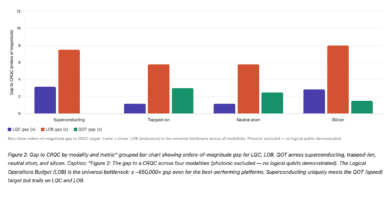
Yesterday, two papers landed that set social media on fire. Google Quantum AI published a landmark resource estimate showing that fewer than 500,000 superconducting qubits could break Bitcoin's elliptic curve cryptography in under nine minutes. Hours later, a team from…
Read More » -
What It Will Actually Cost to Break RSA-2048: Energy, Hardware, People, and the Bill Nobody’s Talking About
Breaking one RSA-2048 key on a CRQC could cost $2–5 million when you add up energy, amortization, personnel, and facilities All three approaches share silicon's core advantages: compatibility with semiconductor industry infrastructure, small qubit footprint (~50 nm), and long coherence…
Read More » -
The Enormous Energy Cost of Breaking RSA‑2048 with Quantum Computers
The energy requirements for breaking RSA-2048 with a quantum computer underscore how different the post-quantum threat is from conventional hacking. It’s not just about qubits and math; it’s about megawatts, cooling systems, and power grids. Today, that reality means only…
Read More » -
Capability E.1: Engineering Scale & Manufacturability
Building a cryptography-breaking quantum computer (often dubbed Q-Day) will demand far more than just better algorithms or a few more qubits. It requires a massive scale-up in engineering - reaching hundreds of thousands or even millions of physical qubits -…
Read More » -
Capability B.4: Qubit Connectivity & Routing Efficiency
Qubit connectivity refers to which qubits can interact directly (perform two-qubit gates) with each other. This is often visualized as a connectivity graph: each node is a qubit, and an edge between two nodes means those qubits can be coupled…
Read More » -
Cryptographically Relevant Quantum Computers (CRQCs)
Cryptographically Relevant Quantum Computers (CRQCs) represent a seismic shift on the horizon of cybersecurity. In this article, we’ve seen that CRQCs are defined by their ability to execute quantum algorithms (like Shor’s and Grover’s) at a scale that breaks the…
Read More » -
The CRQC Quantum Capability Framework
This guide is a detailed, end‑to‑end map for understanding what it will actually take to reach a cryptographically relevant quantum computer (CRQC), i.e. break RSA-2048 - not just headline qubit counts. A CRQC must meet two conditions: the algorithmic requirements…
Read More » -
Capability D.3: Continuous Operation (Long-Duration Stability)
One of the most critical requirements for a cryptographically relevant quantum computer (CRQC) is continuous operation - the ability to run a complex quantum algorithm non-stop for an extended period (on the order of days) without losing quantum coherence or…
Read More » -
Capability D.1: Full Fault-Tolerant Algorithm Integration
Imagine a quantum computer that can execute an entire algorithm start-to-finish with errors actively corrected throughout. Full fault-tolerant algorithm integration is exactly that: the orchestration of all components - stable logical qubits, high-fidelity gates, error-correction cycles, ancilla factories, measurements, and…
Read More » -
Capability D.2: Decoder Performance (Real‑Time Error Correction Processing)
In a fault-tolerant quantum computer, qubits are continuously monitored via stabilizer measurements (producing “syndrome” bits) to detect errors. The decoder is a classical algorithm (running on specialized hardware) that takes this rapid stream of syndrome data and figures out which…
Read More » -
Capability C.2: Magic State Production & Injection (Non-Clifford Gates)
Magic states are an essential “extra ingredient” for universal quantum computing, often metaphorically likened to a magic catalyst enabling otherwise impossible operations. Quantum algorithms require not only robust qubits and error correction, but also a way to perform non-Clifford gates…
Read More » -
Capability C.1: High-Fidelity Logical Clifford Gates
Cryptographically Relevant Quantum Computers (CRQCs) will rely on a suite of core capabilities - and high-fidelity logical Clifford gates are among the most essential. This capability refers to performing the fundamental set of quantum logic operations (the Clifford gates: Pauli…
Read More » -
Capability B.3: Below-Threshold Operation & Scaling
“Below-threshold operation” refers to running a quantum processor at error rates below the critical threshold of a quantum error-correcting code. In simple terms, there is a tipping point in error rates: if each quantum gate and qubit has an error…
Read More » -
Capability B.2: Syndrome Extraction (Error Syndrome Measurement)
Quantum syndrome extraction - also called error syndrome measurement - is the process of measuring collective properties of qubits to detect errors without destroying the encoded quantum information. It is essentially the sensor mechanism of a quantum error-correcting code, analogous…
Read More » -
Capability B.1: Quantum Error Correction (QEC)
Quantum Error Correction (QEC) is the first and arguably most critical capability in the roadmap toward a cryptographically relevant quantum computer (CRQC). Without QEC, a large-scale quantum computer cannot reliably perform the billions of operations needed to break modern encryption…
Read More »