Deep Dive Series
Predicting Q-Day
When will a quantum computer first break the public-key cryptography that underpins digital trust? Expert predictions range from “already happened in a classified lab” to “never” — and the honest truth is that nobody knows. Q-Day prediction is uniquely hard because it depends on simultaneous breakthroughs across qubit quality, error correction, algorithmic efficiency, control systems, and classical infrastructure. Progress must converge across all of them before a cryptographically relevant quantum computer becomes operational.
This Deep Dive series brings rigor and intellectual honesty to a topic that generates more heat than light. It covers what Q-Day actually is and why it’s a confidence crisis rather than an outage, how to think about prediction using the CRQC Readiness Benchmark rather than expert guesses, and why — paradoxically — the exact date may matter less than you think, because regulators, insurers, and clients have already set deadlines that are closer and more certain than any quantum timeline. The capstone article provides the full narrative arc; the individual articles and the interactive Q-Day Estimator tool go deeper on each dimension.
-

When will a quantum computer break RSA and ECC? Expert predictions range from "already happened in a classified lab" to "never" — and the honest truth is that nobody knows. Q-Day prediction is hard because it depends on simultaneous breakthroughs across multiple domains: qubit quality, error correction, algorithmic efficiency, control systems, and classical infrastructure. Progress must converge across all of them before a cryptographically relevant quantum computer becomes operational. This Deep Dive series brings rigor and intellectual honesty to a topic that generates more heat than light. It covers three layers: what Q-Day actually is and why it matters (including why it's a confidence crisis, not an outage), how to think about predicting it using the CRQC Readiness Benchmark framework (three metrics: Logical Qubit Capacity, Logical Operations Budget, and Quantum Operations Throughput) rather than expert guesses, and why — paradoxically — the exact date may matter less than you think, because regulators, insurers, investors, and clients have already set deadlines that are closer and more certain than any quantum timeline.
Read More »
-
Post-Quantum, PQC, Quantum Security

Q-FUD: The Quantum Panic Industry
Cybersecurity has always had a FUD problem. “FUD” (fear, uncertainty, and doubt) is the oldest trick in enterprise security marketing: paint a worst-case scenario, imply you’re already compromised, sprinkle in enough jargon to make the buyer feel outgunned, and then offer the “only” solution - conveniently available this quarter. Q‑FUD is that same playbook, just dressed in quantum vocabulary. Why is Q‑FUD uniquely toxic? Because…
Read More » -
Post-Quantum, PQC, Quantum Security
Q-Day Isn’t an Outage – It’s a Confidence Crisis
Cybersecurity lore often paints Q-Day (the moment a quantum computer cracks RSA/ECC encryption) as an instant "Quantum Apocalypse" where every system gets hacked immediately. Planes falling from the sky, banks drained in seconds, an overnight digital Armageddon - if that nightmare doesn’t happen, some assume Q-Day wasn’t so bad after all. But this view misses a crucial point. The real catastrophe of Q-Day isn’t that…
Read More » -
Q-Day
Forget Q-Day Predictions – Regulators, Insurers, Investors, Clients Are Your New Quantum Clock
Whether you personally believe Q-Day will come in 5 years or 50, the world around you isn’t taking chances - and neither can you. As a CISO, you’re now being implicitly (and sometimes explicitly) told by every corner of your ecosystem that quantum preparedness is mandatory. Regulators demand it via hard deadlines. Key clients and partners demand it in contracts and RFPs. Insurers will soon…
Read More » -
Q-Day
How You, Too, Can Predict Q-Day (Without the Hype)
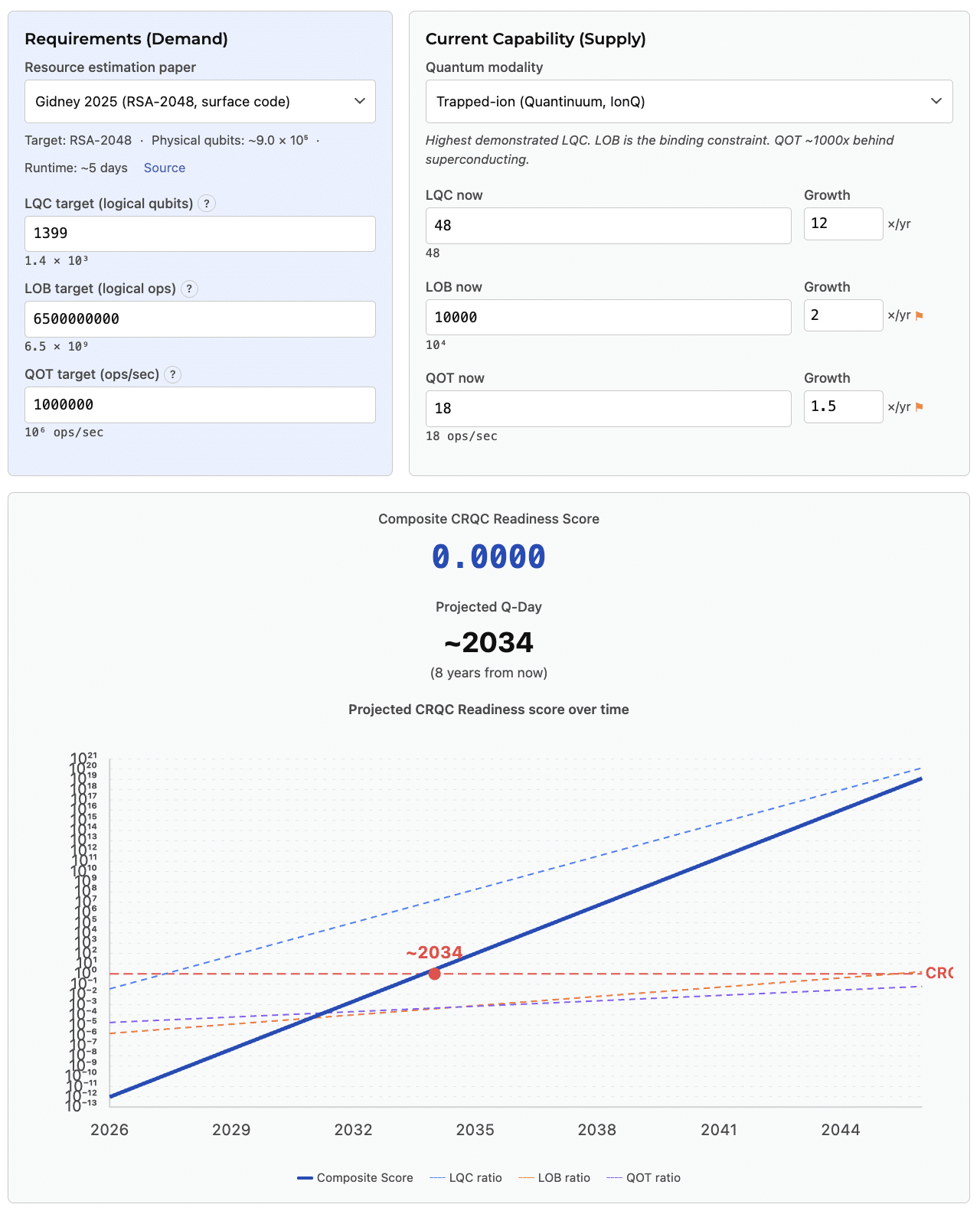
For three decades, Q-Day has been “just a few years away.” I want to show you how to make your own informed prediction on when Q-Day will arrive. Counting physical qubits by itself is misleading. To break RSA you need error‑corrected logical qubits, long and reliable operation depth, and enough throughput to finish within an attack‑relevant time window.
Read More » -
Q-Day
The Trouble with Quantum Computing and Q-Day Predictions
The trouble with quantum computing predictions so far has been that too many have been more speculation than science, more influenced by bias than by balanced analysis. We have the tools and knowledge to do better. By embracing a data-driven, scenario-based approach, we can turn timeline forecasting from a source of confusion into a valuable planning aid.
Read More » -
Post-Quantum, PQC, Quantum Security
CRQC Readiness Benchmark – Benchmarking Quantum Computers on the Path to Breaking Cryptography
Benchmarking quantum capabilities for cryptography is both critical and challenging. We can’t rely on any single metric like qubit count to tell us how near we are to breaking RSA-2048. A combination of logical qubit count, error-corrected circuit depth, and operational speed must reach certain thresholds in unison. Existing benchmarks – Quantum Volume, Algorithmic Qubits, etc. – each address parts of this, but a CRQC-specific…
Read More » -
Q-Day
Q-Day Revisited – RSA-2048 Broken by 2030: Detailed Analysis
It’s time to mark a controversial date on the calendar: 2030 is the year RSA-2048 will be broken by a quantum computer. That’s my bold prediction, and I don’t make it lightly. In cybersecurity circles, the countdown to “Q-Day” or Y2Q (the day a cryptographically relevant quantum computer cracks our public-key encryption) has been a topic of intense debate. Lately, the noise has become deafening:…
Read More » -
Q-Day
What Is Q-Day (Y2Q)?
Q-Day, sometimes called “Y2Q” or the “Quantum Apocalypse”, refers to the future moment when a quantum computer becomes powerful enough to break modern encryption algorithms. In other words, it’s the day a cryptographically relevant quantum computer (CRQC) can crack the public-key cryptography (like RSA or ECC) that underpins our digital security. The term “Y2Q” stands for “years to quantum,” an explicit nod to the Y2K…
Read More » -
Q-Day
What Will Really Happen Once Q-Day Arrives – When Our Current Cryptography Is Broken?
As the world edges closer to the era of powerful quantum computers, experts warn of an approaching “Q-Day” (sometimes called Y2Q or the Quantum Apocalypse): the day a cryptographically relevant quantum computer can break our current encryption. Unlike the Y2K bug—which had a fixed deadline and was mostly defused before the clock struck midnight—Q-Day won’t announce itself with a clear date or time. We won’t…
Read More » -
Q-Day
Q-Day Predictions: Anticipating the Arrival of CRQC
While CRQCs capable of breaking current public key encryption algorithms have not yet materialized, technological advancements are pushing us towards what is ominously dubbed 'Q-Day'—the day a CRQC becomes operational. Many experts believe that Q-Day, or Y2Q as it's sometimes called, is just around the corner, suggesting it could occur by 2030 or even sooner; some speculate it may already exist within secret government laboratories.
Read More » -
Q-Day
Q-Day (Y2Q) vs. Y2K
In the late 1990s, organizations worldwide poured time and money into exorcising the “millennium bug.” Y2K remediation was a global scramble. That massive effort succeeded: when January 1, 2000 hit, planes didn’t fall from the sky and power grids stayed lit. Ever since, Y2K has been held up as both a model of proactive risk management and, paradoxically, a punchline about overhyped tech doomsaying. Today,…
Read More »