Citi’s Quantum Threat Report: The Trillion-Dollar Security Race in Focus

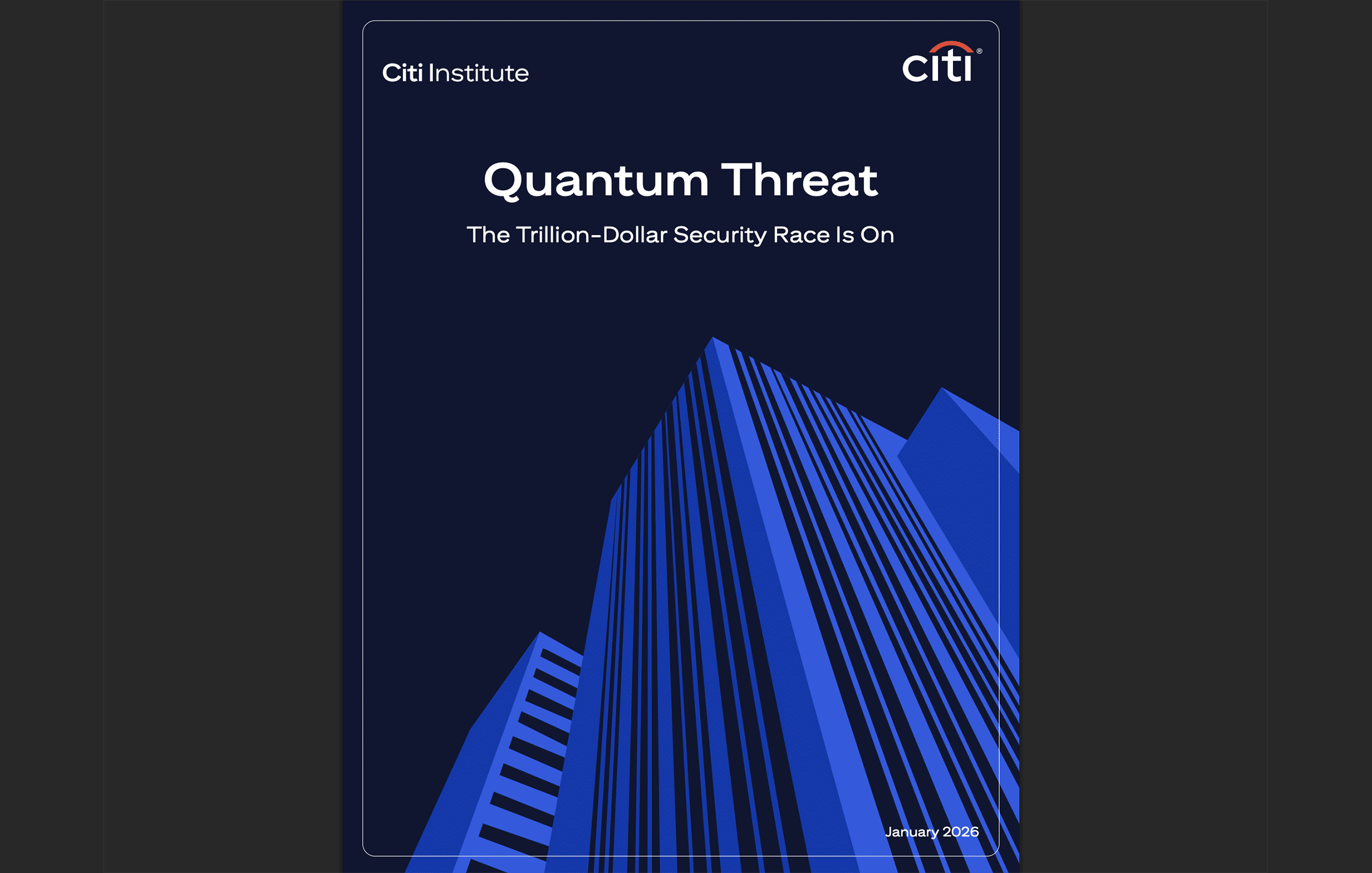
Table of Contents
18 Jan 2026 – The Citi Institute – a research arm of global banking giant Citigroup – published a stark warning titled “Quantum Threat: The Trillion-Dollar Security Race Is On.” In unequivocal terms, Citi’s analysts predict that within the next decade quantum computers are likely to become powerful enough to break widely used public-key encryption. They caution that the economic and geopolitical fallout of an unprepared “Q-Day” – the day a quantum computer shatters our current cryptography – could be severe, disrupting the digital security we take for granted across finance, government, and critical infrastructure.
It’s not every day that a major financial institution frames a technology risk in terms of trillions of dollars and national security, which is why this report is turning heads far beyond the IT departments. Citi’s message: the quantum threat is no longer just a theoretical discussion for academics and engineers, but a tangible business and security risk that demands boardroom attention.
What makes Citi’s frank assessment so significant is the messenger itself. When a bank of Citi’s stature declares that the countdown to Q-Day is on, people listen. Having spent over a decade in the trenches of quantum-safe security, I see this as an important moment – a sign that quantum risk has gone mainstream in the consciousness of institutional finance.
How Soon is Q-Day? Citi’s Timeline for Quantum Codebreaking
Central to Citi’s analysis is the question: when will a cryptographically relevant quantum computer (CRQC) arrive? The report surveys expert forecasts and even a prediction market to bracket the timelines. One data point comes from a Kalshi Inc. survey (a public prediction market), where roughly 8% of respondents expect a “useful” quantum computer (i.e. one capable of cracking RSA-2048 encryption or complex molecular simulations) by 2027, rising to 39% by 2030 and just over 50% by 2035. In other words, there’s essentially a coin-flip chance that we’ll hit Q-Day within the next ~10 years – and a non-trivial chance it could happen even sooner.
Citi also cites research from the Global Risk Institute (GRI) which paints an even starker long-range picture: by 2034, experts peg the probability of quantum computers breaking public-key encryption at 19–34%, and those odds spike to 60–82% by 2044.
In plain English, there is a very real possibility that the cryptography underpinning today’s digital world could crumble within the next decade or two. And critically, as Citi notes, there may be no early warning when this happens – a government or adversary achieving a breakthrough might keep it secret to exploit it as long as possible. “The real Q-day may occur before the world becomes aware of it, as states or bad actors seek to use this knowledge to their strategic advantage,” the report warns. Indeed, the first quantum-enabled breaches might only be discovered after the fact, when troves of previously secure data are suddenly decrypted. The mere uncertainty of the timeline – much like a ticking time bomb with an unknown fuse length – is itself part of the threat, and Citi uses it to urge action now, before the “boom.” (For background on the concept of Q-Day, see the explainer on Q-Day.org, which tracks predictions and preparedness for this cryptographic doomsday.)
Economic Stakes: Trillions on the Line
Why does Citi call this a “trillion-dollar” security race? Because the financial risks posed by a large-scale quantum cyberattack are almost unimaginably high. The report doesn’t shy away from quantifying worst-case scenarios. One cited study modeled a single-day quantum attack on one of the five largest U.S. banks – specifically, an attack aimed at disabling or corrupting its connections to Fedwire (the Federal Reserve’s interbank payment network). The outcome was dire: such an attack could trigger a cascading financial crisis with an estimated $2.0–3.3 trillion in indirect economic damage (GDP at risk), equivalent to a 10–17% drop in U.S. GDP over a subsequent six-month recession. To put that in perspective, that’s on the order of the Great Recession or worse, caused by a single cyber event. It’s a scenario so extreme it almost sounds like science fiction, yet Citi treats it with sober analysis – underscoring that quantum-enabled attacks could fundamentally threaten financial stability.
And that’s just one sector. The broader message is that every industry built on digital trust is vulnerable. If malicious actors harness quantum codebreaking, no encrypted secret would be safe – whether it’s the integrity of financial transactions, the confidentiality of medical records, or the privacy of our communications. Citi explicitly calls out the geopolitical dimension of this threat: the first nation or group to build a powerful cryptanalytic quantum computer would gain a massive intelligence and cyber advantage. Encrypted military and diplomatic traffic from rival states could be unscrambled at will, tipping the scales in espionage and conflict. “Nations or organizations that achieve a cryptographically relevant quantum capability first will gain disproportionate intelligence and defense advantages,” the report notes, exposing other countries’ secrets and potentially upending the global balance of power. In essence, encryption is a pillar of modern civilization – and Q-Day is often likened to a seismic event that could shake that pillar at its foundation. Citi’s contribution here is translating that abstract risk into concrete (and alarming) dollar figures and strategic stakes.
Bitcoin and Blockchains: 25% of a Half-Trillion at Risk
Citi’s report also shines a light on the implications for cryptocurrencies and blockchain systems – an area sometimes overlooked in mainstream cyber discussions. The headline statistic is attention-grabbing: roughly 25% of all Bitcoins in circulation (about 4.5–6.7 million BTC, worth on the order of $500–600 billion today) are “quantum-exposed,” meaning their public keys have already been revealed on the blockchain and would be vulnerable to quantum attack. In Bitcoin’s early years, many addresses were of a type (Pay-to-Public-Key outputs) that left the public key openly visible after a transaction; those coins – including, likely, Satoshi Nakamoto’s legendary early stash – could theoretically be stolen by anyone with a future quantum computer powerful enough to derive the private keys from those public keys. While newer Bitcoin addresses use hashed public keys (making them safer until they’re spent and revealed), Citi’s point is that a quarter of this digital goldmine is sitting behind glass, awaiting a quantum-enabled thief.
And Bitcoin is actually better off than many other blockchains in this respect. In other (especially newer) cryptocurrencies, the majority of coins might be vulnerable, since their protocols or smart contract systems expose public keys more frequently by design. The report implies that blockchains like Ethereum and Solana, for instance, have a higher share of addresses that could be cracked once a quantum computer is online. The silver lining, Citi notes, is that these newer platforms may have more agility to upgrade their cryptography in time (their communities can hard-fork or adopt new signature schemes more readily than Bitcoin’s conservative governance might allow). In fact, several leading blockchain projects are already experimenting with post-quantum signature algorithms (like lattice-based CRYSTALS-Dilithium, Falcon, or hash-based **SPHINCS+), preparing for the day they must switch over. But making that migration is non-trivial – it requires coordinated updates to protocols, wallets, and possibly even addressing formats across a decentralized ecosystem. As an example, Bitcoin faces the conundrum of “orphaned” keys – millions of BTC held in lost or long-dormant addresses whose owners may never come back to rotate them to quantum-safe addresses. Do those coins just remain indefinitely vulnerable, or does the community attempt an unprecedented intervention? There are no easy answers. The takeaway: quantum risk isn’t just an academic worry for crypto holders – it strikes at the fundamental security model of blockchain-based assets. Or as one expert Citi quoted put it, “quantum threatens to undermine the very ideological foundation of “trustless” crypto systems if the keys and signatures can no longer be trusted“.
From Y2K to Y2Q: An Unprecedented Upgrade Challenge
How do we solve this? The good news – emphasized by Citi – is that we’re not defenseless. Post-quantum cryptography (PQC), a new suite of encryption algorithms designed to withstand quantum attacks, is emerging as a ready solution. The U.S. National Institute of Standards and Technology (NIST) has already standardized several PQC algorithms (like Kyber, Dilithium, etc.), and global standards bodies (ISO, IETF, ANSI X9, etc.) are following suit. In Citi’s words, “post-quantum cryptography is key to combatting quantum threats” – meaning we have the mathematical tools to replace vulnerable RSA and ECC encryption. The real challenge, however, is rolling these solutions out at scale. Citi plainly states that the problem is not a lack of technical solutions, but the difficulty of implementing the right solution across complex, global systems. This echoes what those of us in the field have long known: swapping out crypto under the hood of the world’s digital infrastructure is like changing the engines on a jet in mid-flight. It’s hard, it’s costly, and it needs to be done methodically to avoid breaking everything else.
One comparison the report draws is to the Y2K remediation effort of the late 1990s. Back then, businesses worldwide spent an estimated $300–600 billion (over $600 billion to $1 trillion in today’s money) updating and patching systems to handle the millennium date change. That was probably the largest coordinated software upgrade in history – until now. Citi argues that transitioning to quantum-safe crypto will dwarf Y2K in scale and complexity. Why? Because Y2K had a fixed deadline and a relatively narrow scope (mainly date-handling code in certain systems). By contrast, quantum mitigation has no firm deadline (Q-Day is uncertain) and a vastly broader scope. Essentially every device, application, and network that uses encryption or digital signatures – from web browsers and ATMs to industrial control systems and satellites – will eventually need to be upgraded or retrofitted. It’s a generational overhaul of the security fabric of the internet. As one industry veteran cited in the report put it, “Quantum computing will trigger the largest upgrade of cryptography in human history, far bigger than the Y2K transition.”
The costs and logistics of this transition are daunting. Citi notes that for a big global bank (or any large enterprise), tackling quantum readiness means touching thousands of applications and systems and likely spending years in planning, testing, and deployment. It’s not just the IT hardware and software costs, either – it’s retraining developers, re-engineering business processes, coordinating with vendors and customers, and managing the cybersecurity risks during the interim. There’s also a period – possibly a long period – where organizations will have to run “hybrid” cryptography (using classical and post-quantum algorithms side by side) to ensure compatibility. The concept of crypto-agility looms large here. Citi stresses that systems should be made crypto-agile – able to swap out cryptographic algorithms without massive upheaval. That way, if one PQC algorithm is later broken or new standards emerge, you’re not back at square one.
A Roadmap for Readiness: Citi’s Five-Point Plan
So what does Citi recommend organizations do, exactly? The latter portions of the report lay out a structured game plan for quantum readiness – one that aligns closely with what many in the cyber community (and regulators like U.S. Homeland Security and the EU’s ENISA) have been saying, but it’s powerful to see it distilled by a major bank. The core advice is that “vulnerable systems must move to quantum-safe alternatives”, and that this starts with a clear set of steps: “identify exposure, prioritize critical systems, enable agility, guide migration and sustain long-term resilience.” Those might sound like buzzwords, but Citi actually breaks them down into a concrete five-step execution plan:
- Identify – Inventory where and how you are using public-key cryptography across the organization. This means discovering all the places RSA, ECC, Diffie-Hellman, etc., are implemented (in code, in devices, in third-party software). You can’t protect what you don’t know you have – and many firms are astonished by how widespread encryption is in their systems once they start looking.
- Prioritize – Not all crypto exposure is equal. Citi urges focusing on critical systems and long-lived data first. For instance, the algorithms protecting your customers’ passwords or your core banking transactions, or anything that must remain confidential for decades (think health records or state secrets), should be at the front of the line for upgrading. Prioritization also means addressing “crypto deadlines” – systems that will still be in use 10-20 years from now (like an IoT device in a power grid) need attention now, because they must be quantum-safe long before 2030.
- Enable (Crypto-Agility) – Wherever possible, upgrade systems to be crypto-agile and implement hybrid cryptography. This might involve deploying libraries and protocols that can handle both classical and PQC algorithms in parallel (for example, using a TLS implementation that negotiates a post-quantum key exchange alongside the classical one). Crypto-agility is about future-proofing: it makes the eventual cut-over to PQC far smoother because you’re not locked into one algorithm or hard-coded solution.
- Migrate – Execute a phased migration plan to actually swap in post-quantum algorithms, spread over several years and aligned with vendor support and regulatory guidance. This step is the heavy lift: updating cryptographic libraries, certificates, protocols, and infrastructure components across the enterprise. Citi emphasizes doing this in phases – you might start with easier wins (like upgrading software libraries that already support PQC) and schedule harder problems (like replacing embedded hardware crypto) as solutions mature. Importantly, migration isn’t one-size-fits-all; it will be iterative and ongoing, much like patch management is today.
- Sustain – Once you’ve transitioned, don’t fall asleep at the wheel. You must sustain long-term resilience by continuously managing crypto keys and staying agile to swap algorithms again if needed. The post-quantum era will likely bring new threats and possibly new quantum algorithms; organizations will need ongoing processes to monitor advances (e.g. if someone cracks a PQC algorithm or a better one comes along) and roll out updates. Think of it as moving from a one-time project to an evergreen capability in the organization.
Citi also mentions some immediate steps that can be taken right now as a stop-gap: “deploy quantum-safe shields”. By this, they refer to techniques like using quantum-resistant encryption layers to wrap sensitive traffic, without fully replacing the underlying systems. For example, some companies are experimenting with adding a PQC VPN or overlay network so that even if an attacker is recording their data today, it’s already protected with a post-quantum cipher on top of the usual TLS. These network overlays can mitigate “harvest-now, decrypt-later” risks (where adversaries steal data now to decrypt when quantum arrives). It’s like an interim shield for data-in-transit while the slower work of internal migration proceeds.
Another crucial aspect Citi highlights is collaboration. No bank or company can go it alone here – the whole tech ecosystem (hardware vendors, cloud providers, software developers, telecom networks, government agencies) needs to coordinate. The report notes that emerging regulations will likely require quantum-resistant systems in certain sectors, and early compliance could actually be a competitive advantage. In my experience, engaging with vendors early – asking your cloud provider or core banking software when they’ll support PQC – is key. Citi’s voice here adds pressure on technology suppliers: if big customers like global banks demand PQC-ready products, the industry will move faster.
A Quantum Security Veteran’s Take: Why Citi’s Warning Resonates
In my personal opinion, reading Citi’s report was, in a word, validation. For years, those of us in the post-quantum community have been talking about Q-Day with a mix of urgency and admittedly, a bit of anxiety about sounding like Chicken Little. We’ve published papers, held workshops, briefed executives – often met with polite nods but also a sense that “this is tomorrow’s problem.” What Citi has done is put the weight of a major financial institution behind the message that this is today’s problem. When a bank says “trillion-dollar risk,” boards and policymakers listen in a way they might not when a professor or a startup CEO says it.
I find it especially noteworthy that the report doesn’t pull punches. It explicitly calls out that waiting for proof of a large quantum computer is not a strategy – by then it’d be too late. Something I’ve been saying for years. The emphasis on “harvest now, decrypt later” is on point: adversaries are already harvesting sensitive data under long retention, betting they can unlock it in a decade. This means a breach today could turn into full data exposure in 10 years even if the data seems safe now. Citi gets that, and they’re basically telegraphing to their peers (big banks, telecoms, governments) that we have to get ahead of this curve.
From my perspective, another important aspect is how Citi frames quantum readiness as an organizational and strategic risk, not just an IT problem. They mention emerging regulations, the need for executive programs, and even client/customer expectations. This aligns with what we see on the ground: forward-thinking organizations are establishing quantum risk committees, budgeting for crypto upgrades, and educating their workforce. I’ve been part of projects where companies conduct “quantum fire drills” – simulating what happens if tomorrow we learned a nation-state has a working cryptographic quantum computer. It may sound extreme, but it concentrates the mind on what needs to be fixed now. Citi’s five-point plan is a solid checklist to start that journey.
One area I might expand on is the human factor. Upgrading to post-quantum crypto isn’t just a tech rollout; it’s change management. We’ll need more trained cryptographers, developers familiar with new libraries, and risk managers who understand quantum threats. There’s a talent gap there, and I suspect large institutions will start competing for experts (or leaning on specialist firms) as the deadline looms. The report touches on training and multi-year programs, and I can confirm that planning for workforce and budget is crucial – it’s something many organizations underestimate until they’re in the thick of it.
Lastly, I want to highlight the tone of urgency tempered with opportunity. Yes, it’s a warning, but Citi also implicitly recognizes a chance to get ahead and even create value. The subtitle “trillion-dollar security race” hints that this is a race – meaning there will be winners, those who invest and adapt in time, and losers who fall behind. In the security community we often say “don’t waste a good crisis”; here we have a crisis foretold. The winners will be those who act early, innovate in building quantum-safe services (there’s even a nascent market for quantum-safe communications, quantum key distribution, etc.), and can assure their customers that their data will remain safe through the coming transition.
As an industry insider, I’m heartened to see a bank talk about things like crypto-agility, hybrid encryption, and even throw in references to advanced schemes in blockchain. It suggests that the dialogue between tech experts and business leaders is finally syncing up. The fact that Citi Institute’s report is publicly available and free to download means they want this knowledge spread widely, not kept for a select few. It feels a bit like the early days of cloud security or AI ethics – a realization that we need a collective effort.
Quantum Upside & Quantum Risk - Handled
My company - Applied Quantum - helps governments, enterprises, and investors prepare for both the upside and the risk of quantum technologies. We deliver concise board and investor briefings; demystify quantum computing, sensing, and communications; craft national and corporate strategies to capture advantage; and turn plans into delivery. We help you mitigate the quantum risk by executing crypto‑inventory, crypto‑agility implementation, PQC migration, and broader defenses against the quantum threat. We run vendor due diligence, proof‑of‑value pilots, standards and policy alignment, workforce training, and procurement support, then oversee implementation across your organization. Contact me if you want help.
Related Content