
Table of Contents
Quantum technologies are leaving the lab and entering the machinery of national power. In a world where advanced computing, sensing, and secure communications shape military advantage and economic competitiveness, “quantum sovereignty” is becoming a blunt strategic question: who can build, operate, trust, and control quantum capabilities — under geopolitical stress — without being cut off?
This series treats sovereignty as more than a slogan. It shows how deep physics becomes geopolitical leverage, how that leverage reshapes alliances and markets, and how strategy ultimately turns into architecture: procurement rules, vendor dependencies, supply chains, standards, and cryptographic choices.
The timing is not theoretical. PQC standardization has already moved into formal standards and government migration planning. Export controls have expanded to include quantum computing items. Investment screening regimes are tightening around quantum startups. Talent mobility is being reshaped by security concerns. These are signals that the “trust boundary” around quantum is hardening — and that sovereignty decisions made now will constrain options for decades.
The series is organized in four parts: Foundations establishes why sovereignty matters and maps the global race. Levers examines the specific instruments — export controls, supply chains, capital, talent, espionage, and alliances — through which sovereignty is contested. Domains looks at where sovereignty plays out across quantum technology areas: cryptographic standards, cloud access, space infrastructure, and sensing. Strategy translates all of this into an operational playbook for states and enterprises.
Part I — Foundations
Why quantum sovereignty matters, who the players are, and how physics became geopolitics.
Quantum Sovereignty Primer: Inside the New Tech Arms Race
This opening installment introduces quantum sovereignty as a spectrum, not a binary. It frames the modern quantum race as a multi-actor competition where technological dependence can become a strategic liability, and it sets up the series’ central tension: nations want the benefits of global innovation, but they also want the ability to operate when geopolitics turns supply relationships into choke points.
The article builds intuition through the “who, why, and what’s at stake” lens: leading competitors, regional fast followers, and the stakes spanning security, economic advantage, and military power. It also foreshadows where the series goes next — into the physics drivers, the geopolitical map, and then the operational playbook that turns sovereignty from ambition into implementation choices.

Physics at the Heart of the New Cold War
This piece widens the aperture beyond “quantum hype” and explains why fundamental physics is re-emerging as a strategic asset class. It draws historical parallels to eras when physics breakthroughs reshaped global power, and it argues that the competition is not only about products — it is about mastery of scientific frontiers that cascade into defense, industry, and intelligence advantage.
The article also shows how geopolitics feeds back into science: research security, espionage incentives, export-control pressure, collaboration frictions, and the “re-wiring” of where advanced research happens. The purpose in the series is to explain why physics-driven capabilities become leverage — and why quantum, as one of the most strategically loaded physics domains, predictably becomes part of a new Cold War-style competitive logic.
Quantum Geopolitics: The Global Race for Quantum Computing
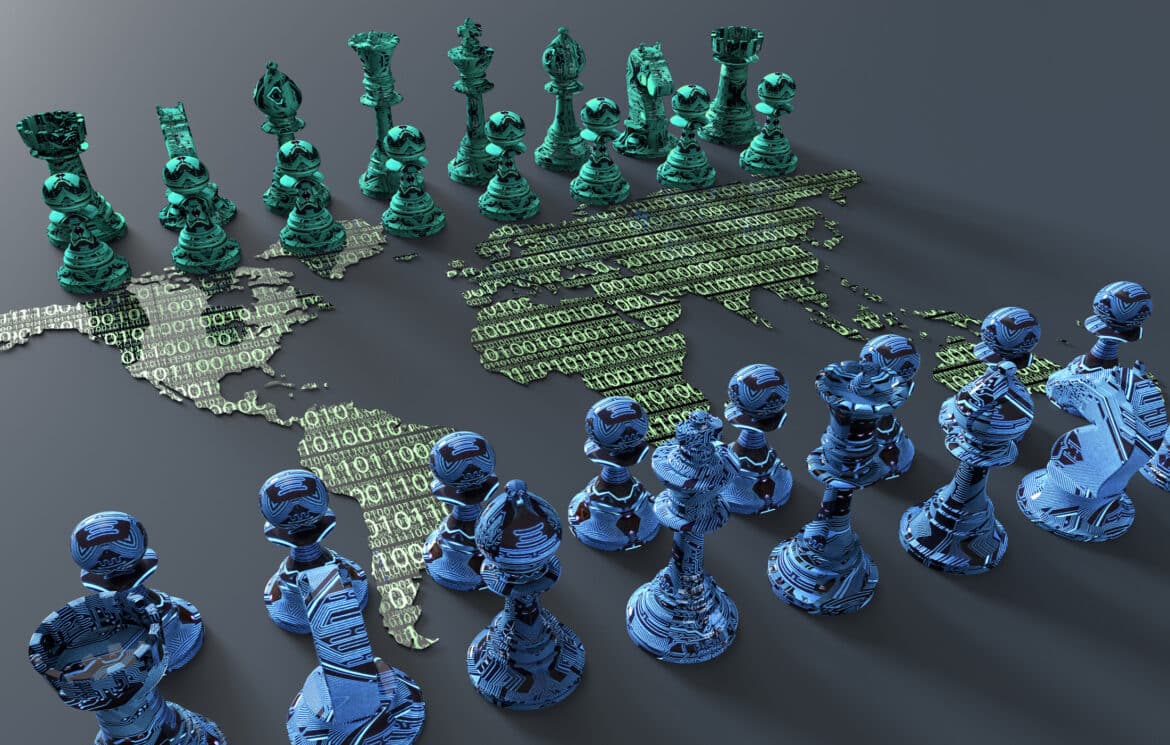
This installment is the macro map. It explains why quantum computing has geopolitical weight — cryptography, defense, economic competitiveness, and prestige — and situates quantum as a strategic technology that governments treat as both an innovation engine and a security concern.
It then surveys national approaches across key jurisdictions — including the United States, China, the European Union, the United Kingdom, India, and Russia — while highlighting the policy layer: export controls, security measures, standards, and the collaboration/competition dilemma. The outcome for the reader is a clearer sense of where the race is actually happening and how states are trying to translate quantum ambition into durable advantage.

Part II — Levers
The instruments through which quantum sovereignty is contested: controls, capital, supply chains, people, intelligence, and alliances.
The Border Around Quantum: Export Controls, Deemed Exports, and “Research as a Controlled Flow”
Export controls are the most visible lever governments use to draw sovereignty boundaries around quantum technology. This article examines how the regime is evolving: from traditional hardware controls to “deemed export” rules that treat knowledge transfer — including to foreign-national researchers in domestic labs — as a controlled flow. It covers the Wassenaar Arrangement updates, U.S. Commerce Department actions, EU dual-use regulations, and the emerging concept of quantum-specific export categories, and it asks what these controls mean for international research collaboration, commercial supply chains, and the pace of global quantum development.

Chokepoints and Industrial Base Realism: What “Quantum Supply Chain Sovereignty” Actually Means
Supply chain sovereignty sounds compelling until you map the actual dependencies. This article does exactly that — tracing the critical chokepoints in quantum hardware supply chains (dilution refrigerators, isotopically purified materials, precision lasers, photonic foundries, cryogenic cabling) and asking which of these can realistically be domesticated, which require allied coordination, and which represent irreducible dependencies that no single nation can escape. It is a reality check on sovereignty rhetoric, grounded in the industrial base as it actually exists.

Investment Screening and M&A: When Capital Becomes a Quantum Sovereignty Vector
Capital flows are a less visible but equally potent sovereignty lever. This article examines how investment screening regimes (CFIUS, the EU Foreign Subsidies Regulation, and equivalents elsewhere) are being applied to quantum companies, and how M&A activity in the quantum sector is being scrutinized through a sovereignty lens. It covers the tension between startups that need capital to survive and governments that worry about strategic technology leaking through ownership, board seats, and licensing agreements — making capital itself a contested terrain in the quantum race.

Quantum Human Capital Controls as Geopolitics
Quantum computing’s scarcest resource is not helium-3 or dilution refrigerators — it is people. This article examines how the global competition for quantum talent has become a sovereignty issue in its own right: visa restrictions, research security programs, “deemed export” rules applied to researchers, talent repatriation incentives, and the broader question of whether nations can build sovereign quantum capabilities without sovereign access to the people who know how to make qubits work. It also explores the second-order effects: how talent controls are reshaping where quantum research happens and who collaborates with whom.

Quantum Tech and Espionage: What Every Researcher Must Know
Where export controls and investment screening are formal instruments, espionage is the informal one — and quantum technology is squarely in the crosshairs. This article examines the intelligence dimension of quantum sovereignty: state-sponsored efforts to acquire quantum IP, the targeting of researchers and startups, the security implications of international collaboration, and the practical steps that labs, companies, and individual researchers should take to protect their work without retreating into paranoia or abandoning the open-science tradition that makes quantum progress possible.

Alliances as “Sovereignty Multipliers”
No nation can realistically build the full quantum stack alone — but alliances can turn partial capabilities into collective strength. This article examines how quantum cooperation frameworks (AUKUS, the Quad, EU initiatives, bilateral agreements) function as “sovereignty multipliers”: pooling supply chains, sharing research, coordinating standards, and creating trusted ecosystems that give member states capabilities they could not sustain independently. It also examines the risks: alliance dependencies can create new vulnerabilities, and the line between “trusted partner” and “new dependency” is thinner than it appears.

Part III — Domains
Where sovereignty plays out across specific quantum technology areas.
Sovereignty in the PQC Era: Standards, Trust, and Crypto-Agility
This installment brings the sovereignty debate into the cryptographic layer — the part that quietly underpins digital power. It starts from a simple observation: PQC is entering the standards stage, but global adoption will not be frictionless or uniform, because standards are also instruments of trust, influence, and strategic autonomy.
The article explores how and why PQC could fragment: states pursuing independent algorithm suites, customizing parameters, layering domestic crypto over international standards, and building “crypto-agile” architectures that can rotate algorithms as trust and threat models change. It also highlights the systemic consequence of sovereignty-driven cryptography: interoperability becomes harder, compliance becomes messier, and “secure by standard” splits into “secure by bloc,” with alliances shaping what is trusted, certified, and deployed.

Sovereign Quantum Clouds and National Control
As quantum computing moves toward cloud delivery, a new sovereignty question emerges: who controls access to quantum compute? This article examines the rise of sovereign quantum cloud initiatives — national and regional efforts to ensure that domestic users can access quantum computing resources without routing through foreign-controlled platforms. It covers the strategic logic (data residency, access denial risk, industrial policy), the emerging models (national quantum data centers, sovereign cloud partnerships, hybrid arrangements), and the tension between sovereign control and the network effects that favor global-scale cloud platforms.

Quantum in Space: Satellites, Timing, and the Geopolitics of Global Quantum Infrastructure
Quantum technology in space is not a distant ambition — it is already shaping sovereignty calculations. This article examines the intersection of quantum and space: satellite-based quantum key distribution (QKD) networks, quantum-enhanced timing and navigation, and the geopolitical implications of who controls orbital quantum infrastructure. China’s Micius satellite demonstrated intercontinental QKD years ago; Europe, the UK, and others are now racing to deploy their own. The article explores why space-based quantum infrastructure is a sovereignty multiplier — and why nations that depend on others for it face a new category of strategic vulnerability.

Quantum Sensing and Navigation as Sovereignty
Quantum computing dominates the sovereignty headlines, but quantum sensing may deliver strategic impact sooner. This article examines how quantum sensors — ultra-precise magnetometers, gravimeters, atomic clocks, and inertial navigation units — are becoming sovereignty-critical capabilities: enabling GPS-denied navigation for military platforms, underground and undersea detection, and timing infrastructure that underpins financial systems and communications networks. It traces the supply chains, the leading national programs, and the sovereignty implications of depending on foreign quantum sensing technology for capabilities that touch defense, critical infrastructure, and economic resilience.

Part IV — Strategy
Turning sovereignty from ambition into operational reality.
Quantum Sovereignty in Practice: When Geopolitics Becomes Architecture
This piece is the pivot from geopolitics to engineering reality. It argues that quantum sovereignty is not only a “strategy document” problem — it becomes a systems-integration and architecture problem the moment you have to procure, deploy, secure, and operate quantum capabilities in the real world.
The article outlines a practical sovereignty playbook: selective domestic capability-building, open and modular architectures to reduce lock-in, diversified partnerships, niche specialization, supply chain and knowledge-base resilience, and the “people layer” of talent and operating know-how. Crucially, it links sovereignty strategy to “sovereign optionality” — the idea that the realistic goal for most actors is not autarky, but the ability to pivot when dependencies become liabilities.

Quantum Sovereign Optionality: Agility Over Autarky
This installment zooms in on the strategy that makes sovereignty practical for everyone who cannot (and should not) try to rebuild the full quantum stack alone. It reframes sovereignty as agility: the ability to verify, swap, and recompose dependencies fast enough to survive shocks — rather than the fantasy of total self-sufficiency.
The article lays out a pragmatic optionality toolkit: standardize interfaces and embrace open platforms, cultivate multiple partnerships, focus on niche strengths, build domestic capabilities for verification and integration, and streamline policy so that “swaps” can happen without multi-year paralysis. It also argues that optionality can be a national advantage — especially when combined with trusted supply chains and standards leadership — because resilience often comes from having credible alternatives, not from insisting everything must be local.

Sovereignty Stress Tests: Tabletop Scenarios for States and Enterprises
The closing installment turns theory into practice with a set of tabletop scenarios designed to stress-test quantum sovereignty postures. What happens when a critical quantum hardware supplier is suddenly subject to export controls? When a PQC algorithm your infrastructure depends on is compromised or withdrawn? When a key researcher is recruited away or a cloud provider restricts access to quantum compute for geopolitical reasons? These scenarios force states and enterprises to confront the gap between their sovereignty ambitions and their actual resilience — and to identify the specific dependencies, decision points, and response capabilities they need to build before a crisis arrives.

This series examines technology and geopolitical dynamics. It does not constitute political, legal, or investment advice.
Quantum Upside & Quantum Risk - Handled
My company - Applied Quantum - helps governments, enterprises, and investors prepare for both the upside and the risk of quantum technologies. We deliver concise board and investor briefings; demystify quantum computing, sensing, and communications; craft national and corporate strategies to capture advantage; and turn plans into delivery. We help you mitigate the quantum risk by executing crypto‑inventory, crypto‑agility implementation, PQC migration, and broader defenses against the quantum threat. We run vendor due diligence, proof‑of‑value pilots, standards and policy alignment, workforce training, and procurement support, then oversee implementation across your organization. Contact me if you want help.