The Border Around Quantum: Export Controls, Deemed Exports, and “Research as a Controlled Flow”


Table of Contents
Quantum Tech Meets a New Border Regime
Quantum research was once an open frontier where ideas flowed freely across borders. Today, however, scientists and engineers find themselves navigating something unprecedented in the academic world: border checkpoints for knowledge. Imagine a quantum physicist in a university lab who must double-check export regulations before sharing a chip design with an overseas collaborator, or a startup founder who realizes that hiring a foreign national might trigger government paperwork. What was recently “just science” is now being treated as strategic infrastructure – subject to controls traditionally reserved for weapons or sensitive military tech.
This change is not happening in a vacuum. Quantum technologies – which exploit quantum mechanics for unprecedented computing power, sensing precision, and secure communication – are rapidly moving from lab curiosities to national security priorities. Because these systems are dual-use, offering civilian breakthroughs in medicine and industry even as they promise to enhance military capabilities, governments are erecting legal barriers to manage who can access them. Export controls have emerged as a main lever to throttle or channel the flow of quantum know-how and equipment, effectively drawing new borders through the global R&D ecosystem. Quantum sovereignty, in other words, isn’t just about spending more on R&D; it’s about enforcing boundaries on that R&D.
The U.S. has led the charge by expanding export restrictions on advanced quantum technologies in the name of national security. In late 2024, the U.S. Department of Commerce’s Bureau of Industry and Security (BIS) rolled out the first comprehensive export controls on quantum computing items – worldwide license requirements on quantum computers and their key components, materials, software, and technology. Complete quantum computers that exceed certain performance specs can no longer be exported without a license. At the same time, U.S. authorities tightened controls on the “deemed export” of quantum technology, meaning the transfer of know-how to foreign nationals inside the country is treated as an export in itself. Other major powers have responded in kind: China, for instance, has tightened its own rules on critical raw materials (like specialized semiconductor inputs) in apparent retaliation, and is surely considering how to shield its nascent quantum industry. Caught in the middle, Europe faces pressure to coordinate with the U.S. approach, even as EU member states debate how far to go in restricting trade and research ties.
In short, a “border regime” is forming around quantum. To understand it, we need to map out what exactly is being controlled, why quantum tech defies easy regulation, and how these new rules are reverberating through labs and businesses worldwide.
What Governments Are Trying to Control in Quantum Technology
Export controls work by specifying controlled items – things that require government permission (a license) to export to certain destinations or end-users. In the case of quantum technology, governments are casting a wide net. With quantum viewed as strategically critical, the controlled items span from tangible hardware to intangible knowledge:
Quantum computing hardware and subsystems
At the core are the quantum computers themselves. The U.S. rules, for example, explicitly list “quantum computers” and related assemblies as controlled. This includes not just a fully assembled quantum computer, but also the key components that go into one: specialized quantum processors (such as superconducting qubit chips or ion trap devices), control electronics, and microwave or optical components used for qubit control and readout. If a component is essential to building or operating a quantum computer, chances are it’s now on a control list. For instance, superconducting qubit chip designs or trapped-ion vacuum chamber systems may fall under the new export control classification numbers created for quantum tech.
Enabling equipment (manufacturing and test tools)
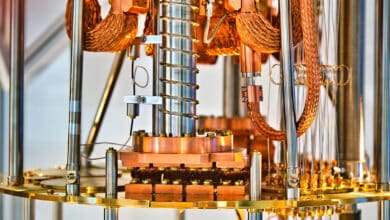
A quantum lab is filled with exotic equipment – dilution refrigerators that cool qubits to millikelvin temperatures, high-precision lasers and cryostats, single-photon generators, ultra-low-noise microwave amplifiers, and so on. These enabling tools are also being roped into export controls. Regulators recognize that controlling the tools to make or run quantum devices can be as important as controlling the devices themselves. In fact, ultra-cold cryogenic systems have been highlighted as a crucial choke point. Dilution refrigerators (the tall, gold-colored “chandeliers” that house many quantum computing setups) were identified early on as a “good chokepoint” technology – critical for many quantum platforms yet produced by only a few companies.
Reports suggest that discussions about restricting exports of dilution fridges to China began as early as 2019. By late 2024, those fridges and other cryogenic technologies were formally added to the Commerce Control List as controlled items. The U.K., similarly, introduced new export control categories in 2024 that explicitly cover quantum technologies and cryogenic systems, meaning a license is now required to export such equipment anywhere in the world.
Specialized materials and inputs
Quantum hardware often depends on unique materials – isotopically purified substances (like isotopically pure silicon or helium-3 for cooling), certain superconducting alloys, rare-earth dopants for quantum memories, or high-end photonic components (nonlinear crystals, single-photon detectors, etc.). Governments are scrutinizing these inputs too. If a material is tailor-made or essential for quantum devices, it might be subject to licensing.
For example, the U.S. control list updates include materials “for the development or production of quantum computers”. While not all basic lab chemicals or standard electronics are restricted, the most cutting-edge or high-purity materials that give a quantum project an edge could be caught by these rules. (Notably, China in turn has looked at restricting exports of certain raw materials that are vital for high-tech manufacturing – a reminder that this is a two-way street.)
Software and algorithms
Software specially designed for quantum development is also covered. This can include quantum error-correction software, control system software for operating quantum hardware, or modeling software used to design quantum components. The U.S. regulations added controls on software “and technology” related to quantum computing, which means proprietary algorithms or software source code might require a license if shared internationally.
One concrete example: if a company has custom software for calibrating and running a quantum processor, sending that code abroad (or even to a foreign national at home) could trigger export rules. That said, general-purpose quantum algorithms published in research journals (like Shor’s algorithm for factoring) remain in the public domain. Governments are not trying to classify basic scientific knowledge as a munition – they focus on software that is not publicly available and is directly useful in building advanced quantum capabilities.
“Know-how” and technical data (the intangible side)
Perhaps trickiest of all is controlling knowledge itself. The schematics of a quantum chip, the engineering drawings of a novel ion trap, the process recipe for fabricating qubits, or even the operating manual for a quantum prototype – all of these fall under what export rules call “technology” (technical information for the development, production, or use of a controlled item). Sharing such know-how can be as tightly regulated as shipping hardware.
Under U.S. law, any “release” of controlled technology to a foreign person is a deemed export. A release can occur through visual inspection (e.g. showing a foreign colleague a CAD design on your computer screen), or through oral/written communication of technical details. This means a simple collaborative discussion or lab tour can count as an export if it reveals controlled technical information. Universities and companies are now grappling with these rules to avoid inadvertent violations.
There are some carve-outs – for instance, fundamental research (basic science intended for open publication) is generally exempt from export licensing requirements, as long as there are no restrictions on publication. But if research results are proprietary or classified as “development” know-how for a controlled technology, the fundamental research exception may not apply. In practice, labs must carefully segregate what is open science and what is controlled engineering data.
In summary, governments are trying to control the full stack of quantum technology. From the top-level machines down to the guts and blueprints, the aim is to create checkpoints for anything that could meaningfully advance an adversary’s quantum program. As the U.S. Commerce Department phrased it, the new rules cover “quantum computers, related equipment, components, materials, software, and technology” involved in their development. If that sounds broad, it is – and intentionally so. But quantum technology is a peculiar beast, and drawing lines around it is easier said than done.
Why Quantum Is Uniquely Hard to Define (and Control) as a “Commodity”
Traditional export controls grew out of the Cold War, when it was somewhat simpler to define what was sensitive: a high-performance radar system, a guidance chip, enriched uranium, etc.
Quantum technology in the 2020s presents a very different challenge. It’s a moving target, a multi-layered stack, and often ambiguous in its end use. Regulators crafting quantum controls have had to confront several unique difficulties:
A Layered Tech Stack with Many Pieces
A quantum computer is not a single monolithic item – it’s an ensemble of advanced sub-components, many of which are not exclusively “quantum.” There’s the cryostat (essentially a fancy freezer), microwave generators and antennas, lasers, vacuum systems, control circuits, and classical computers interfacing with the qubits. Should each of these be controlled? If you control only the complete machine but not the parts, someone could potentially assemble a machine from separately acquired parts. But if you control every part, you might end up ensnaring general-purpose equipment used in all sorts of scientific endeavors.
For example, an ultra-stable laser might be used for a quantum experiment and for precision spectroscopy in chemistry; a high-end oscillator might serve both a qubit control system and a 5G telecom testbed.
Drawing the boundaries of “quantum-enabling” tech is inherently fuzzy. Governments try to solve this by specifying performance thresholds or intended uses – e.g. controlling a dilution refrigerator specifically designed for quantum computing (the U.S. rules target those that can reach extremely low millikelvin temperatures suitable for quantum hardware). But manufacturers could argue about what counts as “designed for quantum” versus a general physics lab fridge.
This layered complexity makes the regulations complex too. It’s one reason it took five years from initial proposals to finalize the U.S. list-based controls – nailing down definitions and thresholds was a painstaking process.
Blurred line between civilian and military (dual-use ambiguity)
Virtually every component in a quantum lab has a dual-use character. Quantum sensors can be used for civilian applications like medical imaging or geological surveys – or for military applications like submarine detection and inertial navigation. Quantum computing algorithms might break encryption (a national security threat) but also optimize pharmaceutical research or logistics.
Because the quantum field is largely non-mature (many technologies are still experimental), it’s not always obvious which developments are military-critical. This ambiguity tends to push regulators toward caution – controlling broadly “just in case.” But it also means sweeping in a lot of benign research. Everything from a photonic chip to a superconducting cable could be repurposed in unexpected ways, so the default has become to err on the side of control. The risk, of course, is that this casts too wide a net, potentially stifling legitimate collaboration on the civilian side (more on that later).
Fast-moving targets and uncertain metrics of “power”
How do you quantify a quantum computer’s capability for control purposes?
In classical computing, export rules historically used metrics like CPU speed or Millions of Theoretical Operations Per Second (MTOPS) to classify “supercomputers.” Those became outdated quickly as technology advanced.
In quantum, the metrics (qubit count, coherence time, gate fidelity, quantum volume) are not only rapidly improving but also hard to compare across platforms. A 100-qubit superconducting machine might be less powerful than a 50-qubit ion trap if the latter has far better error rates.
Early drafts in international talks considered thresholds like “quantum computers with more than 34 qubits and below a certain error rate per gate” – an attempt by Spain and others to define a cutoff for control. But even that modest capability was ahead of what existed at the time, meaning regulators were essentially trying to “future-proof” the rule by aiming at a moving target. In other words, the rules are predicting what level of quantum computing will be strategically significant and attempting to lock it down in advance.
The obvious dilemma: if they set the bar too high, they might allow adversaries to acquire medium-grade systems that are still quite useful; if they set it too low, they’ll end up controlling even trivial, small-scale devices and perhaps strangling the research ecosystem. It’s a bit like trying to ban “fast airplanes” in 1905 – you have to guess what “fast” means before the Wright Brothers have even gotten fully off the ground.
Dependency on specialized infrastructure (chokepoints)
Quantum technology relies on very specialized infrastructure (like those aforementioned cryogenic coolers, or precision nanofabrication tools for making qubits). This creates natural chokepoints – only a few companies globally might make a given tool. That helps control (since targeting those chokepoints can be effective), but it also means if you’re on the receiving end of controls, you are in big trouble until you can replicate that infrastructure.
Policymakers are keenly aware of this: they know that by denying one crucial tool, they might freeze a rival’s entire project. Dilution fridges are a prime example: without access to state-of-the-art refrigerators, it’s incredibly hard to operate a competitive superconducting qubit lab. Thus, they became a focus of U.S. controls.
The flip side is, once such a chokehold is identified, the targeted country has a massive incentive to develop an indigenous alternative (more on this in the next section). In effect, betting on chokepoints is a race – can we hold back their progress long enough, or will they innovate around the blocked piece?
Intangible, easily transferable knowledge
Unlike, say, a fighter jet or even a microchip fab, quantum knowledge can in theory be transferred just by talking or sending files. That makes it inherently harder to police. Researchers worldwide publish papers, attend conferences, and share insights openly. Trying to selectively dam this flow is a bit like trying to control a liquid that’s constantly seeking pathways.
The introduction of deemed export rules for quantum tech is a recognition of this challenge – governments don’t want to just control the shipment of a box, they want to control the know-how from being transmitted in the minds of people. But enforcing that is tricky without hampering the very international collaboration that drives innovation.
The U.S. BIS explicitly acknowledged this tension, noting that “quantum computing R&D is substantially a global endeavor… The United States will continue to rely on foreign talent to fill critical workforce gaps”. Imposing blanket deemed-export licenses (i.e. making every foreign grad student get a license to work on a sensitive quantum project) could be, in BIS’s own words, “devastating to the continued progress of future developments in the quantum field”.
That’s why the U.S. rule-makers chose a compromise: they exempted most foreign nationals from licensing requirements but demand detailed record-keeping and annual reporting when those individuals are from nations of concern. In essence, they’re trying to monitor the flow of knowledge without completely damming it up.
Still, the intangible nature of scientific know-how means that, short of draconian measures, some leakage or diffusion of quantum expertise is inevitable. It’s a far cry from the days of controlling physical shipments of machine tools or steel alloys.
All these factors make quantum export controls a high-wire act. Regulators must write rules that are specific enough to catch what matters, but flexible enough to adapt as the technology evolves – and strict enough to protect security without strangling innovation. It’s no surprise that early efforts hit roadblocks. In the Wassenaar Arrangement (the main multilateral forum for coordinating dual-use controls), proposals to add quantum technologies ran into opposition and delays. Notably, Russia (a participant in Wassenaar) reportedly blocked consensus on quantum controls in 2022-2023, stymieing a unified global update. This leads to the next major development: when consensus falters, nations take things into their own hands.
From Consensus to Coalitions: The Shift in Control Regimes
For decades, export controls on advanced tech were harmonized through international regimes like the Wassenaar Arrangement, which relies on broad consensus (42 countries, including adversaries, all agreeing on list updates). But the geopolitical fractures of recent years – particularly the rivalry between the U.S. and China, and the breakdown of cooperation with Russia – have upended that model. The result is a shift toward unilateral or plurilateral controls: like-minded countries coordinating among themselves, or even single countries forging ahead, to restrict tech flows in the absence of full global agreement.
The quantum tech controls are a textbook case of this shift. As mentioned, attempts to add quantum items to Wassenaar’s dual-use list around 2021–2022 were thwarted, reportedly due to Russia’s objections (likely influenced by its own interests and its post-2022 estrangement from the West).
Rather than wait indefinitely, the U.S. and a cohort of allies formed what some have called “Wassenaar minus one”. In 2024, an ad-hoc coalition of advanced tech nations decided to implement quantum controls on their own and then harmonize with each other. The U.K.’s export control agency openly stated that it was introducing new rules on quantum and other emerging technologies “which the UK, along with a number of like-minded countries, has committed to implement”. Those U.K. rules (taking effect in April 2024) created new control entries for quantum tech, cryogenics, semiconductor tools, etc., requiring licenses to export them anywhere.
Similarly, the EU updated its dual-use regulations to include certain quantum items, reflecting agreements among Western partners. Canada announced quantum tech controls in mid-2024, and finally the U.S. interim final rule came out in September 2024. Each country issued its regulations under national laws, but they were closely coordinated behind the scenes – essentially mirroring each other to prevent gaps.
This coalition approach was crucial because if even one key supplier nation didn’t implement the controls, that could become a backdoor (a non-controlled source from which tech could flow to adversaries). By acting together, the U.S., U.K., Europe, Japan, Canada and others tried to form a united front so that, say, advanced quantum sensors couldn’t simply be bought from a lax-regulation country if denied by another.
In tandem with list-based controls, the U.S. also employed targeted measures. One is the Entity List, which is a blacklist of specific foreign companies or institutes; any export to them requires a license (with a presumption of denial). Starting in 2021 and escalating through 2024, the U.S. added numerous Chinese quantum research institutes, startups, and even component suppliers to the Entity List. By late 2024, major players like China’s QuantumCTek (a QKD company) and Origin Quantum (a quantum computing startup), as well as key university labs, were on that list. In early 2025, the U.S. further added Chinese firms specializing in upstream components – cryogenic equipment manufacturers, laser and photonics suppliers, even distributors of scientific instruments – to the Entity List. The message was clear: not only finished quantum devices, but the ecosystem of suppliers, would be cut off from U.S. technology if they were found aiding China’s military-linked quantum programs. By naming specific intermediary companies (including two Chinese distributors that service research labs), the U.S. aimed to prevent clever workarounds and re-export schemes.
On the flip side of these punitive measures, we see alliances deepening. Trusted allies are not just coordinating on what not to share with rivals, but also making arrangements to share more among themselves. The BIS’s 2024 rule introduced a new License Exception for partner countries: if an export is going to a country that has implemented equivalent controls, it may be exempt from individual license requirements. This effectively creates a club of trust – within the club, tech flows more freely, but exports outside the club are tightly gated. A concrete example of this approach is the AUKUS security pact (between the U.S., U.K., and Australia): within AUKUS, the partners agreed to loosen export controls amongst themselves for certain sensitive technologies, quantum included. It’s like an inner circle that drops internal trade barriers to jointly advance the tech, while maintaining a hard outer boundary to everyone else. While this is great for alliance cohesion, it underscores the emergence of tech blocs: if you’re not in the club, you face a higher hurdle to access cutting-edge tech.
This plurilateral strategy has two big implications.
First, it can be more agile. The coalition of “like-mindeds” can update controls faster than waiting for universal consensus. For instance, the U.S. Under Secretary of Commerce Alan Estevez touted that aligning controls with partners makes them “more effective” and that BIS is building “increased agility into our system”. They can tweak thresholds, add items, or carve out exceptions relatively quickly in response to technological changes or intelligence on proliferation.
Second, however, it means the global export control regime is fragmenting. Countries outside the U.S.-led coalition (notably China, but also others who didn’t immediately sign on) might see these moves as politicized or illegitimate since they bypass the usual multilateral fora. This can lead to tit-for-tat measures: indeed China passed its own comprehensive Export Control Law in 2020 and has been building the legal basis to restrict exports of its strategic technologies (though China’s list of controlled tech is still evolving). Already, after the U.S. curbed chips to China, Beijing struck back by limiting exports of gallium and germanium, critical materials for semiconductors.
We could envision a scenario where China decides to restrict exports of certain quantum cryptography products or sensor components to the West, leveraging whatever advantages it has (China is a leader in quantum communication systems like QKD networks, for example). The endgame could be a more bifurcated global tech landscape, where two or more blocs each impose controls to guard their “home-grown” quantum tech and deny it to others, while trying to reduce their reliance on foreign suppliers.
For smaller countries or those not squarely in one bloc, this shift poses a real dilemma. Take a country like Singapore or Israel, or emerging economies with growing quantum research like India or Brazil: they want to be part of global innovation networks, but now they must navigate a minefield of rules and geopolitical expectations. Many will choose to align with the U.S./EU-led framework, both because they benefit from Western tech and because deviating could incur penalties (losing access to the club). Aligning means enacting similar export controls domestically – which some have done or are in process of doing. The U.S. has actively encouraged allies and partners worldwide to adopt its approach (one can even lose access to U.S. tech if you don’t, in some cases).
On the other hand, those who sit on the fence or lean toward China might find themselves cut off from Western collaborations or supply chains. It’s a delicate balancing act: remaining integrated in the global research community while avoiding dependency traps where one superpower’s embargo could cripple your projects.
Smaller states also worry about being solely dependent on one source for critical quantum components. For instance, if a country’s quantum labs can only buy their superconducting qubits or single-photon detectors from one of the “friendly” suppliers, they need assurance that supply won’t be interrupted due to political whims. This is driving some to invest in local capacity (even if at small scale) as a hedge. We see, for example, European “technological sovereignty” initiatives explicitly aiming to build up European quantum supply chains – not to cut off the U.S., but to ensure Europe isn’t caught helpless if transatlantic politics sour or if U.S. firms monopolize key intellectual property. The EU’s 2025 Quantum Strategy places heavy emphasis on “strategic autonomy”, calling for a resilient, sovereign European quantum ecosystem precisely so that Europe is “not a mere consumer of others’ quantum tech”. That means encouraging European startups in areas like cryogenics, photonics, and quantum chips, even if U.S. alternatives exist, to diversify sources.
In essence, the world is grappling with a partial decoupling in quantum technology. Collaboration hasn’t halted – far from it, scientists from many countries still co-author papers and meet at conferences. But the terms of collaboration are being rewritten.
The default assumption now is: share within your trusted circle, be very cautious about sharing outside it. And if you’re a country in between, you might have to pick a side or invest heavily to go it alone.
As we’ll discuss next, these new realities are forcing individual labs, companies, and researchers to adjust their behavior day-to-day.
Research as a Controlled Flow: Impact on Labs, Startups, and Teams
How are these high-level policies felt on the ground? In university labs, startup companies, and corporate R&D centers, the emerging export control regime is changing both mindset and operations. What used to be an open global enterprise is becoming more compartmentalized. Here are some of the key impacts and shifts we’re seeing:
Lab life with export controls
Academic research groups working on quantum science are learning to live with compliance checklists. Universities in the U.S. (and elsewhere adopting similar rules) have begun issuing guidance to their researchers about the new quantum export controls.
For example, the University of Chicago’s export control office circulated detailed guidance in late 2024 explaining the new rules to its quantum research community. Researchers are advised that if they use newly controlled quantum components or technology in their experiments, they must be mindful about foreign nationals accessing them, or about shipping samples and devices abroad for collaboration.
This doesn’t mean labs must halt international cooperation, but it introduces friction. A graduate student from Country X may now need a special exemption or monitoring if working on a certain project. Labs are establishing internal protocols: perhaps segregating some controlled technical information on secured computers, or restricting certain equipment to authorized users.
In extreme cases, some professors might choose to avoid certain sensitive research areas altogether if they anticipate too much bureaucratic overhead. The famous openness of university science is undoubtedly under pressure – though fundamental research intended for publication is still mostly exempt, the gray zones around applied quantum engineering can trigger restrictions.
A particularly poignant issue is the status of foreign students and researchers. The U.S. considered (then decided against, for now) requiring individual licenses for foreign nationals from adversary countries (like China, Russia, Iran – those in Country Groups D:1 or D:5) to work on controlled quantum technology. This was the “deemed export” licensing that many feared. In the end, instead of making every Chinese PhD student get a license, the U.S. created a general authorization: universities and companies can allow those students to work, but they must keep detailed records of what controlled technology is shared with them and submit annual reports to the government. The logic is, we’ll let the talent in, but we want visibility on what they’re accessing. From a lab manager’s perspective, this means new bookkeeping duties. It’s essentially an internal surveillance requirement: if a Chinese postdoc in a U.S. lab is given access to the blueprints of a new quantum chip (which is controlled “technology”), the lab needs to note that and include it in their yearly report. If the government sees something it doesn’t like, it can then intervene by revoking the general license for that individual.
Researchers in allied countries face similar constraints if they collaborate with colleagues in, say, China or Russia. A European scientist might think twice about sharing certain advanced sensor designs with a Chinese institute, knowing that could run afoul of their country’s export laws or EU sanctions. There have been subtle reports of Western universities quietly unwinding some partnerships or at least not renewing Memoranda of Understanding with Chinese counterparts in sensitive fields like quantum. The chill is not absolute – scientific diplomacy is not dead – but there is a new layer of caution.
Startups and industry burdens
For quantum startups – many of which are small, university spin-offs – export controls add a non-trivial burden. These companies thrive on international talent and often seek global customers and investors. Now, a startup that builds, say, quantum sensing devices will need to determine if their product is classified under a controlled category. If yes, they might have to apply for export licenses for any sale outside allied countries. That’s a whole new bureaucratic process, often requiring legal expertise. Large tech companies have compliance departments to handle export licensing; a 10-person startup probably doesn’t. They may need to bring in consultants or train someone to ensure they don’t accidentally ship a controlled component to an overseas client without permission.
Recruitment is another area impacted. Quantum companies often hire the best person for the job, nationality aside. But if half of your engineering team comes from abroad (which is not uncommon – in fact, roughly “half of the quantum-enabled technical workforce… are foreigners in the U.S., and the biggest group is from China”), you now have to manage their access and perhaps report on it. Some startups might prefer to avoid the headache by prioritizing hiring from countries firmly within the “trusted” circle. Others will shoulder the paperwork but at a cost. Over time, this could affect competitiveness: a startup spending thousands on legal compliance is money not going into R&D or product development.
There’s also anecdotal evidence that investors are paying attention to export control risk. A quantum hardware startup that bases its supply chain or customer base significantly in China might find Western investors skittish, fearing that the company’s market could be cut off by sanctions or that its tech transfer might be restricted. Conversely, some investors see opportunity: companies that can provide controlled tech to Western governments or that specialize in “sovereign-friendly” supply chains might be viewed favorably in this environment.
Multinational companies and “geo-fencing” R&D
Big corporations like IBM, Google, or Airbus that work on quantum have global operations. They are now selectively geo-fencing their quantum R&D – meaning certain projects are kept within certain geographic or national boundaries. For instance, IBM’s cutting-edge quantum computing work is primarily U.S.-based and subject to U.S. export law; IBM might be cautious about duplicating that capability in countries where it could be vulnerable to leak or legal conflicts.
If a multinational sets up a quantum research center in, say, Europe or Japan, it will do so in countries that are part of the trusted network (and likely ensure that tech flows back to the U.S. are smooth via license exceptions, etc.) But the same company might hesitate to have any quantum activity in a country like China now. A few years ago, joint ventures or research labs in China were a thing (for example, Microsoft had a research lab in China that dabbled in quantum computing theory). Today, it’s almost unthinkable for a Western company to base quantum hardware development in China – not only due to IP risk, but because it could run into legal trouble with home authorities. In fact, the U.S. has moved to restrict even investment flows into Chinese quantum companies: an executive order in 2023 mandated that U.S. investors must notify or even refrain from investing in certain Chinese quantum tech sectors. This is a form of “ outbound export control” (on capital and expertise) and companies are adapting to comply with those rules too.
Multinational teams that do exist have to implement internal compartmentalization. Imagine a joint project between an American company and a Japanese partner to build a quantum sensor. Both the U.S. and Japan have similar export control rules now. They will likely set up a framework where sensitive design files are shared through controlled IT systems, with access limited to cleared individuals. They might even avoid involving any team members from third countries that are not explicitly approved. It’s doable – defense contractors have done this kind of thing for ages under ITAR (International Traffic in Arms Regulations) when co-developing fighter jet parts or so – but it’s relatively new to the quantum tech space, which until recently was more akin to open science.
One more subtle effect on research culture is a growing sense of self-censorship or discretion. Scientists might choose not to discuss certain technical details at international conferences anymore, especially if they’re from a company rather than academia. We are already seeing conference panels and talks where speakers speak in more general terms or skip the “secret sauce” parts of their work if they know those might be sensitive. In extreme cases, some Chinese researchers have reported that their Western colleagues became less forthcoming or stopped collaborating as closely after 2018 or so – essentially since the tech tensions ramped up. Trust is eroding in some of these cross-border relationships, not necessarily because individuals changed, but because the political climate casts a shadow. No one wants to be the person who unwittingly handed a strategic advantage to a rival nation or who got their institution fined for an export control violation.
All told, the everyday experience of doing quantum R&D is becoming more bureaucratic and security-conscious. The freewheeling exchange that characterized much of 2000s and 2010s quantum research – where a grad student in Toronto might ship a test device to a group in Shanghai for characterization, or a postdoc from Moscow might join a U.S. lab on a sensitive project – is giving way to a more guarded approach.
Not all of this is imposed from above; some is voluntary. Companies want to stay on the right side of regulators, and universities want to safeguard their government funding (which often comes with compliance strings attached). We’re witnessing the naissance of what might be called a “quantum export control culture.” It’s similar to what the nuclear physics community experienced post-WWII or the aerospace community during the Cold War: a realization that “your research has strategic implications, so handle it responsibly.”
Strategies for Navigating the New Restrictions
If you are a researcher, startup founder, or policymaker in a smaller country, how do you thrive in this environment without getting caught in dependency traps or legal snags? Likewise, how can any organization working in quantum tech best protect itself while still innovating? Here I suggest a practical framework to manage quantum workstreams under the export control regime, and ways to structure collaborations that preserve some freedom of action (optionality) for the future.
Classify your workstreams into “publishable, partnered, and protected.”
It’s useful to sort the activities and outputs of your quantum R&D into three buckets:
- Publishable: This is work you intend to openly publish or disclose – essentially fundamental research or non-sensitive innovation that can be shared with the world. It might include theoretical results, basic experimental demonstrations, algorithms, or hardware designs that don’t confer a significant strategic advantage. By explicitly identifying something as destined for publication, you can often safely exclude it from export control scope (since most regimes exempt publicly available science). For example, if you’re a university team working on a new quantum algorithm, you might decide upfront that all results will go on arXiv and be open source. That means you don’t have to restrict who is involved based on nationality, because there’s no controlled technology if it’s immediately published. The key is to ensure there are no publication or access restrictions on that work (no proprietary sponsor saying “don’t publish this”), otherwise the fundamental research exemption might not apply. In essence, treat this bucket as “safe to share widely” – your global contribution to knowledge. It keeps you integrated scientifically and actually serves as great PR for your country or company’s capabilities, without running afoul of controls.
- Partnered: This includes projects or components where you collaborate with external partners under some controlled terms. Perhaps you’re co-developing a quantum device with an industrial partner, or you have a multinational research consortium under a grant. In these cases, not everything will be open; you’ll share information within the consortium but not publicly. For partnered work, it’s vital to choose partners carefully and set ground rules in writing (via collaboration agreements or MoUs). Ideally, your partners should be from countries within the friendly/export-compliant network – that way you minimize the chances that sharing with them triggers a legal issue. If your partner is from a country under restrictions, then you either need to obtain export licenses for that collaboration or limit the scope of what’s shared (perhaps you do only theoretical discussion with them, but not hardware exchange). Within partnered projects, classify what data or materials are sensitive and label them as such. Use NDAs and clearances to ensure everyone knows that, say, “we can discuss results A and B with each other, but not with outsiders without permission.” By managing this proactively, you make sure that each partnership stays on the right side of regulations. Also, having the partnership documented (including the agreed purpose and end-use of the research) can help if you ever need to apply for a license – you can show authorities that you have a structured, well-understood project, which might make them more willing to approve specific transfers.
- Protected: This is your secret sauce – the things you decide are too sensitive or valuable to share at all (at least for now). It could be a proprietary manufacturing process for qubits, a novel chip design, or any IP that you think gives you a competitive edge or could be classified as a defense asset. You keep this in-house (or within a very tightly knit team if it’s a multi-partner venture, e.g. domestic partners only). For protected work, you implement strong access controls: perhaps only citizens of your country or a few trusted individuals are allowed to work on it, and they are briefed on confidentiality. You might even decide not to publish this work at all until you’ve secured patents or until you clear any export considerations. In some cases, “protected” might also mean eventually you commercialize it under export license – for instance, a company might develop a high-performance quantum sensor and decide it will sell it only to domestic military or with government clearance to allies. Essentially this bucket is treated almost like a defense project, even if it’s not formally one. It’s your hedge against dependency: by having some core know-how that you alone control, you ensure your country or company remains a needed player in the field. One can think of this like trade secrets or crown jewels that you shield from the open market.
By consciously segmenting work this way, you avoid a one-size-fits-all approach. Not everything needs to be locked down (that would isolate you too much), but also not everything should be wide open (that could give away advantages or violate rules). This stratification allows you to contribute to international science where appropriate, build trust with partners on some initiatives, and still keep key capabilities sovereign.
Design collaboration agreements with export controls in mind
When entering any international research collaboration or commercial partnership in the quantum area, it’s wise to bake the new realities into the agreement. For example:
- Include clauses that acknowledge export control obligations. All parties should affirm they will comply with applicable export laws and will not transfer certain information or materials to unauthorized third parties. It sounds legalistic (and it is), but getting this in writing sets the expectation and gives you recourse if a partner carelessly shares something they shouldn’t.
- Define clearly who owns any resulting IP and how it can be used. This preserves optionality if the partnership has to dissolve unexpectedly due to geopolitics. Let’s say you co-invent a new photonic chip with a partner from another country. If relations sour and future collaboration is blocked, a good agreement would spell out that each side can continue using the jointly developed IP (or some fair licensing terms) so that one side isn’t totally stranded. Essentially, plan for a scenario where the “tech border” hardens mid-project – how will you both carry on? Having an exit strategy or contingency for IP rights can save a lot of trouble later.
- Consider setting geographic or personnel boundaries in the project upfront. For instance, if you are a European lab working with an American company, you might agree that all fabrication will happen in Europe and all software development in the US, and then only high-level results are exchanged. This way, each side keeps the detailed know-how of certain steps within their jurisdiction, reducing cross-border transfers. It’s a modular approach: partition the work so that sensitive pieces don’t all cross borders. This can also protect you if one party suddenly faces new restrictions – each has some self-contained capability. It’s somewhat analogous to how in some international defense programs, components are split so no one country has the entire blueprint.
- Build in review and renegotiation triggers. If export control laws change (which they likely will every couple of years as quantum tech progresses), the collaboration agreement should allow the partners to come back to the table and adjust terms. For example, if a new rule bans sharing a particular component, the partners might agree to swap that component out for an alternate approach, or shift that part of R&D to the partner country that isn’t embargoed. Flexibility is key. A rigid long-term agreement might be unworkable if it doesn’t adapt to the shifting legal landscape.
- Don’t overlook the human element: visa and travel considerations. If you plan to have personnel exchanges (researchers visiting each other’s labs), note that in the current climate, visas for researchers from certain countries might be harder to get, or they might be restricted from certain facilities. Collaboration plans should be realistic about whether people can physically work together or if it has to be mostly remote. In some cases, bringing a foreign national into a lab might itself constitute a deemed export (if they will see controlled equipment there). So maybe the agreement specifies that joint experiments will occur in a neutral location or via cloud services, etc. It sounds far-fetched, but these are things people now think about to avoid putting a student or employee in a situation where they’re inadvertently breaking the law by simply doing their job in another country.
Finally, one of the most important strategies at a national policy level for smaller countries is diversification. This means not betting your entire quantum program on one external source. If you’re buying quantum hardware, try to source from multiple allies. If you’re sending students abroad for training, send some to US, some to Europe, maybe some to Japan – spread out the knowledge acquisition. If one door closes, others remain open. It also signals to big players that you’re not completely beholden to any single one – which paradoxically can earn you a bit more respect and leverage.
For companies, diversification applies too: develop multiple markets (if possible, both allied government contracts and some commercial ones) so that if export rules tighten on one front, you have another revenue stream. We’ve seen companies in other sectors do this amid U.S.-China decoupling – for example, some semiconductor firms refocused on selling to U.S./Europe markets when China sales got restricted. In quantum, maybe a company that initially thought of selling devices to Chinese universities pivots to instead sell to Middle Eastern or Southeast Asian institutions that are still considered okay destinations, or just doubles down on Western clients.
In short, optionality is the name of the game. Keep your options open so you can adapt to a volatile policy environment. That might mean a bit of duplication of effort (doing things domestically that you could outsource more cheaply, just in case you have to later anyway), or slower progress in the short term (because maybe you didn’t hire that brilliant student from abroad to avoid paperwork). But the payoff is resilience. Those who plan ahead for export controls will be less shocked when a new rule comes out overnight banning, say, the export of a certain type of qubit beyond the ally circle. We’ve now seen that scenario play out – in October 2022, the U.S. did exactly that in semiconductors, suddenly cutting off advanced chips to China. Many companies were caught off guard. In quantum, by learning from that, organizations can prepare for similar sudden changes.
Conclusion
The landscape of quantum technology development is increasingly defined by boundaries and barriers as much as by breakthroughs. We are witnessing the construction of a “border” around quantum – not a physical border, but a legal and institutional one. Strategic competition in this field has moved beyond the race for funding and talent to a contest of who can control the pipelines of innovation. Export controls and related measures are the tools nations are using to draw those lines.
On one side of the ledger, these controls aim to slow rivals’ progress and safeguard national security. They might succeed in the short term – by denying critical components and know-how, they surely impose hurdles for any country trying to catch up in quantum. On the other side, history suggests that determined efforts will find a way around barriers: either by developing indigenous alternatives (as China is aggressively doing), or by forming new alliances among those shut out. Indeed, the very act of building a tech wall can spur the targeted side to double down – a dynamic playing out now as China accelerates its own quantum supply chain to reduce reliance on foreign inputs.
For the global scientific community, there is a bittersweet reality setting in. The free flow of ideas, which has been the lifeblood of so much innovation, is coming up against the hard reality of state power and mistrust. Researchers will continue to collaborate, but in a more cautious, calibrated fashion. International projects will still happen, but likely within tighter networks of like-minded nations. Smaller countries and non-superpowers will carve out roles by aligning smartly and investing in their niches.
If there is a silver lining, it’s that these challenges are prompting clearer thinking about priorities and risk management in the quantum field. The question “who do we share this with and how?” was perhaps not asked enough in the early days of globalized science. Now it must be asked at every turn – and while that introduces friction, it also forces everyone to value what they have and to be intentional about partnerships.
Quantum Upside & Quantum Risk - Handled
My company - Applied Quantum - helps governments, enterprises, and investors prepare for both the upside and the risk of quantum technologies. We deliver concise board and investor briefings; demystify quantum computing, sensing, and communications; craft national and corporate strategies to capture advantage; and turn plans into delivery. We help you mitigate the quantum risk by executing crypto‑inventory, crypto‑agility implementation, PQC migration, and broader defenses against the quantum threat. We run vendor due diligence, proof‑of‑value pilots, standards and policy alignment, workforce training, and procurement support, then oversee implementation across your organization. Contact me if you want help.
Related Content