Latest Quantum Security, PQC, Post-Quantum, Crypto-Agility News
-
Oct- 2025 -1 OctoberQuantum Security & PQC News

U.S. Federal Reserve Warns of Quantum Threat to Bitcoin
The U.S. Federal Reserve is sounding the alarm that future quantum computers could pose a serious threat to the security of cryptocurrencies like Bitcoin. In a new study titled “Harvest Now, Decrypt Later,” Fed analysts warn that once sufficiently powerful quantum computers exist, they could decrypt historical Bitcoin transactions, potentially revealing years’ worth of users’ transaction histories that are currently…
Read More » -
Sep- 2025 -29 SeptemberQuantum Policy, Standards & Regulation News
MAS and Partners Unveil QKD Sandbox Technical Report: Quantum Security in Financial Services
The Monetary Authority of Singapore (MAS), together with four major banks (DBS, HSBC, OCBC, UOB) and tech partners SPTel and SpeQtral, has released a technical report detailing the results of a pioneering Quantum Key Distribution (QKD) sandbox in the financial sector. This proof-of-concept (PoC) sandbox was initiated under an August 2024 Memorandum of Understanding (MoU) to evaluate QKD’s viability for…
Read More » -
25 SeptemberQuantum Policy, Standards & Regulation News
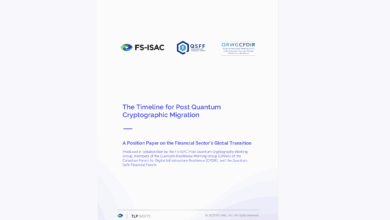
FS-ISAC’s New Roadmap for Post-Quantum Migration in Finance
Financial industry CISOs have a new playbook for the post-quantum era. The Financial Services Information Sharing and Analysis Center (FS-ISAC) has published a position paper titled “The Timeline for Post-Quantum Cryptographic Migration,” offering a detailed roadmap for the financial sector’s transition to quantum-resistant security. The paper lays out why banks and financial institutions must act now to avoid falling behind…
Read More » -
21 SeptemberQuantum Policy, Standards & Regulation News
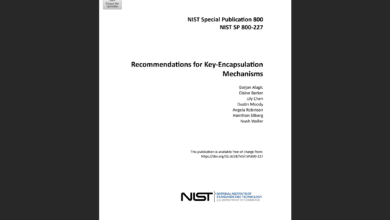
NIST Releases NIST SP 800-227 Recommendations for Key-Encapsulation Mechanisms
NIST has just released the initial public draft of CSWP 48, part of its Migration to Post-Quantum Cryptography project: "Mappings of Migration to PQC Project Capabilities to NIST Cybersecurity Framework 2.0 and to Security and Privacy Controls for Information Systems and Organizations."
Read More » -
20 SeptemberQuantum Policy, Standards & Regulation News
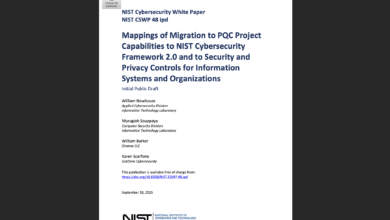
NIST Releases NIST CSWP 48 IPD – Mapping of Migration to PQC Project to NIST CSF 2.0
NIST has just released the initial public draft of CSWP 48, part of its Migration to Post-Quantum Cryptography project: "Mappings of Migration to PQC Project Capabilities to NIST Cybersecurity Framework 2.0 and to Security and Privacy Controls for Information Systems and Organizations."
Read More » -
5 SeptemberResearch News
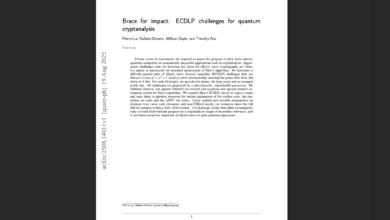
New Paper Alert: Brace for Impact: New ECDLP Challenge Ladder Benchmarks Quantum Threat to Bitcoin
The “Brace for Impact” ECDLP challenge suite is a great attempt to translate a looming cryptographic crisis into a concrete set of problems we can grapple with today. It provides a much-needed “ruler” to measure where we stand in the race between encryption and quantum decryption. The choice of Bitcoin’s secp256k1 curve for these challenges ties the abstract math to…
Read More » -
Jul- 2025 -31 JulyQuantum Policy, Standards & Regulation News
Quantum Cybersecurity Migration Act: U.S. Senate Ramps Up Push for Post-Quantum Readiness
On July 31, 2025, U.S. Senators Gary Peters (D-Mich.) and Marsha Blackburn (R-Tenn.) introduced the National Quantum Cybersecurity Migration Strategy Act, a bipartisan bill to ensure the federal government prepares for encryption-breaking quantum computers. The legislation directs a White House office (leveraging the NSTC’s ESIX subcommittee) to develop a comprehensive national strategy for post-quantum cybersecurity, and it mandates that federal…
Read More » -
15 JulyQuantum Security & PQC News
Future Encrypted: Post-Quantum Cryptography Tops the Cyber Agenda – Key Insights for CISOs
A new Capgemini Research Institute report, “Future Encrypted: Why Post-Quantum Cryptography Tops the New Cybersecurity Agenda”, reveals that while awareness of the quantum threat is rising at the executive level, organizational readiness is dangerously lagging. Nearly two-thirds of businesses now see quantum computing as the most critical cybersecurity threat of the next 3-5 years. “Quantum readiness isn’t about predicting a…
Read More » -
7 JulyQuantum Policy, Standards & Regulation News
Quantum-Readiness Roadmap: BIS Calls Finance to Prepare for the Post-Quantum Era
On July 7, 2025 the Bank for International Settlements (BIS) – often called the “central bank of central banks” – published a major paper titled “Quantum-readiness for the financial system: a roadmap.” This BIS Paper No. 158, authored by experts from BIS’s Innovation Hub and several central banks, provides a comprehensive framework to help the global financial sector transition to…
Read More » -
Jun- 2025 -26 JuneQuantum Policy, Standards & Regulation News
Government of Canada Launches Post-Quantum Cryptography (PQC) Migration Roadmap
On June 23, 2025 The Canadian Centre for Cyber Security (Cyber Centre) has issued a new roadmap for migrating the Government of Canada’s IT systems to post-quantum cryptography (PQC). Effective June 23, 2025, this guidance, "Roadmap for the migration to post-quantum cryptography for the Government of Canada (ITSM.40.001)" lays out clear deadlines and expectations for all federal departments and agencies to…
Read More » -
25 JuneQuantum Policy, Standards & Regulation News
The U.S. GAO Publishes a Quantum Threat Report – Right on Strategy but Wrong on Timing
The U.S. Government Accountability Office (GAO) has issued a June 2025 report titled “Quantum Computing: Leadership Needed to Coordinate Cyber Threat Mitigation Strategy” (GAO-25-108590). GAO makes many spot-on recommendations – calling for strong federal leadership, workforce development, investment in post-quantum readiness, and securing the quantum tech supply chain – and I wholeheartedly agree with these points. However, I strongly disagree…
Read More » -
24 JuneQuantum Policy, Standards & Regulation News
EU Commission Roadmap Targets 2030 for Post-Quantum Cryptography Transition
On June 23, 2025, the European Commission and EU Member States unveiled a coordinated roadmap to transition Europe’s digital infrastructure to post-quantum cryptography (PQC). This plan lays out a clear timeline for moving to quantum-resistant encryption, recognizing the urgent threat that future quantum computers pose to classical cryptography. PQC is seen as a key measure to deflect advanced cyber threats…
Read More » -
15 JuneQuantum Security & PQC News
“Tour de Gross” Bets That High‑Rate QLDPC Modules Can Beat the Surface Code on Qubit Economics – If Inter‑Module Measurements and Links Can Catch Up.
The June 2025 preprint “Tour de gross” proposes the bicycle architecture: a modular, long‑range‑connected fault‑tolerant quantum computing stack built around bivariate bicycle (BB) quantum LDPC codes and an explicit set of fault‑tolerant logical “bicycle instructions” (logical measurements, automorphisms, and T‑state injection). The paper’s central claim is architectural: for a fixed number of physical qubits and a fixed physical error rate,…
Read More » -
May- 2025 -28 MayResearch News
Quantum Breakthrough Slashes Qubit Needs for RSA-2048 Factoring
A new research preprint by Google Quantum AI scientist Craig Gidney has dramatically lowered the estimated resources needed to break RSA-2048 encryption using a quantum computer. Gidney’s May 2025 paper, “How to factor 2048 bit RSA integers with less than a million noisy qubits,” argues that a fault-tolerant quantum computer with under 1 million qubits could factor a 2048-bit RSA…
Read More » -
Apr- 2025 -30 AprilQuantum Security & PQC News
Europe’s New Cryptographic Rulebook Just Made PQC Official
30 Apr 2025 - For years, the EU's position on post-quantum cryptography could be summarized as "we're watching closely." That changed in April 2025, when the European Cybersecurity Certification Group - the body that decides which cryptographic mechanisms are acceptable for products certified under Europe's EUCC scheme - published Version 2.0 of its Agreed Cryptographic Mechanisms document. It's the first…
Read More »