USTC Demonstrates First Scalable Quantum Repeater Building Block

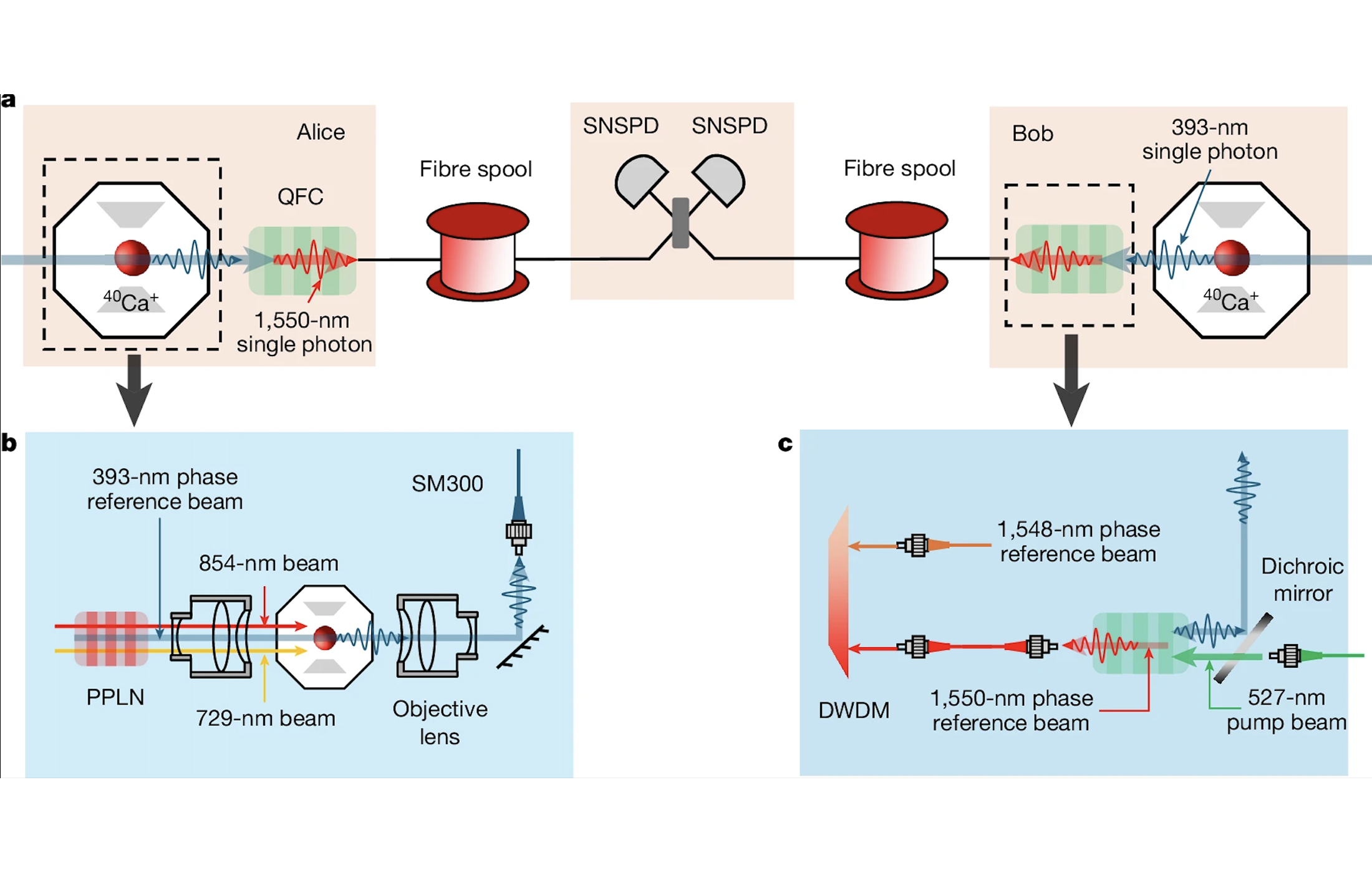
Table of Contents
5 Feb 2026 – A team led by Jian-Wei Pan and Qiang Zhang at the University of Science and Technology of China (USTC) has demonstrated what the field has been waiting for: remote memory-memory entanglement that survives longer than the time it takes to create it. Published in Nature, the result uses trapped calcium-40 ions connected by 10 km of spooled telecom fiber to achieve a coherence time of 550 ± 36 milliseconds against an average entanglement generation time of 450 ms — crossing a threshold that makes multi-stage quantum repeaters physically possible for the first time.
The team also demonstrated device-independent quantum key distribution (DI-QKD) over the same architecture, generating 1,917 secret key bits over 10 km with finite-size security analysis and showing a positive asymptotic key rate over 101 km of fiber — extending the achievable distance for DI-QKD by more than two orders of magnitude over previous demonstrations.
My Analysis: Why 100 Milliseconds Changes Everything
The headline number here is not impressive in absolute terms. A coherence time of 550 ms exceeding a generation time of 450 ms gives a margin of roughly 100 milliseconds — barely a fifth of a second. The distance is 10 km of spooled fiber in a lab. No one is building a continental quantum network with this hardware tomorrow.
But that misses the point entirely. This result crosses a fundamental threshold that separates “interesting physics experiment” from “building block for a scalable architecture.” Every previous demonstration of remote entanglement over metropolitan distances — using atomic ensembles, single atoms, or diamond color centers — suffered from the same fatal limitation: entanglement decohered faster than it could be established. That means you could never store entanglement in one link while waiting for the next link to succeed. You could never chain segments together. You could never build a quantum repeater.
The USTC result changes this. As Ronald Hanson (QuTech/Delft) and Tracy Northup (Innsbruck) noted in their accompanying Nature commentary, it represents the first time entanglement across a long-distance link has been generated faster than it decays — the essential prerequisite for chaining repeater nodes together.
The technical ingredients that made it work
Three engineering advances converged to make this possible.
First, the trapped-ion quantum memories themselves. The team encodes qubits in the S₁/₂ and D₅/₂ states of ⁴⁰Ca⁺ ions, then transfers the entangled state to a longer-lived encoding using stimulated Raman transitions and Knill dynamical decoupling pulses at 0.5 ms intervals. The D₅/₂ state has a natural lifetime of 1.16 seconds — long enough to serve as a working memory if decoherence from magnetic field noise can be suppressed. The decoupling sequence achieves this, yielding the 550 ms entanglement coherence time.
Second, an efficient and low-noise telecom interface. Single photons at 393 nm from the ions are converted to 1,550 nm telecom wavelength via periodically poled lithium niobate (PPLN) waveguides — a single-step frequency conversion that slots directly into existing fiber infrastructure. The critical challenge is noise: the broadband conversion process generates 1.3 × 10⁵ background photons per second per nanometre around 1,550 nm. The team hammered this down to 35 counts per second using cascaded spectral filtering (100 GHz bandpass, 10 GHz volume Bragg grating, 40 MHz etalon) while maintaining 28% combined transmission. At the operating point, the signal-to-noise ratio exceeded 100:1.
Third, a high-visibility single-photon entanglement protocol (SPEP) with active phase stabilization. Single-photon interference protocols are inherently more efficient than two-photon schemes — the entanglement rate scales linearly rather than quadratically with link efficiency — but they demand extraordinary phase stability across the entire optical path. The team combined wavelength-division multiplexing (a 1,548 nm reference co-propagating with 1,550 nm signal photons) and time-division multiplexing (a weak 393 nm reference pulse during Doppler cooling periods) to achieve an interference contrast of 0.986 ± 0.005 through the full 10 km link.
The quantum link efficiency threshold
The paper introduces a metric that deserves wider adoption: the quantum link efficiency, defined as the ratio of entanglement generation rate to decoherence rate. At an excitation probability of α = 17%, the entanglement rate reaches 2.226 Hz and the decoherence rate is 1.8 Hz, yielding a quantum link efficiency of 1.2. This exceeds the critical threshold of 0.83 required for deterministic delivery of remote entanglement — a benchmark established by Humphreys et al. (2018) at QuTech using nitrogen-vacancy centers in diamond over much shorter distances.
The practical consequence: the expected fidelity of a Bell pair stored from a previous entanglement round, evaluated at the moment the next round succeeds, is 0.578 ± 0.006. This is above the 0.5 classical limit — meaning the stored entanglement retains genuinely quantum correlations that could in principle be used for entanglement swapping or purification. The fidelity is not high enough for direct use in a practical repeater chain (you would need purification protocols to boost it), but the principle of “store one, generate the next” has been demonstrated.
DI-QKD: from 700 meters to 101 km
The paper’s second major result is a proof-of-principle device-independent QKD demonstration that leverages the same high-fidelity entanglement. DI-QKD is the gold standard of quantum cryptography — security is certified entirely through observed violations of Bell inequalities, requiring zero trust in the measurement hardware. Previous DI-QKD demonstrations had been limited to roughly 700 meters.
Over a 10 km fiber link, the team collected 405,145 experimental rounds over approximately two months of continuous operation (386.1 valid hours). The CHSH Bell inequality violation reached S = 2.5758 ± 0.0059, well above the classical bound of 2, with a quantum bit error rate of 3.6%. Using a complementarity-based finite-size security analysis, they extracted 1,917 secret key bits — a key rate of approximately 4 × 10⁻³ bits per round.
Over 101 km, they accumulated 2,799 rounds with S = 2.504 ± 0.075 and showed a positive asymptotic key rate of 0.0974 per round. The finite-size analysis was not performed at this distance due to limited data, but the asymptotic result demonstrates that the physics works at metropolitan-to-intercity scales.
To put the distance improvement in perspective: extending DI-QKD from ~700 meters to 10 km (with finite-key security) represents a roughly 14× improvement. Extending to 101 km (asymptotic) represents a roughly 140× improvement. A companion paper by Lu et al., published simultaneously in Science, demonstrated DI-QKD over 100 km using trapped rubidium atoms — a parallel effort from the same broader USTC group achieving comparable distance with a different atomic species.
What this means for quantum networks — and what it doesn’t
Let me be direct about both the significance and the limitations.
What it means: This is the first experimental demonstration that the fundamental operating principle of a quantum repeater — storing entanglement while establishing the next link — actually works over nontrivial distances. The physics is validated. The quantum link efficiency exceeds the deterministic threshold. The entanglement fidelity, while modest, is above the classical limit at the operationally relevant timescale. As I discussed in my analysis of China’s quantum networking dominance, this result is arguably the most consequential single milestone in the quantum repeater field to date.
What it doesn’t mean: A 10 km lab demonstration with 550 ms coherence time and 0.578 fidelity is not a quantum repeater. It is a single building block — the elementary link — that has crossed one critical threshold. Building an actual multi-node repeater chain that extends entanglement over hundreds or thousands of kilometers requires:
- Entanglement swapping between adjacent links — demonstrated in principle but never at these distances with these fidelities
- Entanglement purification — essential to boost the 0.578 fidelity to usable levels, adding complexity and reducing rates
- Multi-node coordination — classical control, synchronization, and routing across chains of repeater nodes
- Independent laser systems — the current experiment shares a common laser between nodes, which simplifies phase stabilization enormously but is impractical for a deployed network
- Dramatically higher rates — 2.2 Hz is adequate for proof-of-principle but orders of magnitude below what operational networks would require
The paper’s outlook section is refreshingly honest about these gaps. They identify clock-transition storage qubits, decoherence-free subspaces, cavity-enhanced photon collection, multi-ion multiplexing, and cross-node optical frequency referencing as necessary next steps. Each of these is a substantial engineering challenge.
The broader strategic picture
This result validates the quantum repeater approach. The theoretical community has long argued that quantum repeaters would eventually overcome the fundamental distance limitations of direct quantum communication. Skeptics have countered that the coherence time / generation time race would never be won at practical distances. This paper settles the question at the proof-of-principle level. The race has been won at 10 km. The engineering challenge now is scaling.
Second, it reinforces China’s commanding position in quantum networking. As I documented in my comprehensive analysis of China’s quantum networking program, the USTC group under Pan Jianwei has systematically built the world’s most advanced quantum communication capability — from the Micius satellite to the Beijing-Shanghai backbone to TF-QKD beyond 1,000 km of fiber. This repeater result, combined with the simultaneous DI-QKD demonstration, adds the two missing pieces — quantum memory integration and device-independent security — to an already formidable portfolio. European groups at Delft, Innsbruck, and Oxford are pursuing comparable approaches, but no one else has demonstrated this particular threshold crossing at this distance.
The gap between a 10 km demonstration and a 1,000 km operational repeater chain is vast. But with this paper, the gap is now an engineering problem, not a physics problem. That distinction matters enormously — because engineering problems, given sufficient resources and time, get solved. And if there is one lesson from China’s quantum program, it is that resources and institutional patience are not the limiting factors.
Quantum Upside & Quantum Risk - Handled
My company - Applied Quantum - helps governments, enterprises, and investors prepare for both the upside and the risk of quantum technologies. We deliver concise board and investor briefings; demystify quantum computing, sensing, and communications; craft national and corporate strategies to capture advantage; and turn plans into delivery. We help you mitigate the quantum risk by executing crypto‑inventory, crypto‑agility implementation, PQC migration, and broader defenses against the quantum threat. We run vendor due diligence, proof‑of‑value pilots, standards and policy alignment, workforce training, and procurement support, then oversee implementation across your organization. Contact me if you want help.
Related Content