Silicon Runs Its First Real Algorithm: Grover’s Search on Four Qubits With Every Gate Above Threshold

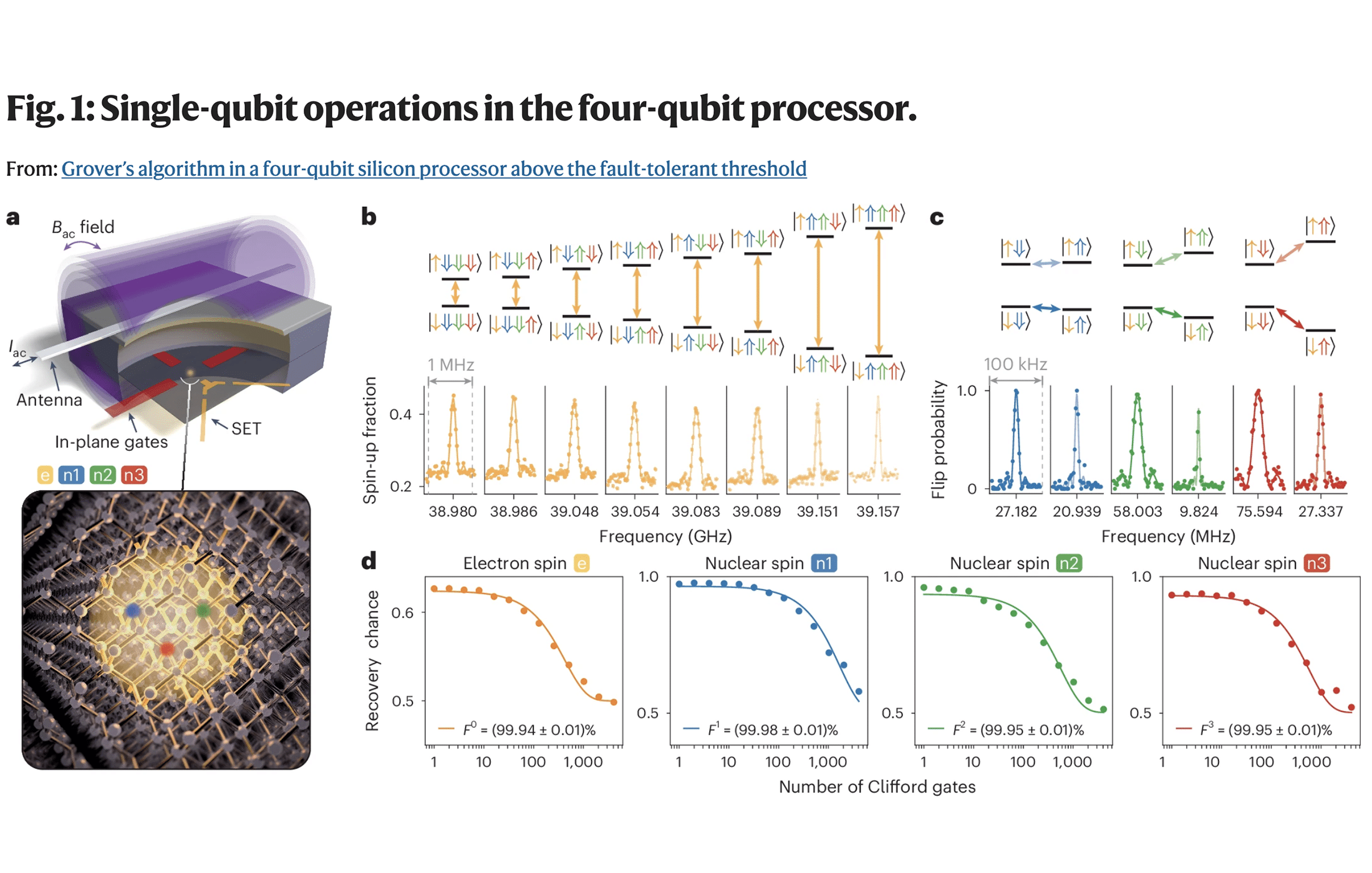
Table of Contents
24 Feb 2025 – There is a difference between proving you can throw a ball and proving you can play a game. For three years, silicon spin qubits have been proving they can throw: individual gate operations above the fault-tolerance threshold, entanglement between pairs and triplets of qubits, the steady accumulation of quality metrics that justify the platform’s ambitions. But executing a meaningful multi-qubit algorithm — stringing together dozens of operations across multiple qubits while maintaining coherence and fidelity throughout — has remained stubbornly out of reach. Only two-qubit algorithms had been demonstrated in silicon. Until now.
Silicon Quantum Computing (SQC), the Sydney-based company led by Michelle Simmons, has demonstrated Grover’s search algorithm on a four-qubit silicon processor with approximately 95% probability of finding the marked state. Published in Nature Nanotechnology, the result is significant not just for the algorithm itself but for the conditions under which it was achieved: every single control operation in the processor — every single-qubit gate, every two-qubit gate, every measurement — operates above the fault-tolerant threshold. No cherry-picking, no “best-case” metrics. The entire system performs above the line.
This is the first multi-qubit algorithm beyond two qubits demonstrated in silicon spin qubits. And it runs at fidelities that suggest silicon’s transition from proof-of-concept to engineering platform is well underway.
The Processor
The SQC processor consists of three phosphorus atoms precision-placed into isotopically purified ²⁸Si using scanning tunnelling microscopy lithography — the atomic-precision fabrication technique that has been Simmons’ hallmark since her group built the world’s first single-atom transistor in 2012. The three phosphorus donors share a single localised electron, and the four qubits are the three nuclear spins of the phosphorus atoms plus the electron spin itself.
This architecture — nuclear spins controlled and interconnected via a shared electron — gives the processor a distinctive advantage: native multi-qubit connectivity. The hyperfine interaction between each nuclear spin and the electron enables single-pulse multi-qubit gates, specifically controlled-Z operations between any pair of nuclear spins mediated by the electron. On other platforms, such all-to-all connectivity typically requires either physical qubit movement or complex gate decompositions. Here, it falls out naturally from the physics of the donor cluster.
The performance numbers are striking in their consistency. Single-qubit gate fidelities exceed 99.9% for all qubits — enabled by the exceptionally long coherence times of nuclear spins in purified silicon. Two-qubit CZ gate fidelities exceed 99% for all pairs of nuclear spins, measured via interleaved randomized benchmarking. The three-qubit GHZ state — the maximally entangled state across three qubits — was prepared with 96.2% fidelity.
These are not peak values selected from a distribution. They represent the operational baseline across the entire processor.
Grover’s Algorithm at 95%
Grover’s search algorithm is the textbook demonstration of quantum speedup: given an unsorted database of N items, a classical computer needs O(N) queries to find a specific entry, while Grover’s algorithm finds it in O(√N). For three qubits searching across eight possible states, the algorithm requires two Grover iterations — each consisting of an oracle (marking the target state) and a diffusion operator (amplifying its amplitude).
The SQC team ran the algorithm for all eight possible marked states. For the best case (|⇓⇓⇓⟩), the algorithm found the marked state with 93.46% probability — corresponding to 98.87% of the theoretical ideal of 94.53%. Averaged across all eight marked states, the success probability was 89.4% ± 2.5%, or approximately 94.6% of ideal performance.
The ~95% headline figure (normalized to ideal) makes this one of the most successful implementations of Grover’s algorithm on any qubit platform, though direct cross-platform comparisons require care because of differences in qubit count, circuit depth, and characterization methods.
What makes the result particularly credible is that it was achieved without post-selection or error mitigation. The raw output of the quantum circuit, measured directly, produced a ~95% success rate. This is the kind of clean result that comes from having every component above threshold: when no single gate is the weak link, the whole circuit benefits.
From Metrics to Algorithms
The transition from isolated gate benchmarks to algorithmic performance is not trivial, and this paper illuminates why.
Individual gate fidelities can be benchmarked in isolation — a single two-qubit gate, applied and reversed, with the fidelity extracted from how well the system returns to its starting state. But an algorithm requires many gates applied sequentially, with errors accumulating. Cross-talk between qubits — where operating on one qubit perturbs its neighbours — becomes relevant only when multiple qubits are active simultaneously. Decoherence during the total circuit runtime limits how deep the computation can go.
The SQC processor navigates these challenges through a combination of long coherence times (nuclear spins decohere slowly), fast gate operations (the electron-mediated CZ gates execute in microseconds), and the native multi-qubit connectivity that eliminates the need for SWAP gates and other routing operations that inflate circuit depth on architectures with limited connectivity.
The lesson for the field: gate fidelity above threshold is necessary but not sufficient. What matters for computation is sustained high-fidelity operation across the full processor, over the full depth of a circuit. This paper demonstrates that silicon donor qubits can deliver that.
What It Means for the CRQC Trajectory
For security professionals tracking the path to a cryptanalytically relevant quantum computer, this result advances silicon’s position along several dimensions.
First, it demonstrates that silicon can execute multi-qubit algorithms with meaningful circuit depth — not just isolated gate operations. The Grover circuit involves dozens of individual gate operations across three data qubits plus an ancilla. This is still far from the millions of gates required for cryptographic attacks, but it represents a qualitative leap from two-qubit demonstrations.
Second, it validates the donor cluster architecture as a building block for larger systems. The paper explicitly looks ahead to “coupling neighbouring nuclear spin registers via electron–electron exchange” — connecting multiple three- or four-qubit clusters into a larger processor. This modular vision, where each cluster serves as a high-fidelity node interconnected through electron exchange, is SQC’s roadmap toward scalable quantum computing.
Third, it comes from a company, not just an academic lab. SQC is backed by significant investment (A$83 million seed round plus subsequent funding) and operates with an explicit commercial mandate to build a fault-tolerant quantum computer. The fact that this result was produced by a company with industrial ambitions, using atomically precise fabrication, signals that silicon donor qubits are transitioning from academic curiosity to engineering programme.
The gap between a four-qubit Grover search and breaking RSA-2048 remains enormous — thousands of logical qubits, millions of physical qubits, and error correction protocols that haven’t been demonstrated in silicon at all. But the gap between “silicon can’t run algorithms” and “silicon can run algorithms above threshold” just closed. That’s the kind of gap that matters for long-term planning.
Organizations still calibrating their PQC migration timelines should note: the number of qubit platforms demonstrating algorithmic capability above threshold continues to grow. Silicon is no longer waiting in the wings.
Quantum Upside & Quantum Risk - Handled
My company - Applied Quantum - helps governments, enterprises, and investors prepare for both the upside and the risk of quantum technologies. We deliver concise board and investor briefings; demystify quantum computing, sensing, and communications; craft national and corporate strategies to capture advantage; and turn plans into delivery. We help you mitigate the quantum risk by executing crypto‑inventory, crypto‑agility implementation, PQC migration, and broader defenses against the quantum threat. We run vendor due diligence, proof‑of‑value pilots, standards and policy alignment, workforce training, and procurement support, then oversee implementation across your organization. Contact me if you want help.
Related Content