Eleven Qubits, Two Registers, One Processor: Silicon Quantum Computing Links Atomic-Scale Nodes With Record Fidelity

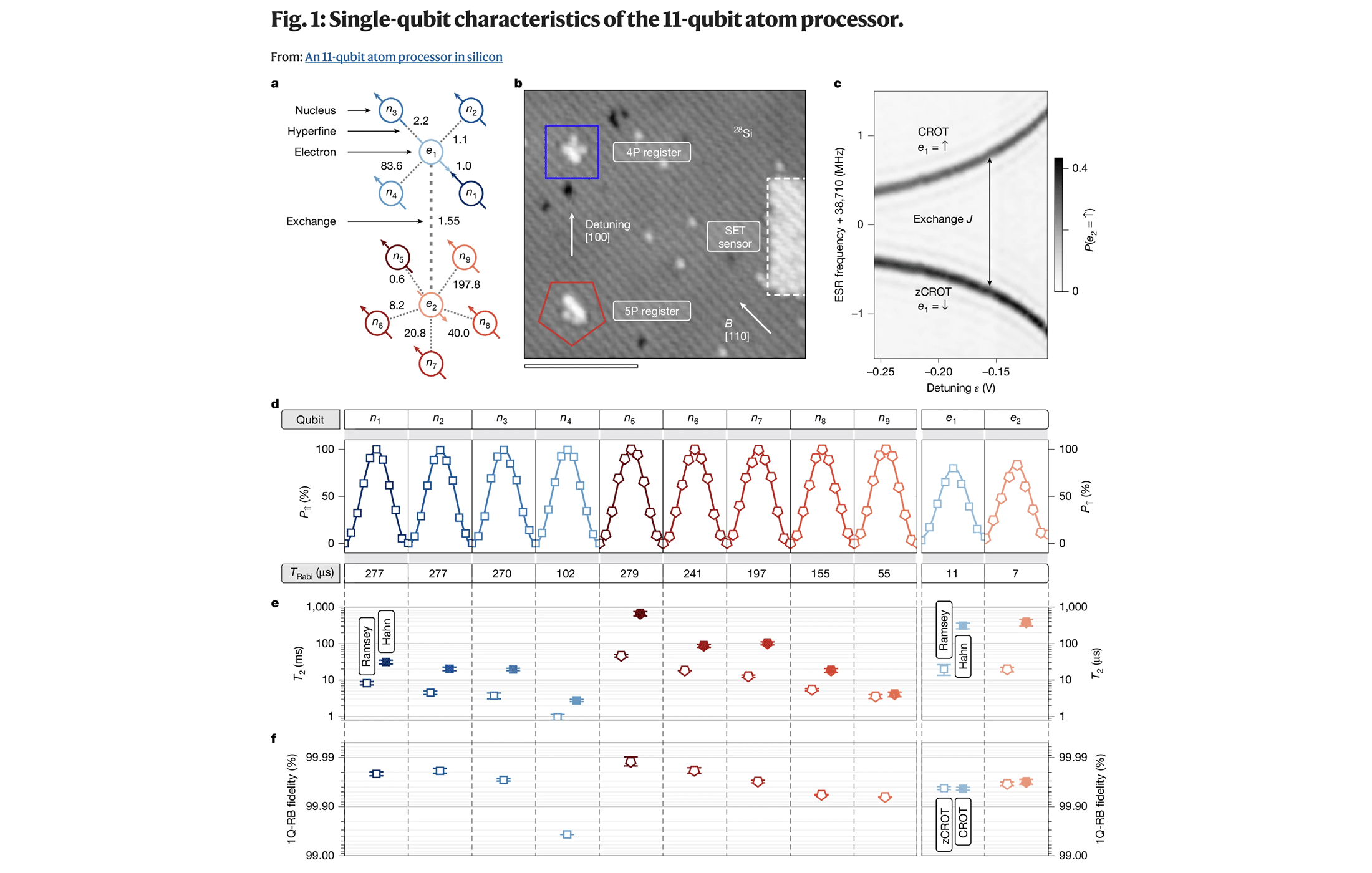
Table of Contents
21 Dec 2025 – Every scalable quantum computing architecture faces the same fundamental problem: individual qubits are small, but quantum computers are not just collections of individual qubits. They are networks. And the performance of a network depends not only on the quality of its nodes but on the quality of the connections between them.
For silicon donor qubits, this problem has a specific physical form. A cluster of phosphorus atoms sharing an electron makes an excellent few-qubit register — long coherence times, high gate fidelities, native multi-qubit connectivity through the hyperfine interaction. Silicon Quantum Computing (SQC) demonstrated as much earlier this year with a four-qubit processor that ran Grover’s algorithm above the fault-tolerance threshold. But a single cluster of three or four donors can only hold so many qubits. To build a larger processor, you must connect clusters — and the question is whether those inter-cluster connections can be made fast and clean enough that they don’t become the system’s weak link.
SQC has now answered that question. Published in Nature, the team’s 11-qubit atom processor links two precision-placed phosphorus donor registers — a four-atom cluster and a five-atom cluster, engineered 13 nanometres apart — through electron exchange interaction. The result is a fully controlled processor where every gate, single- and multi-qubit, local and non-local, achieves fidelities ranging from 99.1% to 99.9%. The two-qubit gate fidelity of 99.9% is itself a record for silicon qubits.
This is the largest silicon donor processor ever demonstrated. And it is the first to show that connecting registers does not degrade performance — it can actually improve it.
The Architecture
The processor comprises two nuclear spin registers: a 4P register (four phosphorus atoms hosting nuclear spins n1–n4 and a shared electron e1) and a 5P register (five phosphorus atoms hosting n5–n9 and a shared electron e2). The two clusters were positioned 13 nm apart using SQC’s scanning tunnelling microscopy hydrogen lithography — the same atomic-precision fabrication technique that distinguishes the donor approach from gate-defined quantum dot architectures.
Within each register, nuclear spins are controlled via NMR pulses and coupled to each other through their shared electron’s hyperfine interaction — the same mechanism that powered the four-qubit Grover demonstration. Between registers, the two electrons are coupled via exchange interaction, controlled by voltage detuning. This electron-electron link enables non-local two-qubit gates between any nuclear spin in register 1 and any nuclear spin in register 2 — all-to-all connectivity across the full 11-qubit system.
The key insight of the architecture is modularity. Each register functions as a self-contained quantum computing node with high internal connectivity. The inter-register electron link then networks those nodes into a larger processor. This is the atomic-scale analogue of the chiplet architectures being explored for classical computing — except here, the “chiplets” are clusters of precisely placed atoms.
The Numbers
The performance characterization is exhaustive and, for the silicon community, somewhat startling in its consistency.
Single-qubit gate fidelities, measured via randomized benchmarking, range from 99.10% to 99.99% across all nine nuclear spin qubits and both electron qubits. Ramsey coherence times range from 1.3 ms to 13.9 ms for nuclear spins and 0.34 ms for electron spins, with Hahn echo times reaching up to 31 ms for certain nuclear spins.
Two-qubit gate fidelities are where the record lands. The geometric CZ gate between nuclear spins n6 and n9 achieved 99.9% Clifford fidelity — the first time any silicon two-qubit gate has reached this level. The electron-electron CROT (controlled rotation) gate that links the two registers achieved 99.2% fidelity, demonstrating that the inter-register connection performs at the same calibre as intra-register operations.
Bell state fidelities — the standard measure of two-qubit entanglement quality — ranged from 91.4% to 99.5% within registers and from 87.0% to 97.0% across registers. The team extended entanglement to GHZ states with up to eight nuclear spins, demonstrating that coherent multi-qubit entanglement can be sustained across both registers simultaneously.
Perhaps the most important number is not the highest fidelity but the lowest: 99.10%. In a system where the weakest link determines the effective performance of error correction, having a floor of 99.1% means the entire processor operates above the commonly cited surface code threshold. No qubit is dragging the system down.
Why This Matters: The Scaling Argument
Silicon donor qubits have always carried a particular tension. Their individual qubit quality — coherence times of seconds, gate fidelities approaching 99.99% — is among the best of any platform. But their fabrication method — placing individual atoms with sub-nanometre precision using an STM — raises the obvious question: can this possibly scale?
The 11-qubit processor addresses the scaling question at the architectural level, even if the absolute qubit count remains small. The key demonstration is not “we made 11 qubits” but rather “we connected two independent registers and everything stayed above threshold.” This is the foundational experiment for a modular scaling strategy: if connecting two registers works without performance degradation, connecting ten registers — or a hundred — is an engineering challenge, not a physics question.
The paper explicitly makes this argument, noting that “coupling neighboring nuclear spin registers via electron–electron exchange may enable larger, fault-tolerant quantum processors.” The calibration and control protocols developed for this two-register system were designed to scale linearly with additional registers, avoiding the combinatorial explosion that plagues some other multi-qubit calibration schemes.
For the broader silicon community — which now includes Intel (gate-defined quantum dots on 300 mm wafers), Diraq (CMOS-compatible quantum dots), and Quantum Motion (spin qubits with cryo-CMOS integration) — the SQC result offers both a benchmark and a challenge. The donor approach achieves the highest fidelities in silicon but requires atomic-precision fabrication. The quantum dot approaches offer easier fabrication but have not yet matched these fidelity levels across multi-qubit systems. The competition between these sub-modalities within silicon will be one of the defining dynamics of the field over the coming years.
Implications for Quantum Security
The 11-qubit processor is noteworthy for what it demonstrates about silicon’s trajectory rather than for any near-term threat implication.
Eleven qubits cannot threaten any cryptographic system. But the architecture demonstrated here — modular registers with all-to-all connectivity, linked through exchange coupling, with every operation above the fault-tolerance threshold — is precisely the kind of building block that could eventually compose into a fault-tolerant quantum computer. The path from 11 physical qubits to the thousands of logical qubits required for cryptographic attacks remains long. But it is now a path with a visible architecture, not merely a theoretical hope.
The 99.9% two-qubit gate fidelity is also worth noting in the context of error correction overhead. Higher physical gate fidelities translate directly to lower overhead — fewer physical qubits per logical qubit, smaller error correction circuits, less demanding decoder requirements.
Silicon’s combination of high fidelity, long coherence, CMOS-compatible material, and now demonstrated modular connectivity makes it the platform most likely to benefit from architectural innovations in error correction — particularly the shift from surface codes to more efficient qLDPC codes that offer dramatically better logical-to-physical qubit ratios.
Security leaders should watch this space. Silicon is assembling all the pieces. The question is when they snap together.
Quantum Upside & Quantum Risk - Handled
My company - Applied Quantum - helps governments, enterprises, and investors prepare for both the upside and the risk of quantum technologies. We deliver concise board and investor briefings; demystify quantum computing, sensing, and communications; craft national and corporate strategies to capture advantage; and turn plans into delivery. We help you mitigate the quantum risk by executing crypto‑inventory, crypto‑agility implementation, PQC migration, and broader defenses against the quantum threat. We run vendor due diligence, proof‑of‑value pilots, standards and policy alignment, workforce training, and procurement support, then oversee implementation across your organization. Contact me if you want help.
Related Content