Canada’s PQC Procurement Playbook: ITSM.00.501 Moves Post-Quantum From Strategy to Contract Language

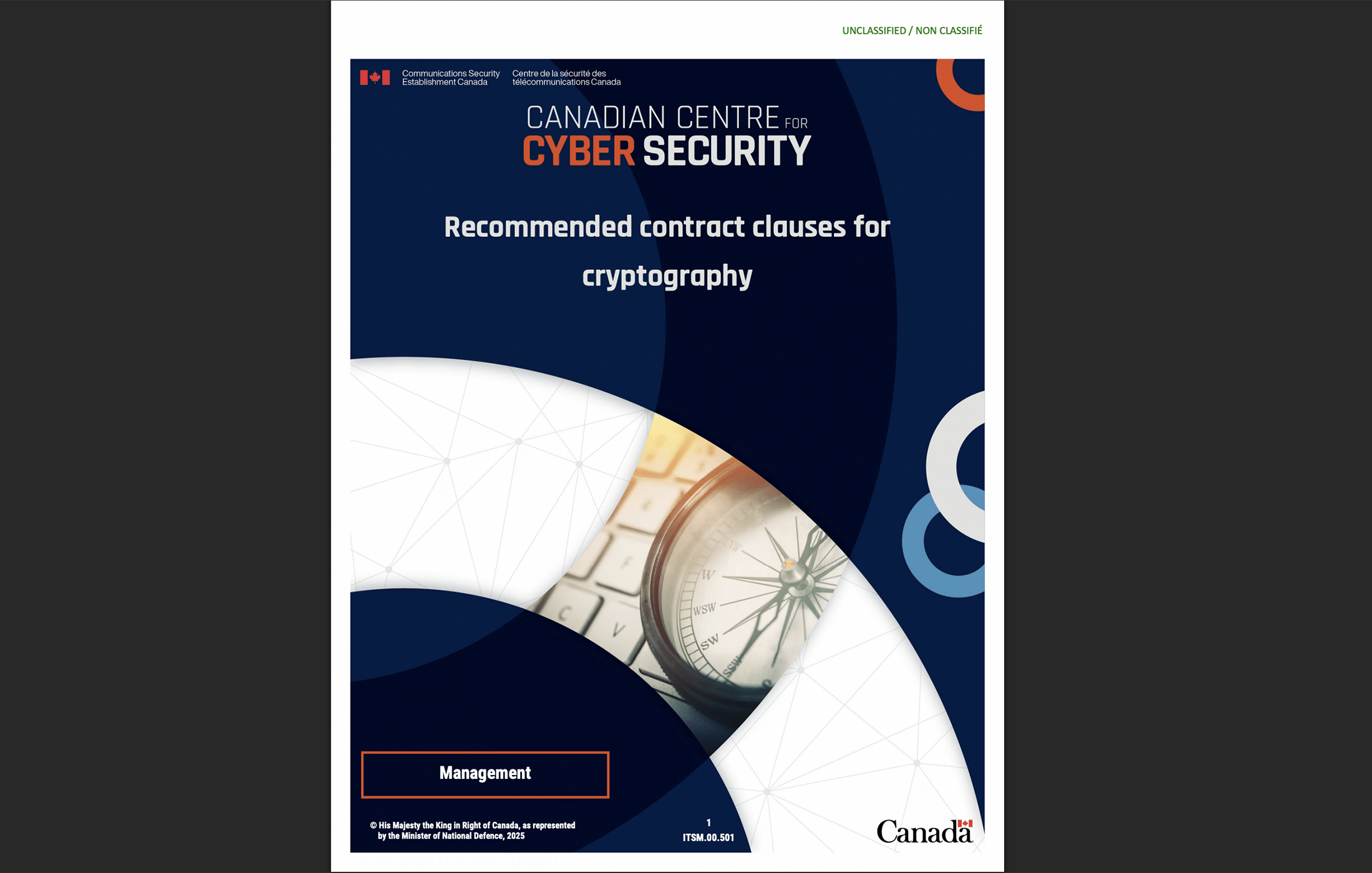
10 Oct 2025 – The Canadian Centre for Cyber Security’s newly released ITSM.00.501 is the most procurement-ready PQC artifact Canada has published so far: it translates “migrate to PQC” into contract clauses that vendors can actually quote, negotiate, and commit to. The headline signal is a vendor-facing expectation that key establishment and digital signature cryptographic modules support PQC by the end of 2026, backed by cryptographic agility requirements and CMVP/CAVP validation language. While ITSM.00.501 is not law (and is explicitly not legal advice), it becomes materially more consequential when paired with Treasury Board direction that makes these types of clauses standard for new federal contracts with digital components.
What was published and when
ITSM.00.501 (“Recommended contract clauses for cryptography”) is a Management-series publication with Revision 1 listed as “First release: September 1, 2025.” The publication states it “takes effect on September 2025,” but does not specify a day for the effective date (only a month).
Two framing points matter for how procurement teams should use it. First, the document positions its clauses as examples rather than prescribed legal text, and recommends seeking legal/procurement advice when using them. Second, it is explicitly scoped to cryptography protecting UNCLASSIFIED / PROTECTED A / PROTECTED B information (i.e., the same “non-classified” envelope that anchors most of Canada’s published crypto and PQC guidance).
What the recommended clauses actually demand
ITSM.00.501’s most important contribution is specificity—particularly in four areas:
It binds crypto requirements to the Cyber Centre’s algorithm baseline (ITSP.40.111), including “CSE-approved” algorithms, parameters, and key lengths, and it emphasizes that ITSP.40.111 is updated as guidance evolves.
It sets a clear PQC support timeline in its example clause language: by the end of 2026, cryptographic modules implementing key establishment and digital signatures should support appropriate PQC “compliant” with ITSP.40.111. The document also frames this as a way to buy now while obligating upgrades by a fixed date (rather than waiting for “PQC-ready” SKUs).
It operationalizes cryptographic agility: clauses call for configurable algorithms/parameters/crypto periods, plus support for vendor-signed patches and updates – a subtle but important hook for secure update pipelines and long-lived systems.
It hardens assurance language via CAVP/CMVP: algorithms should be CAVP-validated, modules should be CMVP-validated (with active certification), and operation should follow the module’s security policy (approved/allowed modes).
How this operationalizes the roadmap and why the market should care
Canada’s PQC roadmap (ITSM.40.001) already signaled that procurement must carry PQC requirements (PQC per ITSP.40.111, CMVP validation, crypto agility). ITSM.00.501 effectively provides the missing “how-to” text procurement teams need to write enforceable RFP and contract language.
Treasury Board’s PQC SPIN (October 9, 2025) then turns this into a practical, time-bound procurement lever: contracts with a digital component entered into after April 1, 2026 are expected to include clauses aligned to the Cyber Centre’s recommendations – explicitly calling out PQC compliance with ITSP.40.111, CMVP-certified modules, and cryptographic agility. This is where vendors should pay attention: the “recommended clauses” become a de facto federal buying requirement, and therefore a roadmap driver for product teams selling into Canada’s public sector supply chain.
The gaps/risks are also clear. Enforcement still depends on procurement execution and contract management, and the scope is fundamentally anchored to federal (and up to Protected B) systems; applicability beyond federal procurement is not explicit in the document itself.
Actionable advice for vendors and procurement teams
- Vendors: publish a concrete PQC/crypto roadmap showing how your key establishment and signature components will meet the end-of-2026 PQC support expectation, and map explicitly to ITSP.40.111 terminology.
- Vendors: treat CMVP/CAVP evidence as a deliverable, not a footnote—prepare certificate references, security-policy operating modes, and upgrade commitments that are contract-grade.
- Procurement teams: require crypto agility (configurable algorithms/parameters and signed updates) and write measurable SLAs for staying aligned with evolving Cyber Centre crypto guidance over the contract term.
Overall, ITSM.00.501 materially advances Canada’s quantum readiness by making PQC a procurement requirement that vendors can be held to – especially once combined with Treasury Board’s contract-timing direction.
Quantum Upside & Quantum Risk - Handled
My company - Applied Quantum - helps governments, enterprises, and investors prepare for both the upside and the risk of quantum technologies. We deliver concise board and investor briefings; demystify quantum computing, sensing, and communications; craft national and corporate strategies to capture advantage; and turn plans into delivery. We help you mitigate the quantum risk by executing crypto‑inventory, crypto‑agility implementation, PQC migration, and broader defenses against the quantum threat. We run vendor due diligence, proof‑of‑value pilots, standards and policy alignment, workforce training, and procurement support, then oversee implementation across your organization. Contact me if you want help.
Related Content