Q-Day Knowledge Center & Q-Day Framework and Estimator


Your complete guide to understanding, forecasting, and preparing for quantum decryption risk.
Quantum decryption (“Q-Day”) is no longer a fringe topic: governments and major cloud providers now treat it as a credible near-term cybersecurity event.
This post is your structured entry point into the complete set of resources, methodologies, forecasts, and tools I developed over the years to understand when a cryptographically relevant quantum computer (CRQC) might emerge – and what to do about it.
Whether you’re a policymaker, CISO, researcher, regulator, journalist, or just deeply curious, this guide will help you navigate the landscape.
1. Start Here: The Definitive Framework
CRQC Quantum Capability Framework
If you read only one resource, read this one. But warning – it’s a long read.
This is the master blueprint for predicting Q-Day.
It breaks quantum readiness into nine technical capabilities plus one cross-cutting engineering capability – everything from quantum error correction, to magic-state distillation, to decoder performance, to continuous multi-day operation.
Each capability has its own in-depth explainer:
- Quantum Error Correction (B.1)
- Syndrome Extraction (B.2)
- Below-Threshold Operation (B.3)
- Qubit Connectivity & Routing (B.4)
- Logical Clifford Gates (C.1)
- Magic-State Production (C.2)
- Full Fault-Tolerant Algorithm Integration (D.1)
- Decoder Performance (D.2)
- Continuous Operation (D.3)
- Engineering Scale & Manufacturability (E.1)
Together they form the “deep stack” of what must be achieved before any quantum computer can break RSA-2048 or ECC.
I’ve just updated this framework, but in its previous iterations it has already been used by national security analysts, industry analysts, national labs, and industry experts worldwide.
2. Executive-Level Prediction Model
CRQC Readiness Benchmark

If the framework above is the foundation, this is the dashboard.
The benchmark compresses the nine capabilities into three executive levers:
- LQC – Logical Qubit Capacity – How many usable logical qubits the hardware can maintain simultaneously.
- LOB – Logical Operations Budget – How deep a calculation it can survive before failing.
- QOT – Quantum Operations Throughput – How fast it can execute logical operations, including T-gates and lattice surgery.
These three numbers give you a single snapshot of quantum readiness.
3. The Q-Day Estimator Tool
Interactive Model: CRQC Readiness Benchmark & Q-Day Estimator
CRQC Readiness Benchmark (Q-Day Estimator)
Current Capability (Supply)
Benchmark Explanation | Scorecard | CRQC Capability Framework
This is the interactive version of the benchmark. Move the sliders – Change assumptions – Toggle between simplified and advanced modes – Run “what-if?” scenarios.
The estimator tells you what combinations of:
- logical qubits
- operations budget
- throughput
- physical-error rates
- connectivity
- decoder speed
- manufacturability
would be sufficient to break RSA-2048 (or other crypto systems) in realistic time.
It’s a public model letting you experiment with the CRQC stack as if you were designing the quantum computer yourself.
The practical guide to how to use it is at How, You, Too Can Predict Q-Day (Without the Hype). This step-by-step guide distills the entire framework into a simple methodology anyone can follow.
It walks you through:
- How to think about physical vs. logical qubits
- How to map quantum capabilities to cryptographic vulnerability
- How to estimate timelines without overshooting or underestimating
- How to separate hype from real engineering progress
- Why most public predictions are mathematically incoherent
If you want a rational, defensible way to talk about Q-Day, this is your playbook.
4. The Forecast: RSA-2048 Broken by ~2030
RSA-2048 Broken by 2030 ± 1–2 Years

This is my current best estimate based on:
- Gidney-style classical and quantum cost models
- The nine-capability maturity trajectories
- The manufacturing trajectory
- Ion-trap and superconducting roadmaps
- Real experimental progress (not speculative claims)
- What’s publicly visible—and plausible behind classified curtains
The conclusion is clear:
Q-Day is most likely around 2030 ± 1–2 years. Possibly earlier. Unlikely later.
The article also explores accelerators, blind spots, and real-world uncertainty distribution curves.
5. The Q-Day Domain Hub
Q-Day.org
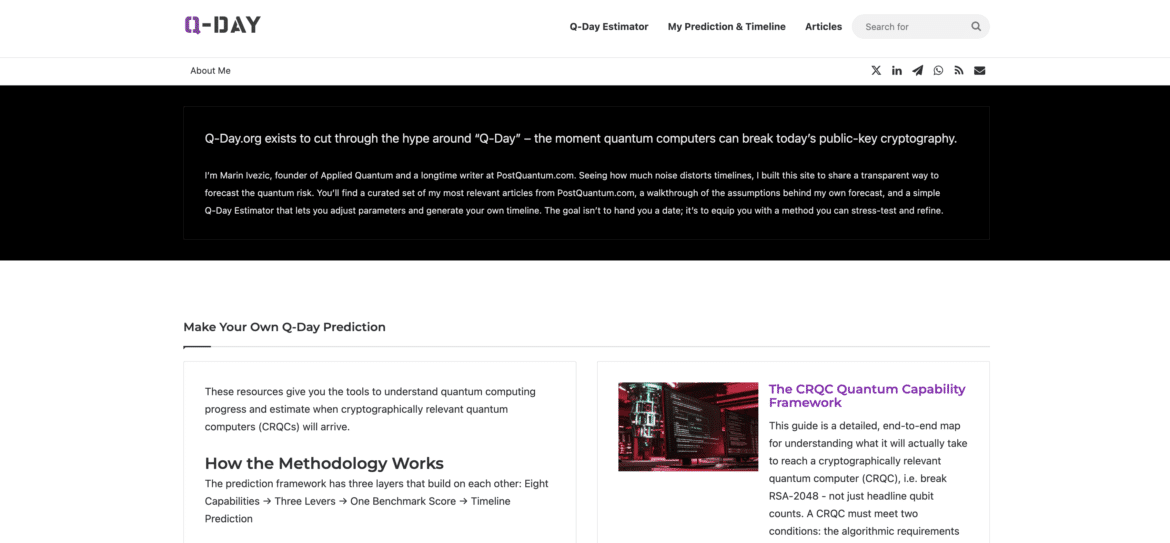
This is the public portal consolidating all my work on:
- Q-Day predictions
- Cryptanalytic risk
- Reporting on new quantum milestones
- Guidance for CISOs, regulators, policymakers
- Links to all PostQuantum.com deep-dive content
- Every capability article
- Media resources
- The benchmark tool
- The estimator
- My latest commentary
Quantum Upside & Quantum Risk - Handled
My company - Applied Quantum - helps governments, enterprises, and investors prepare for both the upside and the risk of quantum technologies. We deliver concise board and investor briefings; demystify quantum computing, sensing, and communications; craft national and corporate strategies to capture advantage; and turn plans into delivery. We help you mitigate the quantum risk by executing crypto‑inventory, crypto‑agility implementation, PQC migration, and broader defenses against the quantum threat. We run vendor due diligence, proof‑of‑value pilots, standards and policy alignment, workforce training, and procurement support, then oversee implementation across your organization. Contact me if you want help.
Related Content