Rydberg Atom Sensors: The Quantum Technology That Could Rewrite the Rules of Electronic Warfare


Table of Contents
In April 2024, a startup nobody outside Beijing’s quantum corridor had heard of quietly incorporated in Zhongguancun. Kewei Quantum, spun out of the Beijing Academy of Quantum Information Sciences, completed its first funding round within months of founding and began marketing two product lines: atomic clocks and Rydberg atom electromagnetic detection systems.
That second product line deserves attention far beyond what it has received. Rydberg atom sensors represent a genuinely different kind of quantum sensing technology — one that doesn’t improve on existing instruments by increments but operates on fundamentally different physics. They detect electromagnetic fields without antennas, across a frequency range spanning from near-DC to terahertz, with inherent self-calibration traceable to atomic constants. Nothing in classical electronics does this.
And both the United States and China are racing to militarize them.
What Makes Rydberg Sensors Different From Everything Else
To understand why Rydberg sensors matter, you need to understand what a Rydberg atom actually is, and why its properties are so exotic.
A Rydberg atom is an atom in which a single electron has been excited to an extraordinarily high energy level – a principal quantum number (n) of roughly 50 to 100 or more. At these excitation levels, the outer electron orbits approximately 10,000 times further from the nucleus than in a ground-state atom. The result is an atom with a physical size measured in micrometers – thousands of times larger than a normal atom – and an electric dipole moment that scales as n², making it staggeringly sensitive to external electric fields.
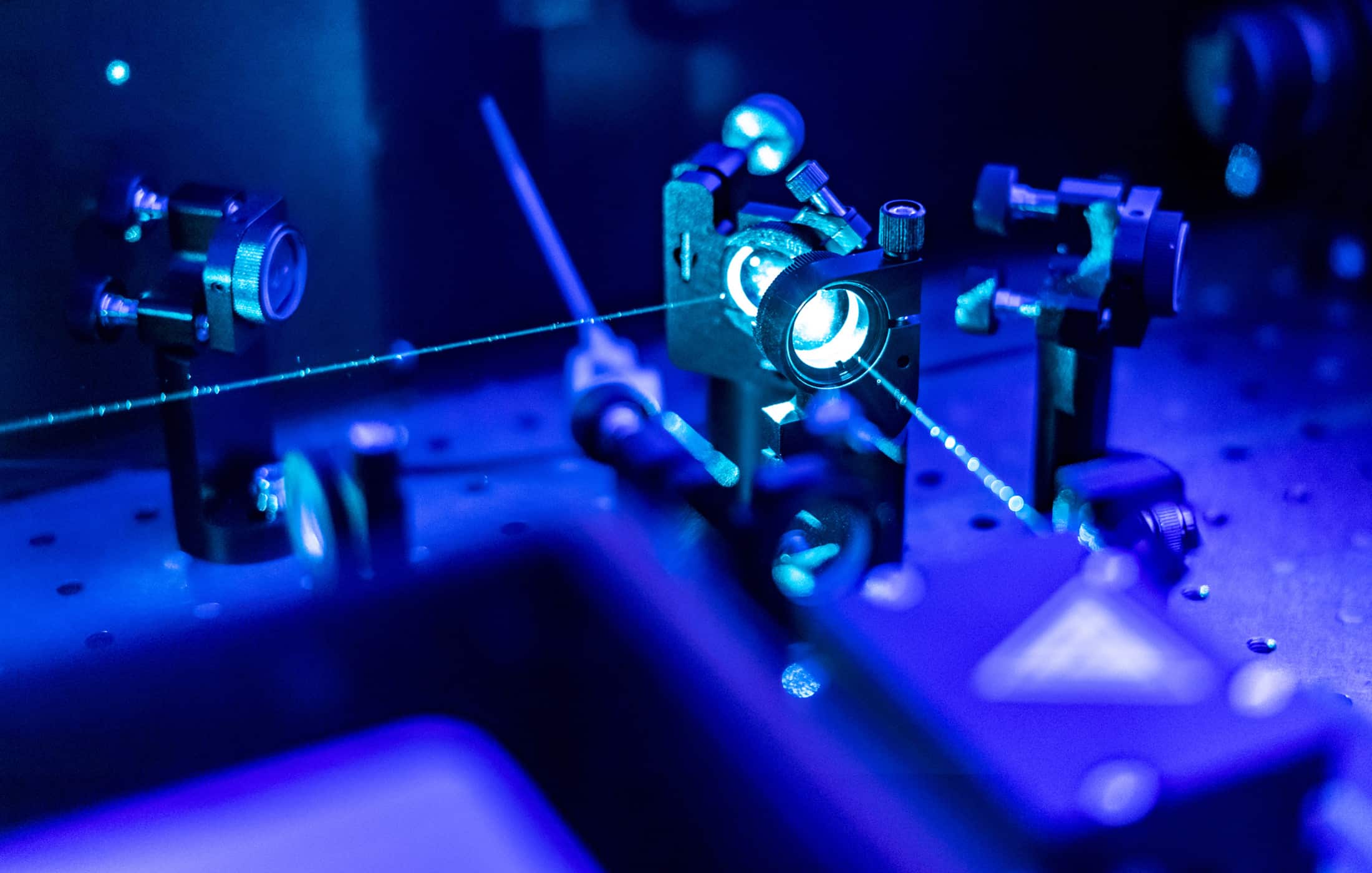
In practice, this means a vapor cell containing rubidium or cesium atoms, excited to Rydberg states by carefully tuned lasers, functions as an electromagnetic field detector. The detection mechanism relies on electromagnetically induced transparency (EIT) — a quantum optical effect where a coupling laser renders an otherwise opaque atomic medium transparent to a probe laser. When an external RF field interacts with the Rydberg atoms, it shifts or splits the EIT transparency window (via the Autler-Townes effect), and that change is read out optically.
The implications are profound. A Rydberg sensor is not an antenna. It has no metallic elements, no impedance matching requirements, no resonant frequency dictated by physical size. A vapor cell a few millimeters across can detect signals from a few megahertz to tens of gigahertz, and potentially into the terahertz regime, simply by tuning the laser to address different Rydberg transitions. A classical antenna system covering the same range would require an entire rack of hardware.
Moreover, because the measurement is tied to fundamental atomic constants – the transition frequencies and dipole moments of the atoms – Rydberg sensors provide SI-traceable, self-calibrating field measurements. No classical antenna can do this. NIST has been developing Rydberg-based measurement standards precisely because of this property, achieving field measurement precision at the 0.1% level — an improvement of over 10× compared to classical antenna standards.
The Military Applications Are Obvious. And Both Sides Know It
DARPA has invested heavily in Rydberg sensors through two major programs: the Quantum Apertures (QA) program, launched in 2021 with teams led by ColdQuanta (now Infleqtion), Honeywell, Northrop Grumman, and SRI International; and the Science of Atomic Vapors for New Technologies (SAVaNT) program, focused on overcoming decoherence challenges to make atomic vapor sensors fieldable.
The QA program’s goal is blunt: develop a portable, directional RF receiver operating from 10 MHz to 40 GHz or more, with greater sensitivity, bandwidth, and dynamic range than any classical receiver — packed into a sensor element of approximately one cubic centimeter. DARPA program manager John Burke framed the ambition as creating a device that can replace a century of antenna design constraints with an entirely new set of physics-based capabilities.
The U.S. Army Research Laboratory demonstrated a Rydberg spectrum analyzer capable of detecting the full RF spectrum — AM radio, FM radio, Wi-Fi, Bluetooth, and other communication signals — using a single benchtop device. The Army’s C5ISR Center has been developing a shoebox-sized version intended for electronic warfare and spectrum awareness missions.
In February 2025, DARPA issued a new broad agency announcement explicitly aimed at taking quantum sensors, including Rydberg systems, out of the laboratory and onto defense platforms. The applications listed include electronic warfare, signals intelligence, communications, and radar.
The military appeal is straightforward. A Rydberg sensor on an aircraft, ship, or ground vehicle could simultaneously monitor an enormous swath of the electromagnetic spectrum with a single, compact sensor head — detecting adversary radar emissions, communications signals, and electronic warfare transmissions across bands that would otherwise require multiple specialized antenna systems. It would be inherently jam-resistant (the atoms respond to fundamental physics, not to hardware vulnerabilities). It could provide angle-of-arrival estimation for signal geolocation. And because the sensor head is a glass vapor cell connected by fiber optics, it has a negligible radar cross-section — it’s essentially invisible to the signals it’s detecting.
For SIGINT and COMINT applications, a Rydberg-based wideband receiver could be transformative. Current signals intelligence platforms use banks of antennas and receivers, each covering a portion of the spectrum. A single Rydberg sensor could, in principle, replace them — or at minimum provide a front-end survey capability that identifies signals of interest for conventional receivers to focus on.
China’s Rydberg Ecosystem Is Broader Than Kewei
Kewei Quantum is the most visible commercial entrant, but China’s Rydberg atom research infrastructure is deeper than a single startup suggests.
The academic foundation spans multiple institutions. Shanxi University’s State Key Laboratory of Quantum Optics and Quantum Optics Devices has published extensively on Rydberg atom electrometry, including low-frequency electric field waveform measurements and superheterodyne detection techniques. USTC’s CAS Key Laboratory of Quantum Information has active Rydberg programs, contributing to a major 2024 Science Bulletin review on Rydberg atom sensing for metrology, communication, and hybrid quantum systems. South China Normal University contributes EIT-based detection work.
Notably, a comprehensive 2024 review paper on Rydberg atom radio technology was published in High Power Laser and Particle Beams — a journal affiliated with the China Academy of Engineering Physics (CAEP) in Mianyang. CAEP is China’s equivalent of Los Alamos National Laboratory — the institution responsible for nuclear weapons design. The review was funded in part by CAEP’s presidential discretionary fund and the Electronic Engineering Institute’s science and technology innovation fund. The authors are from CAEP’s Mianyang campus. When China’s nuclear weapons complex publishes a review of Rydberg atom technology with explicit discussion of radio reception, spectrum monitoring, and electromagnetic field detection, the defense implications are not subtle.
A separate 2024 paper in Information and Communications Technology and Policy — a journal published by CAICT (China Academy of Information and Communications Technology), which advises the Ministry of Industry and Information Technology — includes BAQIS authors (Cong Nan is listed on BAQIS’s Quantum Precision Measurement division staff). This paper connects Rydberg electromagnetic detection directly to telecommunications and standards applications. The dual-use framing — 6G antenna characterization for the civilian market, electromagnetic spectrum monitoring for the military market — is explicit.
Kewei itself claims to be the first Chinese company to apply quantum sensors to both the power industry (grid monitoring and fault detection) and meteorology (atmospheric electromagnetic measurement). These are commercially differentiated niches, but they are also engineering proving grounds. A Rydberg sensor that can monitor power grid electromagnetic signatures in an industrial environment is developing the robustness and miniaturization that military deployment demands.
The BAQIS-to-Startup Pipeline
Kewei’s rapid spin-out trajectory — from BAQIS research team to funded startup in months — reflects a deliberate Beijing municipal policy to commercialize BAQIS research outputs. BAQIS was established in December 2017 with backing from the Beijing Municipal Government and co-founded with Tsinghua University, Peking University, and the Chinese Academy of Sciences. Its founding president is Qi-Kun Xue, a CAS Academician and Fritz London Prize recipient.
BAQIS encompasses five major research fields, including quantum precision measurement — the division where Kewei’s parent research team sits. The institution has become a significant node in China’s quantum ecosystem, absorbing Baidu’s quantum computing laboratory and equipment when the tech giant exited the field in early 2024.
The Kewei spin-out follows a pattern I’ve documented across China’s quantum ecosystem: state-funded research institutions develop capabilities, then deliberately create commercial entities to scale and deploy them. It’s the same playbook that produced CIQTEK from USTC and QuantumCTek from Pan Jianwei’s group. The speed of Kewei’s transition — founded April 2024, funded within months, presenting products at Beijing’s inaugural Quantum Information Technology Innovation Conference before year-end — suggests either exceptional execution or pre-arranged institutional support. Probably both.
Where Rydberg Sensors Stand: Honest Assessment
The hype around Rydberg sensors requires the same balanced treatment I apply to all quantum sensing technologies. The physics is real. The potential is enormous. The gap between laboratory demonstrations and fielded military systems remains substantial.
What works today: Benchtop Rydberg spectrum analyzers can detect real-world RF signals across enormous bandwidths. SI-traceable electric field measurements at precision levels exceeding classical standards. Laboratory demonstrations of superheterodyne detection achieving sensitivities approaching μV/m/√Hz. Reception and demodulation of AM, FM, and digitally modulated signals. A December 2025 Nature Communications paper demonstrated multichannel detection across 1 GHz to 40 GHz using an optical frequency comb – a major step toward practical wideband receivers. A comprehensive December 2025 review in Photonics catalogued advances from 2022–2024 including cavity-assisted electrometry, chip-scale photonic integration, and coherent microwave-to-optical transduction.
What doesn’t work yet: Sensitivity still falls short of optimized classical receivers at most individual frequencies – a point rigorously quantified in a September 2024 Applied Physics Letters comparison of Rydberg and antenna-based sensors in the electrically small regime. Current systems require laboratory-scale laser infrastructure that is far from portable. Instantaneous bandwidth (how much spectrum can be observed simultaneously) remains limited compared to the total tunable range. Environmental robustness — vibration, temperature fluctuation, stray fields — has not been demonstrated in operational conditions. The atoms detect electric fields, but directional reception (angle-of-arrival) requires antenna-like structures or multiple sensor heads, partially negating the size advantage.
The timeline: DARPA’s Quantum Apertures program is a 56-month effort. The US Army C5ISR Center has discussed shoebox-sized prototypes. A reasonable assessment suggests that laboratory-grade Rydberg receivers with military-relevant performance could be demonstrated within 2–3 years. Compact, fieldable systems for electronic warfare platforms are likely 5–8 years away. A transformative replacement for shipboard or airborne antenna farms is 10+ years out, if achievable at all.
Why This Matters for the Broader Quantum Sensing Landscape
Rydberg sensors occupy an interesting position in the quantum sensing taxonomy. Unlike quantum magnetometers (NV-center, SQUID, CPT) or quantum inertial sensors (cold atom interferometers), which improve on existing measurement types, Rydberg sensors create a genuinely new measurement capability — antenna-free electromagnetic field detection with self-calibration. There is no classical equivalent to directly compare against, which makes both the opportunity and the assessment challenge different.
For the defense and intelligence communities, the dual-use nature is particularly acute. A Rydberg sensor optimized for 6G antenna testing is developing exactly the same core technology needed for passive spectrum surveillance. China’s strategy of building commercial market beachheads in power grid monitoring, meteorology, and telecommunications while simultaneously funding the technology through defense-adjacent institutions (CAEP, BAQIS) follows the military-civil fusion doctrine that has characterized China’s approach to quantum technology sovereignty more broadly.
The West’s advantage is institutional: DARPA’s Quantum Apertures program involves Infleqtion, Honeywell, Northrop Grumman, and SRI International — defense primes with integration experience. NIST provides the metrology backbone. The US Army Research Laboratory has demonstrated the spectrum analyzer. The UK’s Defence Science and Technology Laboratory (DSTL) has funded Rydberg research. This institutional depth matters for the transition from laboratory to platform.
The US also has Rydberg Technologies — a dedicated Rydberg sensor company with government contracts across multiple funding agencies, producing commercial RF measurement instruments including the Rydberg Field Measurement Standard (RFMS) that spans DC to millimeter-wave frequencies. It is the closest Western equivalent to what Kewei is building, though with a more metrology-focused commercial strategy.
China’s advantage is strategic urgency and the BAQIS-to-Kewei pipeline that compresses the research-to-product timeline. If Kewei can deliver commercial Rydberg instruments at scale — even at modest performance levels — while Western programs remain in DARPA Phase II, the operational implications could be significant.
This is a space worth watching far more closely than it has been. The headlines go to quantum computing and quantum radar. The practical near-term military impact may well come from a vapor cell full of rubidium atoms and a pair of lasers.
Quantum Upside & Quantum Risk - Handled
My company - Applied Quantum - helps governments, enterprises, and investors prepare for both the upside and the risk of quantum technologies. We deliver concise board and investor briefings; demystify quantum computing, sensing, and communications; craft national and corporate strategies to capture advantage; and turn plans into delivery. We help you mitigate the quantum risk by executing crypto‑inventory, crypto‑agility implementation, PQC migration, and broader defenses against the quantum threat. We run vendor due diligence, proof‑of‑value pilots, standards and policy alignment, workforce training, and procurement support, then oversee implementation across your organization. Contact me if you want help.
Related Content