Peking University Demonstrates 20-User Chip-Based QKD Network Spanning 3,700 km

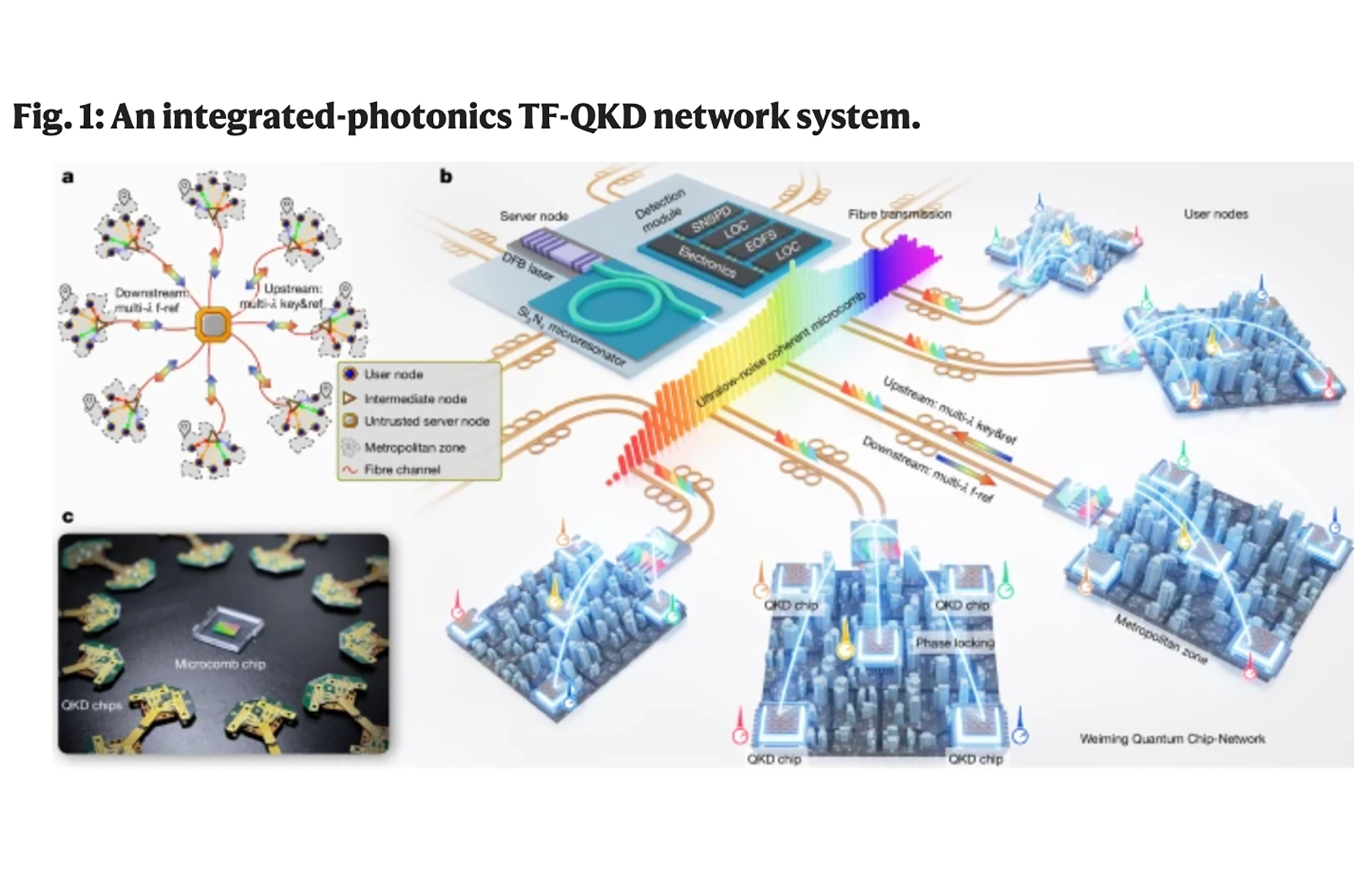
Table of Contents
12 Feb 2026 – A team led by Jianwei Wang and Lin Chang at Peking University has demonstrated an integrated-photonics twin-field quantum key distribution (TF-QKD) network connecting 20 independent client chips across ten wavelength-multiplexed channels, with each channel surpassing the repeaterless bound at 370 km in spooled fiber. The results, published in Nature, achieve a total networking capability — defined as the number of client pairs multiplied by communication distance — of 3,700 km without any trusted relay nodes.
The system, named the “Weiming Quantum Chip-Network,” uses two types of integrated photonic chip. At the server node, a silicon nitride (Si₃N₄) optical microcomb generates ultralow-noise coherent frequency combs with Hz-level linewidths, serving as both seed lasers and phase references for the entire network. At the client side, 20 indium phosphide (InP) transmitter chips — each measuring 4.6 × 2 mm — monolithically integrate lasers, phase modulators, intensity modulators, and variable optical attenuators. The 20 client chips were randomly selected from a 3-inch wafer without preselection, with 117 of 120 modulators functioning as designed — a 97.5% yield.
Each client chip locks its local laser to the microcomb reference via optical injection locking, regenerating light with intrinsic linewidths of approximately 60 Hz from lasers that originally exhibited MHz-level noise. At 370 km, the network’s secure key rates exceeded the Pirandola–Laurenza–Ottaviani–Banchi (PLOB) repeaterless bound by 51.5% to 251.4% across all ten channels. The microcomb demonstrated 12-hour operational stability with intensity fluctuations of only 0.6%.
The team notes that the server-side integration of detection components (single-photon detectors, linear-optic circuits, frequency shifters) remains underway, and that the current implementation used sequential rather than simultaneous QKD across channels due to electronic control constraints. The authors also acknowledge that imperfect phase randomization and potential vulnerabilities in the injection-locking technique require further improvement.
My Analysis
This paper matters less for what it achieves in raw distance — China already holds the fiber TF-QKD record at 1,002 km — and more for what it demonstrates about manufacturability.
The central innovation here is the marriage of optical microcombs with mass-produced photonic chips. Previous TF-QKD demonstrations relied on expensive, bulky laboratory laser systems that could never scale to multi-user networks. This team solved the coherence problem with a single microcomb chip distributing Hz-linewidth reference light to 20 independent transmitter chips — and critically, those transmitter chips came off a wafer with near-commercial yields. That 97.5% modulator yield from randomly selected chips is an engineering result, not a physics result, and it’s the kind of number that matters for eventual deployment.
As I detailed in my comprehensive analysis of China’s quantum networking and QKD program, this result fits squarely within the systematic progression that has characterized Chinese quantum communications research. The same community that built the 12,000+ km carrier-grade CN-QCN backbone is now solving the hardware scalability problem that trusted-node networks sidestepped.
What TF-QKD Changes — and What It Doesn’t
TF-QKD’s key advantage is that it operates under a measurement-device-independent (MDI) framework, meaning the central server node doesn’t need to be trusted — a direct answer to the most persistent criticism of China’s deployed QKD infrastructure, where every relay node is a potential point of compromise. The protocol also beats the PLOB repeaterless bound, which represents the theoretical maximum key rate achievable without quantum repeaters or relays.
But context is important. This is a proof-of-principle laboratory demonstration using spooled fiber, not deployed fiber in the field. The 370 km distance, while respectable, used symmetric configurations (185 + 185 km) under controlled conditions. The sequential QKD operation across channels means the system wasn’t generating keys for all 20 users simultaneously. And the server-side detection module — the part that would need superconducting nanowire single-photon detectors (SNSPDs) operating at cryogenic temperatures — wasn’t fully integrated.
None of these caveats diminish the core result. They simply mark where this sits on the technology readiness scale: a compelling proof-of-concept that the integrated photonics approach works, with a clear engineering path to scaling.
Quantum Upside & Quantum Risk - Handled
My company - Applied Quantum - helps governments, enterprises, and investors prepare for both the upside and the risk of quantum technologies. We deliver concise board and investor briefings; demystify quantum computing, sensing, and communications; craft national and corporate strategies to capture advantage; and turn plans into delivery. We help you mitigate the quantum risk by executing crypto‑inventory, crypto‑agility implementation, PQC migration, and broader defenses against the quantum threat. We run vendor due diligence, proof‑of‑value pilots, standards and policy alignment, workforce training, and procurement support, then oversee implementation across your organization. Contact me if you want help.
Related Content