Table of Contents
01 Dec 2025 – A new paper in Nature Photonics by Natalia Herrera Valencia et al. (2025) reports a prototype quantum network that connects two previously separate networks into a single eight-user system.
In practical terms, the team from Heriot-Watt University demonstrated a reconfigurable quantum photonic network that can route entanglement to different users on demand and even “teleport” entanglement across network boundaries.
This achievement marks the first time two distinct quantum networks have been linked together, allowing one network to effectively talk to the other. It sets a new benchmark for the scale, versatility, and performance of quantum networks envisioned as the backbone of a future “quantum internet”.
At the heart of the demonstration is not an expensive quantum chip, but an off-the-shelf multimode optical fiber costing under £100. The researchers turned the inherent complexity of light in a multimode fiber into an advantage. Light scattering inside the fiber’s hundreds of internal pathways is usually random and chaotic, but by carefully shaping the light input with programmable optics, the team “effectively programmed the fiber,” transforming its messy internal scattering into a high-dimensional optical circuit.
In essence, the multimode fiber acts as an 8×8 photonic multi-port: an entanglement router that can direct quantum entanglement between any of its 8 inputs and 8 outputs. Four spatial light modulators (SLMs) impose phase patterns that reconfigure how the fiber mixes the light, allowing on-demand routing of entangled photons through different paths. This “light’s chaos as a resource” approach bypasses the fabrication challenges of traditional photonic chips by using the fiber’s natural mode-mixing as a large, volumetric beam splitter.
The network itself consisted of two local quantum networks (think of them as two “clusters” of users), each with four users receiving entangled photon pairs from their local source. By inserting the programmable fiber-circuit between the two clusters, the team merged them into one global eight-user network. Crucially, this network is fully reconfigurable: entanglement connections can be switched between various patterns at will. For example, the device can distribute entangled photon pairs to support local entanglement links within each cluster, global links between a user in one cluster and a user in the other, or even mixed configurations that combine local and cross-network entanglements.
The paper’s Figure 1 illustrates these modes: from local pairings (each source entangling two users in the same group) to hybrid pairings across groups, and finally to a “large-scale” mode where entirely new entangled pairs are created between distant users that initially had no direct connection.
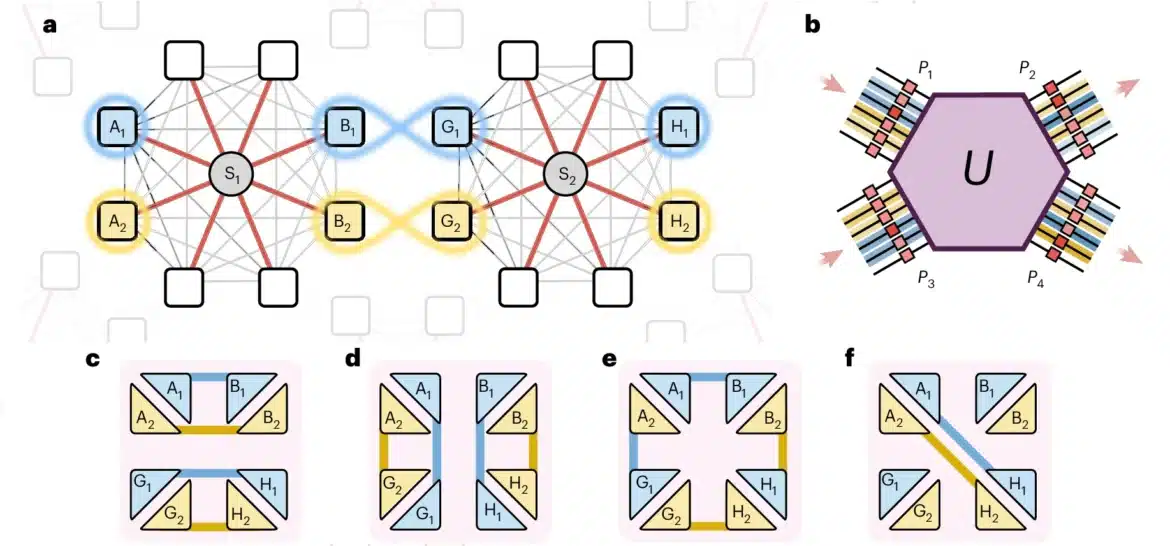
The showpiece achievement is the on-demand entanglement swapping between the two networks – effectively teleporting entanglement across the boundary so that users in different clusters become entangled.
Entanglement swapping is a process where two entangled pairs are combined in such a way that two previously unrelated endpoints become entangled with each other (often described as “teleporting” entanglement). The Heriot-Watt team performed this in a multiplexed fashion, simultaneously swapping two entangled pairs in parallel. In the experiment, four users (two from each cluster) were involved, resulting in two new entangled links bridging the clusters at once.
Previous demonstrations have achieved entanglement teleportation, but never across so many users concurrently in such a flexible architecture. This multiplexed entanglement swap is a form of entanglement teleportation on demand, using the fiber-circuit to perform the necessary joint measurements that reconfigure the entanglement connections. All eight users ended up sharing entanglement in the combined network, a miniature preview of how a future quantum internet node might dynamically connect to any other node via intermediaries.
The technical underpinnings are sophisticated but were conveyed in an accessible way by the authors. Dr. Natalia Herrera Valencia, the lead author, explained that by shaping the input light, they turned the fiber’s chaos into a controllable resource, essentially programming a complex quantum circuit into a simple piece of fiber. This allowed them to route quantum entanglement wherever needed – even to “teleport” it – using a deceptively ordinary optical fiber.
In practice, the team generated entangled photon pairs (initially high-dimensional spatial-mode entanglement from two SPDC crystal sources ) and sent these photons into the multi-port fiber device. By adjusting the SLM patterns, they could choose which user ends up entangled with which. They verified genuine quantum entanglement for each configuration using standard two-photon correlation measurements and entanglement witnesses. Impressively, every entangled link (whether local or across-network) had a high quantum state fidelity (generally 77%–88% fidelity to an ideal Bell state in their tests). Even over a two-week period, the fiber setup maintained stability (with simple clamps) and kept entanglement quality above ~76%, underscoring the practicality of the approach.
This demonstration’s immediate promise is clear: it shows a path to quantum networks that are larger and far more adaptable than previously achieved. Prior state-of-the-art multi-user quantum networks could connect up to 8 users in a single local network by multiplexing (often using different wavelengths for different entangled pairs). The Heriot-Watt result takes the next step by interconnecting two such networks into one, and doing so with a single, reconfigurable photonic device capable of both routing and entanglement swapping. As Professor Mehul Malik (the team lead) put it, others had shown one can distribute entanglement to many users in one network, “but this is the first time anyone has managed to link two separate networks together… a major milestone on the road to a real-world quantum internet”.
The use of a standard telecom fiber component also means this approach is compatible with existing communications infrastructure (optical fibers and components), an important consideration for scaling in the real world.
Why This Breakthrough Matters
Beyond the buzz of a lab success, this achievement matters for the future of quantum technology.
Stepping-Stone to a Scalable Quantum Internet
Reconfigurability and multiplexing in one device address key hurdles in scaling quantum networks. Earlier multi-user networks could share entanglement among several users, but typically in a fixed or manually switched topology.
The new demonstration shows a single network device handling dense connectivity – any user to any other on demand – and doing so across what were two independent networks. This foreshadows a modular quantum internet architecture: local networks (think of them as quantum LANs) can be joined into a larger “network of networks” by inserting a programmable entanglement router.
Notably, the device can simultaneously handle multiple entangled pairs (thanks to multiplexing), which means it can support many secure channels or quantum operations in parallel. In a future quantum internet, such multiplexed entanglement distribution would be essential for serving many users or applications at once without bottlenecks.
The use of standard fiber optics also means easy integration with existing telecom fiber links – a big practical advantage. Of course, achieving global distances will still demand quantum repeaters and quantum memory to combat loss over long fiber links. Those pieces are outside the scope of this photonic router, but the study is an important complement: it shows how to flexibly connect segments of a quantum network once entanglement links (even shorter ones) are available.
In short, the Heriot-Watt network is a promising scaling strategy – demonstrating how to fuse networks and manage entanglement in high capacity – but additional advances (memory, repeaters) will be needed to reach a globe-spanning quantum internet.
Implications for Secure Quantum Communication
A quantum internet is often heralded for enabling provably secure communication via quantum key distribution (QKD) and beyond. This experiment’s success is directly relevant to that goal. By distributing entanglement between arbitrary pairs of users, one can perform entanglement-based QKD between any two nodes in the network, even if they have no direct fiber connection between them.
In traditional QKD networks today, if two users aren’t directly connected, intermediate “trusted nodes” have to perform key relay – which introduces security weaknesses. In an entanglement-swapping network, by contrast, the intermediate nodes (or devices like this multi-port router) don’t need to be trusted, since the key can be generated using quantum correlations (and even device-independent protocols) that reveal any eavesdropping.
The demonstration shows that entanglement swapping across network regions is feasible in a multiplexed, automated way, which is a step toward secure quantum communications on a larger, dynamic network. All eight users in the experiment could, in principle, engage in entanglement-based protocols like quantum key exchange simultaneously over different channel pairs.
Moreover, the high-dimensional capabilities of the system hint at using higher-dimensional entangled states (beyond qubit pairs) in the future. High-dimensional entanglement can potentially carry more information per photon and increase the resilience or throughput of QKD. While the current experiment focused on distributing qubit entanglement (two-level systems) to each user pair, the underlying 8×8 fiber-circuit could be programmed to route qutrit entanglement or other multi-level states as the paper suggests.
For cybersecurity professionals, these advances mean that quantum-secure networks might become far more flexible – not limited to point-to-point links or star networks, but functioning more like today’s internet, where any client and server can establish a secure link on the fly. It’s a move toward quantum networking without trusted nodes, which heightens security but also requires complex quantum coordination (precisely what this work begins to tackle).
Connecting Quantum Processors – Toward Distributed Quantum Computing
Another significance of this work lies in distributed quantum computing. Quantum computers are still limited in size and qubit count; one vision for scaling up to a powerful quantum computer is to network many smaller quantum processors together, sharing entanglement between them to perform larger joint computations.
The Heriot-Watt prototype explicitly demonstrates the kind of entanglement distribution that would be needed to connect multiple processors in a flexible way. Such entangled links could enable protocols like distributed quantum algorithms, secure cloud quantum computing (where a user’s qubits are entangled with a server’s qubits for delegated computation), or even the creation of large entangled states (like cluster states) spread across machines.
The experiment’s ability to rapidly reconfigure which nodes are entangled (and even perform two entanglement swaps simultaneously) is particularly relevant, as real computing tasks might require dynamically changing connectivity between qubit registers.
Additionally, the fact that the multi-port device is high-dimensional means it might connect more than just pairs of processors – potentially it could perform multi-qubit operations or entangle multiple nodes in one go (though that wasn’t shown yet).
It’s important to temper the excitement with the reminder that this was a lab demonstration with photons only – the “users” in this case were measurement stations, not actual quantum CPUs performing logic. To truly network quantum processors, one would need interfacing with memory qubits or matter qubits that can store the photonic entanglement. Nonetheless, the architecture is extendable – it could be adapted to link actual quantum memory devices or ion traps or superconducting qubits via photonic channels. This is highly relevant to the design of future quantum data centers or quantum cloud infrastructure, where entangled photonic interconnects join modules of qubits.
For cybersecurity, distributed quantum computing doesn’t immediately pose new threats, but it does promise to accelerate the field – which in turn could impact timelines for powerful quantum computers.
Multiplexed Entanglement & High-Dimensional Operations – Changing the Game
The use of multiplexing and high-dimensional mode control in this experiment is a trendsetter for quantum networks. Multiplexing entanglement means the network can send multiple entangled pairs concurrently through the same physical channel, dramatically increasing the network’s effective bandwidth for quantum bits.
In practical terms, a single fiber (or single device) could host dozens of entangled links at once, each on different wavelengths or different spatial modes, just as classical networks carry many channels in one fiber. This is essential if quantum networks are to scale without requiring a dedicated fiber for every pair of users.
The Heriot-Watt team implemented multiplexing in spatial modes and demonstrated two channels at once; in principle their scheme could be extended to more channels with more sophisticated control. For quantum communication, more entanglement channels mean higher key rates (multiple keys generated in parallel) and the ability to serve many user pairs simultaneously, approaching an internet-like traffic model rather than one pair at a time.
High-dimensional operations, on the other hand, refer to the network device’s ability to manipulate photons in a large state space (8-dimensional in their case). This allows realization of more complex quantum protocols. For example, one could use a higher-dimensional entangled state to connect more than two parties in a single quantum signal (e.g., distributing a GHZ state to three users), or perform entanglement swapping that involves multi-level quantum states (teleporting a qutrit, for instance). The authors even tested that their fiber-circuit could route a qutrit-entangled pair in a smaller four-user configuration. Although today’s quantum network applications mostly use qubit entanglement, future protocols (for quantum consensus, voting, clock synchronization, etc.) might leverage high-dimensional entanglement.
High-dimensional entanglement can also enhance security – for instance, device-independent QKD protocols can sometimes be more robust or higher-rate with high-dimensional states, and eavesdropping detection can be sharpened with more outcomes to test.
Additionally, the “top-down” design approach used here (fiber + SLMs) hints at how one might build large, complex quantum circuits without the usual scalability headaches. Rather than fabricating a massive photonic chip with hundreds of beam splitters (which leads to loss and fabrication errors), one can use a naturally high-dimensional scattering medium like a fiber and simply control its input and output phases. This could make it easier to build bigger network switches or quantum routers that handle tens or hundreds of modes – something that would be prohibitive on a planar photonic chip.
Of course, there are trade-offs: the fiber must remain stable and its transmission matrix well-calibrated; as you add more modes or longer fiber, loss and mode dispersion can increase. The experimenters note that expanding to higher dimensionality may encounter these issues, but additional phase control layers or other tricks could mitigate them.
In any case, the success here shows that multiplexed, high-dimensional quantum operations are not just theory but working in practice, changing the network landscape from “one entangled pair at a time” to “many entangled pairs and complex quantum channels simultaneously.” For professionals, this means thinking about quantum network capacity in new ways – much as classical network engineers had to adopt WDM (wavelength-division multiplexing) and spatial multiplexing to meet internet traffic demands, quantum engineers are now doing the equivalent for entanglement distribution.
Conclusion
The demonstration of a large-scale reconfigurable multiplexed quantum photonic network is a landmark on the path to the quantum internet. It showcases technical ingenuity – using a cheap piece of fiber as an 8×8 quantum router – and achieves a level of network complexity and flexibility that pushes the state-of-the-art. For the cybersecurity community, this development is double-edged in a positive way: it helps enable quantum-secure communications by making entanglement distribution practical at scale, and it hints at new ways to scale quantum computing which will eventually necessitate updated cryptographic safeguards.
Quantum Upside & Quantum Risk - Handled
My company - Applied Quantum - helps governments, enterprises, and investors prepare for both the upside and the risk of quantum technologies. We deliver concise board and investor briefings; demystify quantum computing, sensing, and communications; craft national and corporate strategies to capture advantage; and turn plans into delivery. We help you mitigate the quantum risk by executing crypto‑inventory, crypto‑agility implementation, PQC migration, and broader defenses against the quantum threat. We run vendor due diligence, proof‑of‑value pilots, standards and policy alignment, workforce training, and procurement support, then oversee implementation across your organization. Contact me if you want help.
Related Content