Elevate Quantum Launches First Open Quantum Architecture System in U.S. (Colorado)


17 Nov 2025 – Elevate Quantum and an international team of partners have announced the deployment of the United States’ first Quantum Open Architecture (QOA) quantum computing system, to be hosted in Colorado. In a collaborative effort involving Dutch quantum processor maker QuantWare, control electronics specialist Qblox, quantum software firm Q-CTRL, and Colorado-based cryogenics startup Maybell Quantum, the group is establishing a modular quantum computer with both on-premises and cloud Quantum-as-a-Service (QaaS) access. The modular, commercially reproducible system – called the Quantum Platform for the Advancement of Commercialization (Q-PAC) – is designed to accelerate quantum adoption and commercialization, enable cross-platform interoperability, and serve as a national resource for companies, national labs, academic researchers, and students.
This marks the first deployment of a QOA-based quantum system on U.S. soil, strategically located at Elevate Quantum’s Quantum Commons campus in Colorado.
The Q-PAC system will be hosted at Elevate Quantum’s Commercialization Lab on Colorado’s new Quantum Commons tech campus, providing users integrated access to a full, modular quantum computing stack – from the quantum processing unit (QPU) and control electronics to cryogenic infrastructure and advanced software layers. Users will be able to tap into the machine either via the cloud (as a QaaS offering) or directly on-premises. According to Elevate Quantum, this initiative represents “a major step toward strengthening U.S. leadership in quantum systems integration and workforce development”. State officials also lauded the project’s significance. “The Q-PAC system is a significant step for Colorado’s economic future, solidifying our state’s leadership in the quantum industry while advancing national collaboration and quantum development,” said Eve Lieberman, Executive Director of the Colorado Office of Economic Development, adding that it will “attract new investment, generate high-skill jobs across Colorado and the Mountain West, and accelerate the commercialization of cutting-edge technology, all through unprecedented public-private collaboration”.
A New Open Quantum Platform in Colorado
Elevate’s Q-PAC is built on a Quantum Open Architecture model, meaning its components come from multiple specialized providers rather than a single vendor. Each partner brings a unique capability to the system:
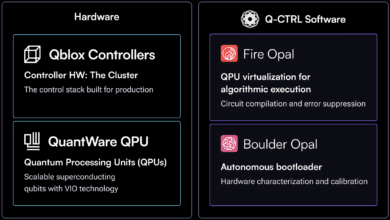
- QuantWare – contributing its award-winning Contralto-A3 superconducting QPU (quantum processor), a third-generation chip designed with quantum error correction in mind, which serves as the system’s central computational engine.
- Qblox – supplying its high-fidelity Cluster control hardware, based on the advanced Q1 pulse-processing architecture, along with dedicated support to get the best performance out of every qubit application.
- Q-CTRL – providing its AI-powered quantum control software suite (including tools like Boulder Opal for autonomous calibration and Fire Opal for error suppression) to deliver autonomous operation and accelerate quantum algorithms on the hardware.
- Maybell Quantum – delivering a custom cryogenic wiring tree and integration of subsystems inside a dilution refrigerator, ensuring all components are interconnected at milli-Kelvin temperatures.
- Elevate Quantum – hosting, operating, and maintaining the entire Q-PAC system at its Colorado lab, including managing the cryogenic infrastructure (a Maybell dilution fridge) and supporting facilities.
This assembly follows the blueprint of the recently announced Quantum Utility Block (QUB) reference architecture – a family of full-stack, pre-validated quantum computer designs built on the QOA approach. The QUB model integrates QuantWare’s modular QPUs (scalable up to 41 qubits), Qblox’s extensible control stacks, and Q-CTRL’s automation software into a standardized unit for quantum computing. The Colorado Q-PAC is in fact the first deployment of a QUB-based system: an initial reference installation that is slated to come online in 2026 as a hands-on testbed for researchers and enterprises. By leveraging the QUB architecture, the Q-PAC aims to give users a cost-effective and upgradable path to state-of-the-art quantum capabilities.
What does this mean in practice? For end-users, Q-PAC will offer access to a cutting-edge quantum computer without needing to build one from scratch. The system is open-access in the sense that companies, startups, and research teams can run experiments on the hardware through Elevate’s quantum cloud portal, or arrange on-site use. “The Q-PAC system will create access for commercial, workforce, scientific, and government users and open up new opportunities for collaboration and commercialization,” Elevate noted in its announcement. Anchored within the local Quantum Commons campus, the platform is also expected to bolster the region as a national quantum technology hub, accelerating commercialization, attracting investment, and amplifying public-private collaboration across the Mountain West.
Notably, Q-PAC is envisioned as a stepping-stone for new quantum adopters. Organizations just beginning their quantum journey can experiment on this open architecture system “without committing to full purchase and deployment”, using it as a sandbox to test applications before investing in their own machines. Because the system is modular and commercially reproducible, a company that finds success on Q-PAC could later acquire a similar QUB-based setup for itself, or upgrade components as the technology advances. The open architecture also makes it easier for international collaborators to work alongside U.S. institutions: foreign companies can leverage the platform in a U.S.-hosted environment, facilitating joint research with national labs and universities under U.S. safeguards. From a workforce perspective, the Colorado lab will partner with universities and training programs so students can gain hands-on experience via remote access and in-person workshops on the Q-PAC hardware. In short, the system is meant to be “a national resource” that serves industry, academia, and government alike.
Officials and industry leaders see this as a model for accelerating quantum innovation. Colorado’s designation as a federally backed Quantum Tech Hub (Elevate Quantum was named an Economic Development Administration Tech Hub in late 2025) provides institutional support to sustain such shared infrastructure. “Colorado is the national hub for innovation in the fast-growing quantum industry,” said Governor Jared Polis, “and the Quantum Frontier Testbed will strengthen the industry in our state. By accelerating our world-class quantum technology we are driving forward our next chapter in quantum innovation, creating more jobs, and driving economic development”. Industry partners likewise highlighted the broader impact. “Working with our partners, Qblox is proud to provide quantum control electronics to strengthen America’s access to quantum infrastructure, develop the next generation workforce, and enable quantum innovation,” said Niels Bultink, CEO of Qblox, adding that “we’re proud to deliver this first-of-its-kind U.S.-based qubitlab with our partners”. “Quantum technology is reaching a critical inflection point, moving from research into real-world commercial relevance,” noted Michael Biercuk, CEO of Q-CTRL. “Q-PAC and our QUB reference architecture accelerate this transition by delivering more cost-effective, upgradable, and accessible systems. With our automation software, these solutions make quantum technologies easy to adopt and scale for any organization, not just research teams”.
Elevate Quantum – the organization coordinating this project – is a consortium-based initiative that spans Colorado, New Mexico, and Wyoming. Backed by the U.S. Department of Commerce, Elevate’s mission is to accelerate the diffusion and commercialization of quantum tech in the United States and build a robust quantum workforce for the future. By launching the first QOA-aligned quantum computing system in the country, Elevate and its partners are not only showcasing a new technical architecture but also planting a flag for quantum innovation sovereignty on American soil.
Analysis
As a quantum technology consultant who has written about Quantum Open Architecture (QOA) and Quantum Sovereignty, I see the Colorado Q-PAC deployment as a significant milestone on both fronts. QOA is an emerging approach that envisions quantum computers built from mix-and-match parts – much like a classical PC with components from different vendors – rather than closed, proprietary stacks. The Q-PAC system is a tangible embodiment of this idea: its construction draws on multiple best-of-breed components integrated into one platform. This demonstrates that a composable, multi-vendor quantum system is not only feasible but also advantageous in practice. Until now, most cutting-edge quantum computers in the U.S. have been delivered as end-to-end solutions from single providers (or accessed via proprietary cloud services). By contrast, the Q-PAC shows that with agreed standards and collaboration, we can assemble a full-stack quantum computer much as we assemble classical IT systems – choosing each piece from the specialist that does it best.
Why is this so important? For one, it promises faster innovation and diffusion of quantum technology. When different companies can contribute via open interfaces, improvements in one layer (say, a better QPU or a better control system) can slot into existing setups without needing to rebuild the entire machine. This open architecture ethos reduces vendor lock-in and ensures no single supplier can hold the whole system captive. This modular approach lowers the barriers for organizations to procure and operate quantum computers. The Q-PAC’s very name – “Platform for the Advancement of Commercialization” – underscores that goal: it’s about making quantum hardware more accessible and transferable. A startup that begins on Q-PAC today could, in theory, upgrade piecewise (add more qubits, swap in a new control module, etc.) or even purchase a clone of the system down the line. That kind of flexibility is a departure from the era of monolithic quantum machines, and it could spur a broader adoption by lowering cost and risk per entry.
It’s worth noting that the U.S. is not the first to embrace QOA in practice. In Europe, for example, the University of Naples recently stood up one of the continent’s largest quantum computers (a 64-qubit system) by combining a Dutch-made QuantWare QPU with locally integrated control electronics and a Finnish cryostat. That project – explicitly described as a product of the QOA model – significantly lowered the time and cost to build a world-class system, compared to the alternative of either buying a full proprietary system or attempting a fully homegrown build. It put a cutting-edge quantum machine in the hands of a university, highlighting how open architecture can democratize access beyond just the tech giants.
The Colorado Q-PAC is a parallel milestone on the other side of the Atlantic: it signals that the modular, open approach to quantum computing is gaining traction in the U.S. as well. Given the Department of Commerce’s support through the Elevate Quantum Tech Hub, this also aligns with national strategy – America is investing in regional quantum innovation centers that can develop indigenous expertise and capacity, rather than relying solely on cloud access from big providers.
Another major benefit of having a sovereign, on-premises quantum infrastructure like Q-PAC is workforce development. Quantum talent is as critical a resource as the hardware itself. By operating a physical quantum system in Colorado, Elevate Quantum is creating a training ground for U.S. students, engineers, and researchers to learn how to run and maintain such machines. This hands-on experience is invaluable – it’s reminiscent of the approach Germany took when it partnered with IBM to host a quantum computer at Fraunhofer Institute. That arrangement gave German researchers “full access and hands-on experience” with a cutting-edge system, essentially “importing capability in a sovereign-friendly way” and jump-starting Germany’s own quantum hardware efforts. The Q-PAC testbed will similarly allow American researchers to get under the hood of a quantum computer’s operation, rather than treating it as a black box accessed over the internet. Participants can learn about everything from calibrating qubits to cryogenic maintenance and integrated system tuning. Such know-how stays in the local talent pool, strengthening what future U.S. quantum programs – whether academic, commercial, or defense – can do on their own. In the long run, this helps ensure the U.S. isn’t just using quantum technologies developed elsewhere, but is fully capable of developing and sustaining its own.
Of course, the open architecture approach is not without challenges and risks. Integrating disparate components into a seamless quantum computing platform is a complex engineering feat. Each layer (chip, control, software, refrigeration) must interface flawlessly; hiccups in calibration or timing can severely degrade performance. In a vertically integrated system (like those built by a single company), the pieces are custom-designed to fit together, whereas in a mix-and-match system, a lot of effort must go into standardizing interfaces and protocols. The Q-PAC partners addressed this by pre-validating the combination (through the QUB reference design) and using Q-CTRL’s automation software to handle calibration and error correction across the stack. Still, maintaining peak performance in a modular system will require continued coordination – effectively, a new kind of systems integration expertise becomes vital in the quantum sector. There is also a strategic risk that comes with any one layer becoming too dominant. For example, if one company’s control software becomes the linchpin for all QOA systems, that company could gain outsized influence (a new form of vendor lock-in, albeit at the software layer). Ensuring a truly open ecosystem means fostering multiple options at each layer and open standards (as IEEE and industry groups are now working on) to prevent swapping one dependency for another. Likewise, while Q-PAC’s parts come from different sources, they are all currently allies or partners – going forward, maintaining supply chain diversity (and having backup suppliers for key components) will remain important for resilience.
In summary, the launch of Q-PAC in Colorado is a landmark for Quantum Open Architecture. It shows that quantum computing need not be confined to proprietary silos or remote clouds; instead, an open, modular model can take root domestically, bringing together the best technologies from around the world under one roof. If successful, this approach could accelerate innovation by breaking the monopoly of any one vendor and spreading know-how more widely. We are likely to see more such initiatives where regional hubs build their own quantum platforms with a mix of components – effectively creating sovereign quantum sandboxes that combine local control with global collaboration.
Quantum Upside & Quantum Risk - Handled
My company - Applied Quantum - helps governments, enterprises, and investors prepare for both the upside and the risk of quantum technologies. We deliver concise board and investor briefings; demystify quantum computing, sensing, and communications; craft national and corporate strategies to capture advantage; and turn plans into delivery. We help you mitigate the quantum risk by executing crypto‑inventory, crypto‑agility implementation, PQC migration, and broader defenses against the quantum threat. We run vendor due diligence, proof‑of‑value pilots, standards and policy alignment, workforce training, and procurement support, then oversee implementation across your organization. Contact me if you want help.
Related Content