The OECD’s new quantum paper looks, at first glance, like a survey of national strategies. Read more closely, it is a sharper story about how quantum is being turned into industrial policy, procurement policy, standards policy, and national security policy all at once.
Table of Contents
10 Dec, 2025 – Quantum policy has produced no shortage of rhetoric. What it has lacked is a clear map. This week, the OECD published An overview of national strategies and policies for quantum technologies as OECD Digital Economy Papers No. 379, with the publication page dating it to 8 December 2025. The OECD frames it as a stocktake of the national strategies and policy instruments countries are using to support quantum technologies. That description is accurate, but it undersells the paper. In practice, this is one of the clearest snapshots yet of how governments are trying to turn quantum from a scientific frontier into a governed strategic sector.
The OECD publication page attributes the paper to the organisation itself, while the PDF credits Andrés Barreneche, Maxime Benallaoua and Daniela Valenzuela, under the guidance of Alistair Nolan and Elizabeth Thomas-Raynaud. The PDF also says the paper was approved and declassified by written procedure by the Digital Policy Committee and the Committee for Scientific and Technological Policy on 27 November 2025.
The topline findings are substantial. The report says that, by November 2025, 18 OECD member countries plus the European Union had adopted dedicated quantum strategies. It cites an estimate that governments worldwide have committed USD 55.7 billion to quantum science and technology since 2013, though it also warns that such figures should be handled carefully because they are based on public announcements and can include legacy allocations or even non-governmental sources. And it says the OECD’s quantum policy database now captures close to 250 policies across 40 countries and the European Union. Across that policy landscape, the OECD identifies five recurring instruments: institutional funding for public research, project grants for public research, grants for business R&D, public procurement, and equity financing.
This is not a capability scoreboard. It is a map of state capacity.
My read is that the report matters less because it counts strategies and more because it shows how similar the underlying playbooks are becoming. Country after country is reaching for the same toolkit: public research funding, industry grants, testbeds, procurement programmes, and state-backed capital. That is not the pattern of a field being left to open-ended academic exploration. It is the pattern of a field being operationalised by the state. Quantum is still a science story. But it is now unmistakably also a governance story.
That comes through especially clearly in the report’s treatment of governance. It notes that France, Japan and the United States place quantum strategy oversight at the highest executive levels. It also points to more specialised offices in countries such as the United Kingdom, the United States and Singapore, and it highlights the use of mission-oriented innovation policy to coordinate multiple programmes around explicit objectives. The United Kingdom is the paper’s clearest example of that logic: quantum is framed not just as research funding, but as a series of missions tied to secure communications, healthcare diagnostics, infrastructure resilience and other use cases. That is a meaningful shift. It says governments are no longer just asking, “Should we invest in quantum?” They are asking, “How do we organise the state around it?”
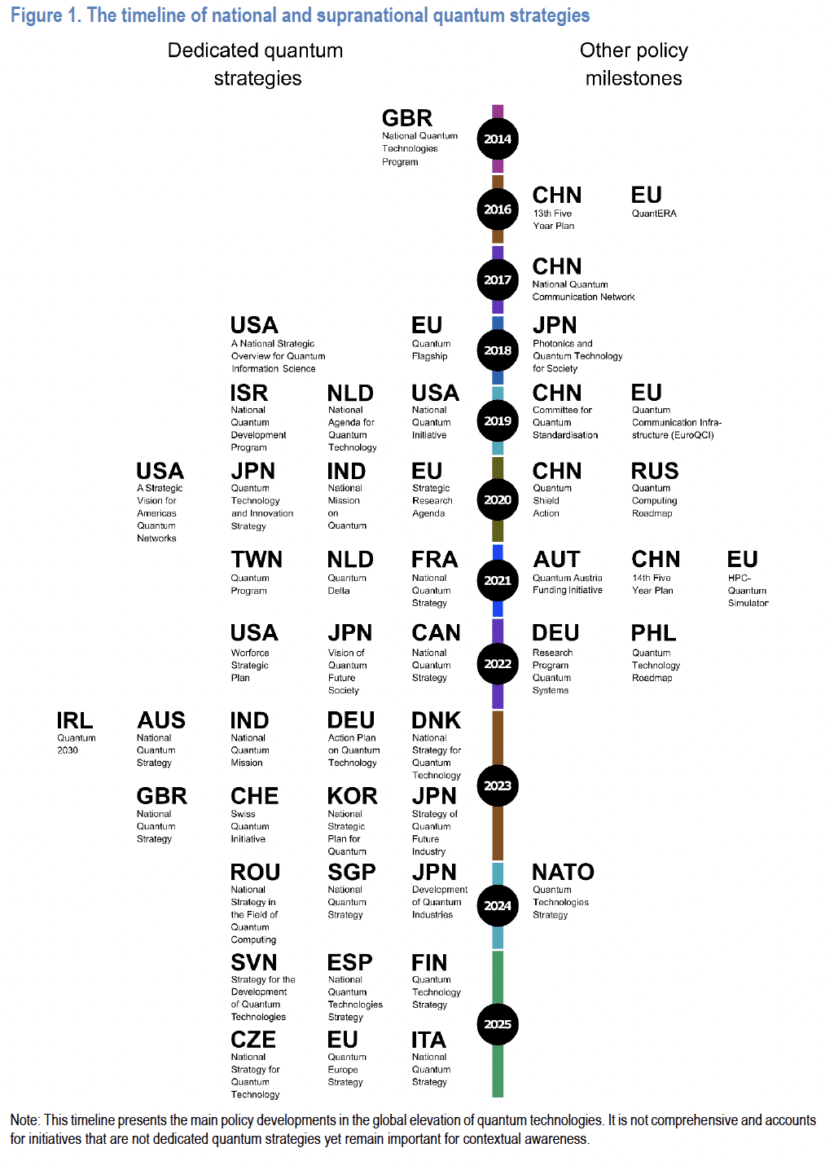
The report’s timeline graphic is one of its quiet strengths. On page 10, it places dedicated national strategies next to adjacent policy milestones, from the UK’s early programme and the US National Quantum Initiative to EU initiatives, Chinese standardisation moves and NATO’s 2024 quantum strategy. The picture is revealing. Quantum is no longer sitting at the edge of science policy. It is now lodged inside the machinery of industrial policy, strategic competition and alliance planning.
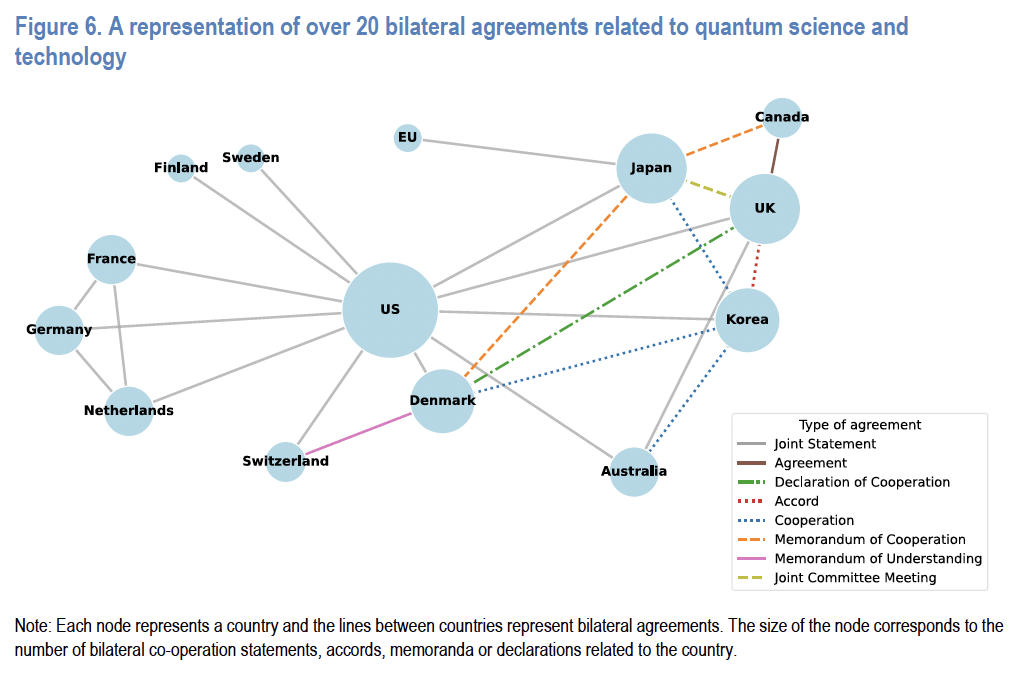
The bilateral-agreements diagram later in the report makes the same point in a different way: quantum diplomacy is now a thing.
On quality, this is better than much of the quantum policy literature
What I like most about the paper is its methodological sobriety. It does not pretend that announced funding equals deployed capability. It explicitly says the USD 55.7 billion figure should be interpreted with care. It also says that a complete thematic breakdown of public quantum expenditure is not yet possible, and that the OECD’s Fundstat-based project-level view covers only part of the underlying government R&D picture. That kind of candour is rare in quantum discourse, where grand totals are often repeated as if they were audited measures of real national capacity. 5e55e7ab-en
The notes matter too. The report explains that the OECD policy database was built in part from a commercial dataset from The Quantum Insider, then reviewed, curated, extended with official government sources, and validated by experts and delegates. That is not perfect, and nobody should mistake it for omniscience. But it is a far more transparent and disciplined approach than the usual ecosystem infographics and “race” charts that circulate with little methodological disclosure. On quality alone, that makes this a useful reference document.
The paper is also stronger than most institutional reports when it touches security nuance. Its box on quantum key distribution avoids the usual mythology. It notes that practical QKD security is implementation-dependent, does not solve source authentication on its own, and is not recommended by cybersecurity agencies unless its operational and technical limitations are resolved. In a market that still likes to advertise “physics-based security” as if that ends the conversation, that is a welcome dose of realism.
The most important signal in the paper is geopolitical, not technical
The report’s most consequential chart may be the collaboration data rather than the funding data. OECD says international co-authorship in quantum publications fell from about 33% to below 30% between 2019 and 2022, and that collaboration intensity between the United States and EU member states in quantum publications fell 15% between 2018 and 2022. The paper does not claim a single cause, but it connects the trend to a world of tighter export controls, scientific-security concerns, technology-transfer restrictions and strategic competition.
That matters. For years, quantum carried a certain internationalist glow: open science, multinational teams, cross-border research networks, shared standards work. The OECD is not saying that phase is over. But it is clearly showing that the field is moving into a more conditional environment, where collaboration remains important yet increasingly sits inside guardrails. That should get the attention of anyone building cross-border research partnerships, supply chains or investment theses around quantum.
The standards discussion is equally important. The report notes that most national strategies now view standards-setting as strategic, while also acknowledging the risk of standardising too early and freezing the wrong technical path. That is exactly the right tension to highlight. In quantum, standards are not just housekeeping. They are a lever for interoperability, market access, benchmark-setting and, eventually, technological influence. Whoever shapes the measurement language and validation framework of the field shapes more than documentation. They shape the market.
Where the paper is thinner
The OECD report is strongest on policy architecture and weaker on actual comparative capability. That is not a flaw so much as a boundary. Readers should not use this paper as a geopolitical scorecard for who is “winning” quantum. It does not tell you who is genuinely ahead in fault-tolerant computing, whose photonics or cryogenics supply chain is deepest, who is best at translating public funding into deployable systems, or whose domestic firms can survive without continuous state scaffolding. It maps intent, instrument choice and institutional design better than it maps execution.
It also operates under the broad label of “quantum technologies,” which is analytically useful for policy but flattening for operators. Quantum sensing, quantum communications, post-quantum migration and fault-tolerant quantum computing do not sit on the same commercial or security timeline. The report does acknowledge different maturity levels. Even so, the umbrella view can make the field look more synchronized than it really is. For boards, CISOs and critical-infrastructure operators, that distinction is essential. The near-term operational agenda is not universal quantum computing. It is standards, cryptographic transition, procurement, pilots, sector-specific sensing and the politics of trusted ecosystems.
Why this matters for industry
The deeper implication of the report is that national quantum strategies are becoming market-shaping documents. They signal where public procurement will emerge, where sovereign capability will be protected, what kinds of testbeds and cloud access will be funded, which firms may benefit from grants or equity support, and where standards influence will be contested. In that sense, these strategies are not just declarations of ambition. They are early blueprints for competitive advantage.
For industry, that means the important quantum signals are not limited to qubit counts and lab milestones. They also include which ministries are in charge, which procurement mechanisms are being built, whether foreign investment is being screened, how export controls are expanding, what standards bodies are becoming politically salient, and where public infrastructure is being opened to researchers and companies. The OECD paper does a good job of showing that this layer of the market is thickening fast.
What organisations should do with this report
- Treat it as a policy-intelligence document, not a market-forecast document.
- Track procurement, standards, testbeds and safeguard measures as closely as technical benchmarks.
- Separate internal planning for quantum computing, sensing, communications and post-quantum cryptography rather than treating “quantum” as one timeline.
- Assume international collaboration will remain valuable, but increasingly conditional.
The bottom line is simple. This OECD paper is not the last word on quantum competition. It is, however, a credible and useful snapshot of how governments are building the scaffolding around the field. And that scaffolding will matter. Physics will decide what is possible. Policy will decide who gets funded, who gets procured, who shapes the standards, who sits inside trusted supply chains, and who does not. The quantum race is still technological. But the OECD’s report is a reminder that it is already bureaucratic, fiscal, diplomatic and strategic too.
Quantum Upside & Quantum Risk - Handled
My company - Applied Quantum - helps governments, enterprises, and investors prepare for both the upside and the risk of quantum technologies. We deliver concise board and investor briefings; demystify quantum computing, sensing, and communications; craft national and corporate strategies to capture advantage; and turn plans into delivery. We help you mitigate the quantum risk by executing crypto‑inventory, crypto‑agility implementation, PQC migration, and broader defenses against the quantum threat. We run vendor due diligence, proof‑of‑value pilots, standards and policy alignment, workforce training, and procurement support, then oversee implementation across your organization. Contact me if you want help.
Related Content