OCP Initiative to Integrate Quantum Computers into Data Centers


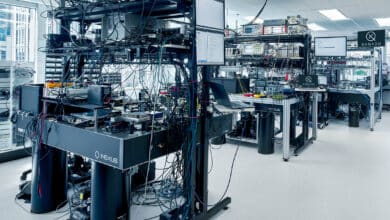
21 Nov 2025 – The Open Compute Project (OCP) has launched a new workstream to prepare conventional data centers for co-locating quantum computers alongside classical HPC systems. Announced at OCP’s Global Summit, this initiative will develop open specifications, best practices, and checklists to guide facility operators in accommodating quantum hardware within traditional server rooms. Drawing on lessons from a few early deployments (for example, IBM’s 20-qubit superconducting machine at the LRZ supercomputing center in Germany), the effort is aimed at enabling “hybrid” high-performance computing environments mixing quantum and classical resources.
Why is this needed? Quantum computers – especially those based on superconducting qubits – have very different infrastructure requirements than classical servers. OCP notes that one cannot simply “walk into” a datacenter with a quantum computer without significant prep. Key considerations include:
- Weight and Structural Support: The cryostat (refrigeration unit) of a typical superconducting quantum system weighs on the order of 750 kg, requiring floor loading support of about 1000 kg per square meter. Data center floors and racks must be engineered for this heavy, concentrated weight.
- Cooling and HVAC: Quantum cryostats use cryogenic cooling. They often need a supply of chilled water in the range of 15–25 °C, much colder than the ~45 °C water loops used for standard HPC cooling. Additionally, humidity must be tightly controlled between ~25–60% to prevent condensation on the super-cold components.
- Environmental Isolation: Quantum devices are extremely sensitive to environmental noise. OCP advises removing or mitigating sources of vibration and electromagnetic interference. For instance, overhead fluorescent lighting should be at least 2 m away, and DC magnetic fields must be kept below 100 µT (with AC magnetic fields <1 µT) near the system. Even nearby infrastructure like cellular base stations, elevators, or train lines within ~100 m could disrupt operations.
- Installation and Maintenance: Unlike typical servers that can be racked in minutes, installing a quantum computer is an involved process taking several weeks. It requires specialized personnel (cryogenic experts, electricians, plumbers for cooling hookups) and careful calibration. In fact, a power outage or significant downtime can mean up to 10 days of recalibration for a quantum machine, so backup power and redundancy are critical.
- Power and Compute Integration: Interestingly, power consumption is not a major obstacle – quantum systems often draw less power than equivalently sized classical supercomputers. However, integrating scheduling and orchestration is a challenge; the workstream will also explore “hybrid scheduling frameworks” so classical and quantum jobs can coexist in workflows.
By compiling these requirements into open guidelines, OCP aims to smooth the path for more organizations to host quantum hardware in their facilities. A white paper of best practices is planned, and OCP will share interim findings via blog posts. The big picture: this is a practical step toward the convergence of HPC and QC. As The Register quipped, it’s an “ethereal and weighty” problem – literally and figuratively – but one that must be solved as we enter a hybrid computing era. Enabling quantum accelerators to sit next to classical supercomputers could unlock new capabilities in research and industry, from faster optimization solvers to new simulations, without building entirely separate quantum labs for each machine.
With industry players like IBM already testing quantum systems in datacenters, OCP’s effort will help standardize the approach and avoid each data center having to reinvent the wheel. Ultimately, mixing qubits and bits on the same floor could become as routine as housing GPUs today – but getting there will require careful infrastructure adaptation, which is exactly what OCP’s guidelines will address.
Quantum Upside & Quantum Risk - Handled
My company - Applied Quantum - helps governments, enterprises, and investors prepare for both the upside and the risk of quantum technologies. We deliver concise board and investor briefings; demystify quantum computing, sensing, and communications; craft national and corporate strategies to capture advantage; and turn plans into delivery. We help you mitigate the quantum risk by executing crypto‑inventory, crypto‑agility implementation, PQC migration, and broader defenses against the quantum threat. We run vendor due diligence, proof‑of‑value pilots, standards and policy alignment, workforce training, and procurement support, then oversee implementation across your organization. Contact me if you want help.
Related Content