New World Record: Twin-Field QKD Achieved Over 1,000 km Fiber Link

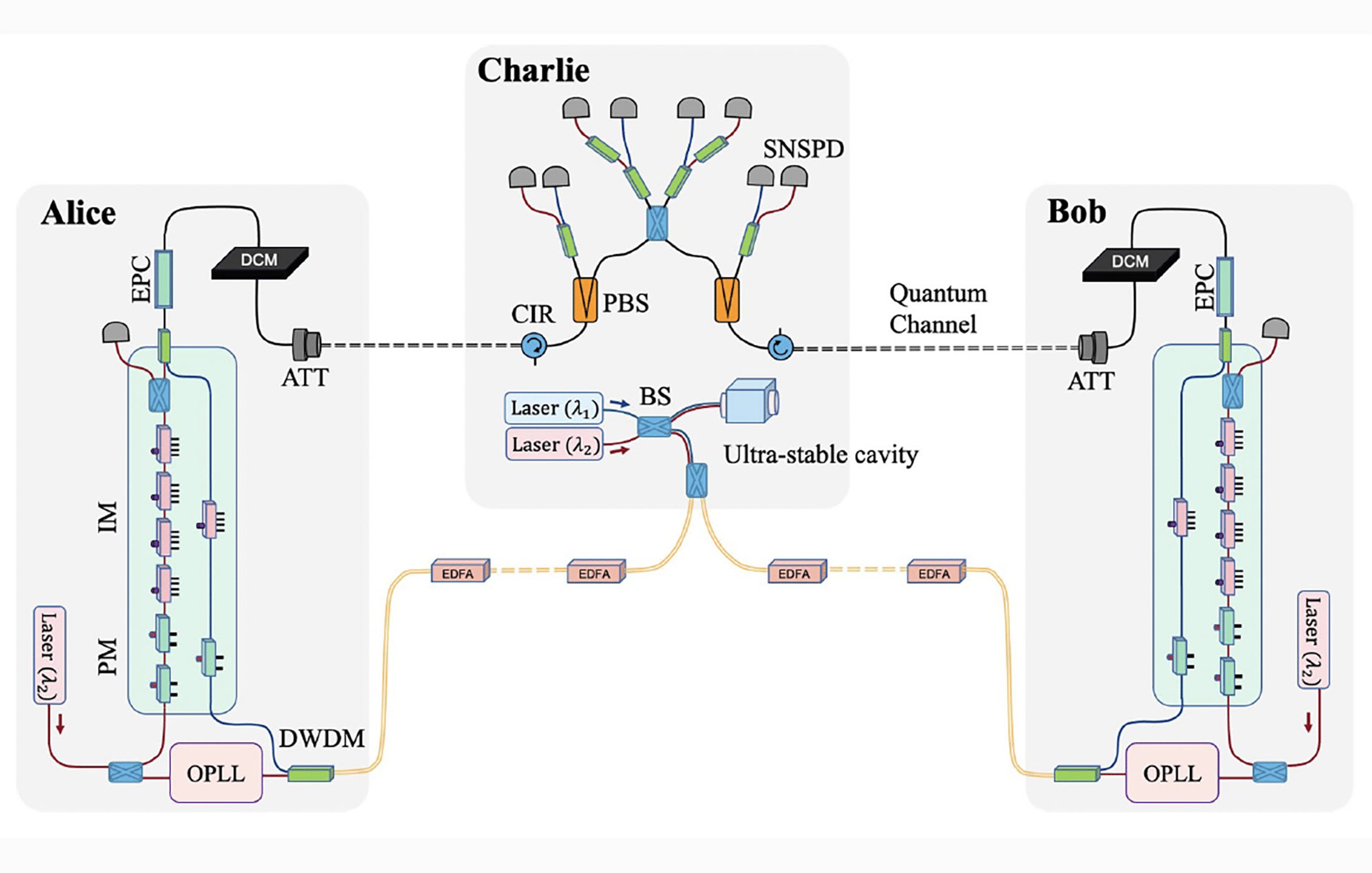
Table of Contents
28 May 2023 – Chinese scientists have shattered the distance record for quantum key distribution (QKD) by successfully exchanging secure cryptographic keys across 1,002 kilometers of optical fiber – more than double the previous record. In a landmark experiment published in Physical Review Letters, a team from the University of Science and Technology of China (USTC) and collaborators demonstrated twin-field QKD (TF-QKD) over a 1,002 km spool of ultra-low-loss fiber without any intermediate repeaters or “trusted” nodes. The result marks the first time QKD has been achieved over such an extreme distance as a point-to-point link, pointing to a critical technical breakthrough on the path toward large-scale, quantum-secure communication networks.
Breaking the 1,000 km Barrier in Fiber QKD
Ordinarily, sharing quantum encryption keys over hundreds of kilometers of fiber is thwarted by fundamental physics: single-photon signals cannot be amplified like classical telecom signals, and fiber-optic loss grows exponentially with distance. Even the best fibers and detectors eventually succumb to diminishing photon rates and accumulating noise, making long-distance QKD infeasible without some form of relay. Prior to this experiment, the longest demonstrated fiber QKD distances were on the order of a few hundred kilometers (a 605 km link by Toshiba’s Cambridge lab, later pushed to 830 km by another USTC team). Those earlier feats already strained the limits of conventional QKD protocols, which see secure key rates scale linearly with the transmission efficiency (η) of the channel. Surpassing the 1,000 km threshold was thus widely considered out of reach without quantum repeaters – devices still under development – or resorting to satellite links.
The USTC-led team overcame this distance barrier by using Twin-Field QKD, a newer protocol that relaxes the rate-vs-distance tradeoff. In TF-QKD, both Alice and Bob send extremely weak coherent pulses to a central measuring station, where an interference measurement is performed. Crucially, the intermediate node need not be trusted; if an eavesdropper tampered with the signals, it would spoil the delicate quantum interference and be noticed. This scheme effectively improves the key rate scaling from linear in η to proportional to √η. In other words, the secret key rate falls off more slowly with distance than in standard QKD, enabling much longer links without quantum repeaters. Using the “sending-or-not-sending” (SNS) variant of TF-QKD, the Chinese team succeeded in distributing keys across 1002 km of fiber, dramatically beyond prior lab demonstrations (which maxed out at ~830 km on spools) and field trials (~511 km over deployed fibers).
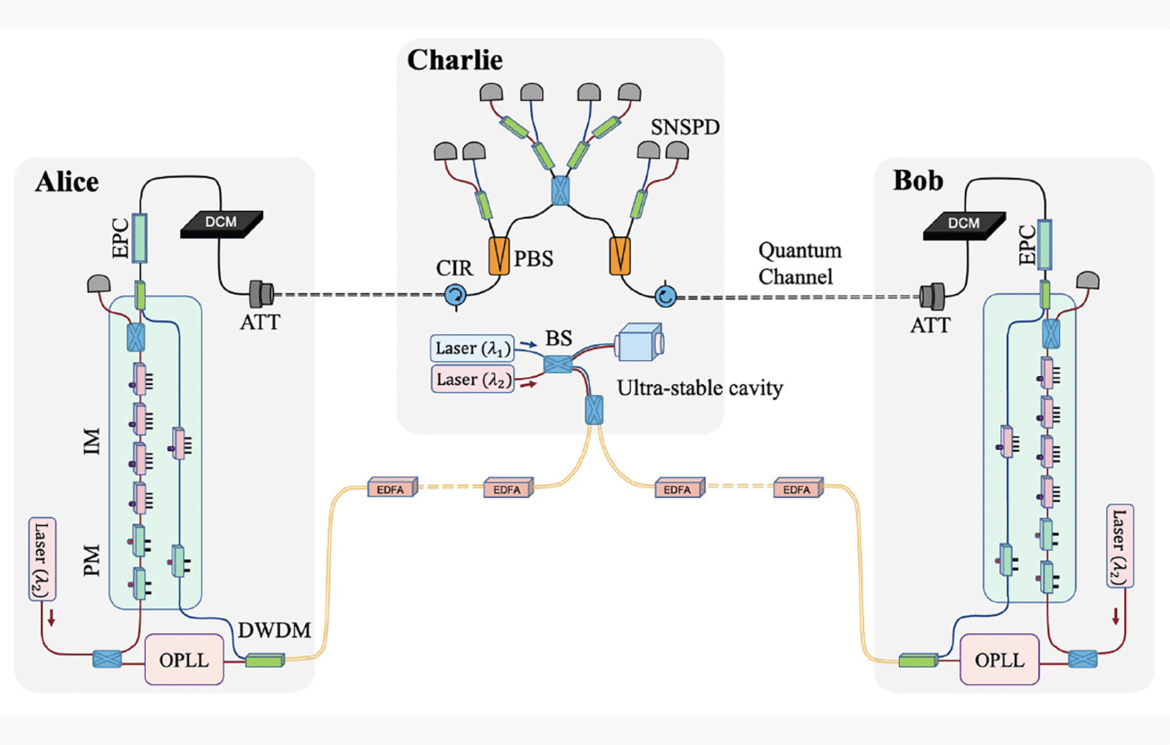
Experimental setup. In Charlie’s station, two lasers (λ1 . 1548.51 and λ2 . 1550.12 nm) are frequency locked to an
ultrastable cavity, then combined, and distributed to Alice (Bob) via 450 (450 km) single mode fiber spools. In Alice’s (Bob’s) station, λ2
is regenerated with an optical phase-locked loop (OPLL). The λ2 light is encoded to dim phase reference and quantum signal with time
multiplexing, then combined with the λ1 strong phase reference with wavelength multiplexing. Signals from Alice and Bob are
transmitted to Charlie for interference. The interference results are measured with SNSPDs. Additional SNSPDs are used to monitor the
signal intensities at Alice and Bob, the polarization and the relative delay at Charlie. Beam splitter (BS); polarization beam splitters
(PBS); intensity modulator (IM), phase modulator (PM); attenuator (ATT); dense wavelength division multiplexing (DWDM);
optical circulator (CIR); erbium-doped fibre amplifier (EDFA); dispersion compensation module (DCM); electronic polarization
controller (EPC).
Achieving this record required cutting-edge hardware and engineering. The experiment used ultra-low-loss optical fiber (only 0.16 dB of attenuation per kilometer, developed with Yangtze Optical Fibre and Cable Co.) to minimize signal loss. Even so, after 1,000 km the channel attenuation was enormous (~156 dB). To detect the vanishingly small signals, the team employed ultra-low-noise superconducting nanowire single-photon detectors, cooled with multiple cryogenic filtering stages to suppress dark counts to ~0.02 counts per second. A specialized dual-band phase stabilization scheme further mitigated phase drift and filtered out spurious Raman scattering in the fiber, keeping the system noise below 0.01 Hz. Thanks to these improvements, the QKD link could operate right at the edge of the “noisy” threshold where secret keys are still extractable. The reported secure key rate was admittedly very low – on the order of 0.0034 bits per second across the 1002 km span – but nonetheless non-zero, meaning a provably secure key was generated and shared. (For context, at shorter distances like a few hundred kilometers, the same system can achieve much higher key rates, on the order of tens of kilobits per second.) Demonstrating even an ultralow key rate over 1,000 km is a proof-of-concept that quantum-encrypted links can span inter-city distances comparable to a regional fiber network. As the researchers note, this constitutes “a critical step towards [a] future large-scale quantum network”.
Why It Matters: A Step Toward Global Quantum Security
Breaking the 1,000 km fiber barrier is more than just a record – it attacks one of QKD’s most-cited practical limitations. Skeptics of QKD have long pointed out that its range is severely limited (tens of kilometers on fiber before requiring trusted relays) and that deploying specialized quantum channels over large distances is impractical. Indeed, U.S. and UK security agencies have tended to downplay QKD, arguing that classical post-quantum cryptography (PQC) is a more practical path to secure long-distance links. The success of twin-field QKD at 1000+ km directly challenges the notion that distance will forever confine quantum key distribution to niche scenarios. It shows that with enough innovation in physics and engineering, the usable range of QKD can be extended dramatically – potentially enough to connect cities hundreds of miles apart with fiber quantum links.
From my perspective, the significance of this experiment is twofold. First, it demonstrates the viability of long-haul, point-to-point QKD without the need for quantum repeaters – a capability many thought would require another decade or more of R&D. While 0.003 bps is not a practical key rate for large bandwidth applications, it is sufficient to periodically refresh encryption keys for systems like one-time-pad secure voice links. The fact that any key can be distilled at 1000 km is a remarkable validation of the TF-QKD protocol. It reassures researchers that the protocol’s theoretical advantages (the √η scaling) hold up in practice even under extreme loss. This means that secure quantum communication could be implemented over continental distances with only minimal use of trusted nodes, well before true quantum repeaters become available.
Second, this result paves the way for integrated quantum networks combining shorter high-speed QKD links and occasional ultra-long links. In a real-world scenario, one could envision a backbone of ~100-200 km QKD segments (where keys can be generated at high rates) interconnected by a few ultra-long TF-QKD spans that leapfrog over untrusted zones or difficult terrain. Such a design would drastically reduce the number of intermediate nodes compared to today’s QKD networks. The experiment also showcases how advances in detector technology and fiber manufacturing directly translate into better QKD performance. It’s a reminder that progress in quantum communications isn’t just about abstract protocols, but also about materials and hardware engineering – from ultralow-loss glass fiber to cryogenic photon detectors. Each incremental improvement extends the secure reach and robustness of QKD. In short, this breakthrough brings the dream of an intercity quantum-secure network closer to reality, addressing one of the field’s key challenges head-on.
From Micius to Fiber: Complementary Paths to Long-Distance QKD
This 1,002 km fiber experiment invites comparison to earlier quantum communication milestones – notably China’s own Micius satellite. Launched in 2016 as the world’s first quantum communications satellite, Micius demonstrated quantum key distribution links from space to ground spanning up to 2,600 km. By transmitting quantum signals through open air (above most of the atmosphere) and leveraging line-of-sight to distant ground stations, the satellite essentially sidestepped the problem of fiber loss. In 2017, for instance, Micius generated about 300 kilobytes of secure key in a 273-second downlink window, enabling the world’s first intercontinental quantum-encrypted video call between Beijing and Vienna. That was a historic QKD demonstration, but it treated the satellite as a trusted node – i.e. keys were shared separately between the satellite and each ground station, then combined using classical post-processing. The Chinese team later upped the ante by using Micius to distribute entangled photons to two ground stations, achieving entanglement-based QKD between cities with no trusted intermediate. However, that entanglement QKD test (reported in 2020) yielded very low key rates – on the order of only a few bits per pass, highlighting that the satellite approach, while excellent for long distance, comes with its own challenges (limited photon flux, strict line-of-sight conditions, and narrow time windows for communication).
In contrast, the twin-field QKD approach is entirely ground-based and does not require putting hardware into orbit. Instead of a satellite acting as a relay, TF-QKD uses an untrusted optical middle station (e.g. a simple beam splitter and detectors) where interference is measured. Security is maintained by the physics of interference – any eavesdropping or tampering at this middle station will degrade the quantum interference visibility and alert Alice and Bob. This concept is related to measurement-device-independent QKD, which also removes trust from intermediate measurement devices. The big advantage of TF-QKD is that it dramatically extends the distance over which keys can be exchanged on Earth, by effectively reducing the impact of channel loss. The new 1002 km result shows that with extraordinary control of noise and phase, ground links can begin to rival satellite links in distance. Unlike satellites, fiber links can in principle operate continuously (24/7) and aren’t affected by day-night cycles or cloud cover – but they do require a physical cable and advanced infrastructure.
Going forward, these two approaches – satellite QKD and long-distance fiber QKD – are likely to be complementary. Satellites are ideal for connecting distant continents or islands, whereas fiber-based QKD can seamlessly interconnect nodes within continents and metropolitan areas. It’s easy to imagine a future global quantum network that uses satellites for the longest hops (thousands of km) and twin-field QKD for regional backbones, stitching together a worldwide secure communication grid. Notably, China has been pursuing both approaches in parallel: the space-based QUESS/Micius program and an extensive terrestrial fiber network. The successes of Micius provided a “bird’s-eye” quantum network spanning continents, while breakthroughs like the 1000 km fiber link fill in the gaps on the ground.
China’s Ongoing Quantum Communications Investment
It is not a coincidence that this 1000 km QKD breakthrough came from China. Over the past decade, China has made QKD a national priority, investing heavily in both research and infrastructure. As early as 2016, Chinese scientists launched Micius and began integrating satellite QKD with terrestrial networks. By 2017, China had completed a 2,000 km fiber QKD backbone linking Beijing to Shanghai. Shortly thereafter, they combined that backbone with additional fiber links and satellite nodes to create the world’s first nationwide quantum-secure network, spanning a total of 4,600 km and connecting over 150 users across multiple cities. Those users included banks, electrical grid control centers, and government institutions – a mix of critical infrastructure secured by quantum keys in daily operation. This scale of deployment is unparalleled; to quote one analyst, “that’s a staggering level of deployment compared to anywhere else in the world”.
China’s “whole nation” approach to quantum tech – coordinating academia, industry, and government toward ambitious goals – has clearly paid dividends in QKD. Pan Jian-Wei, the lead scientist on many of these projects (and a corresponding author of the 1000 km TF-QKD paper), often emphasizes how a concerted national effort enabled China to leap from theory to practical systems in a short time. The results speak for themselves: China is widely viewed as the global leader in quantum communications, thanks to a string of world-first achievements and the sheer scale of its investment.
Meanwhile, Western countries have taken a more cautious stance. The U.S. National Security Agency, for instance, “does not support the usage of QKD” for securing its communications, citing the technology’s practical limitations, and instead backs post-quantum cryptography that can be deployed on existing classical networks. Europe has shown interest in QKD (with projects like the EuroQCI initiative for a quantum-secure EU network), but European efforts remain at the pilot stage and have not yet produced operational networks on China’s scale. No other nation has yet achieved an integrated quantum communication system combining both terrestrial and satellite links comparable to China’s network.
From my point of view, the new 1000 km experiment underscores how far China’s “full steam ahead” strategy has pushed the state of the art. It extends the reach of China’s quantum networks even closer to the goal of linking all major cities with quantum-encrypted channels. Practically, a 1000 km fiber QKD link could connect Beijing to Shanghai with only minimal reliance on intermediate trusted nodes – a tantalizing prospect for truly end-to-end secure communications. It’s also a timely achievement as global interest in quantum-secure networking grows. We are effectively witnessing a high-tech race: on one side, nations focusing on software-based cryptographic upgrades (PQC), and on the other, nations building new quantum hardware infrastructure. China’s bet on the hardware approach is yielding record-breaking capabilities that seemed hypothetical just a few years ago. If quantum cryptography becomes essential in the future, China will have built a considerable lead in expertise and infrastructure.
Quantum Upside & Quantum Risk - Handled
My company - Applied Quantum - helps governments, enterprises, and investors prepare for both the upside and the risk of quantum technologies. We deliver concise board and investor briefings; demystify quantum computing, sensing, and communications; craft national and corporate strategies to capture advantage; and turn plans into delivery. We help you mitigate the quantum risk by executing crypto‑inventory, crypto‑agility implementation, PQC migration, and broader defenses against the quantum threat. We run vendor due diligence, proof‑of‑value pilots, standards and policy alignment, workforce training, and procurement support, then oversee implementation across your organization. Contact me if you want help.
Related Content