Table of Contents
Introduction
For years, creativity has been held up as the last bastion of human uniqueness. A mysterious force that AI could never replicate. Our moat against AI. A defining trait that would forever separate human minds from silicon brains. The idea is that AI fundamentally lacks the imaginative originality that defines human creativity.
This belief often extends to the idea that creativity could serve as a litmus test for advanced AI: if a machine ever demonstrated true creative genius, perhaps that would be the moment it achieves artificial superintelligence (ASI). In theory, an unimaginative algorithm might solve equations, but it “cannot paint a masterpiece or pen a poem like a human can,” or so the thinking went.
As an observer of AI development, this premise is becoming increasingly harder to defend. From visual art to writing and even scientific problem-solving, AI-generated creations are exhibiting “creativity” that is hard to discern from human creativity. Recent research and achievements suggest that our creativity might not be such a safe moat after all.
What Do We Mean by Creativity?
Traditionally, psychologists define creativity as the ability to produce ideas or artifacts that are both original and valuable. In simple terms, a creative idea should be novel (not just a copy of something that already exists) and also useful or meaningful in context. This definition doesn’t explicitly require a flesh-and-blood human – it just sets criteria that could, in theory, be met by any thinking agent. Psychologist J. P. Guilford famously distinguished between convergent and divergent thinking. Convergent thinking is about zeroing in on the single correct answer to a problem, whereas divergent thinking is the ability to generate many different ideas or solutions. It’s divergent thinking – coming up with lots of novel, varied approaches – that’s most closely associated with creativity in the human mind. Tests that measure divergent thinking, such as asking someone to list as many uses for a common object as possible, have long been used as proxies for creative potential.
Crucially, these psychological measures of creativity can just as well be applied to machines. If an AI can also produce ideas that are original (novel) and useful, then by the standard definition it is being creative. The same yardsticks of fluency (how many ideas), flexibility (how different the ideas are), originality (how novel the ideas are), and elaboration (how detailed the ideas are) can be used to judge the outputs of AI against those of humans. This is more than a thought experiment – researchers are actively doing this, pitting human participants against AI systems in creativity tests. The results are illuminating, often surprising, and sometimes a bit unsettling for us humans.
AI’s Rapid Rise in Creative Tasks
It turns out that when you actually measure creative performance side by side, AI is already matching or beating humans in many cases. A clear example comes from a recent study published in Scientific Reports (Nature’s open-access journal) in early 2024. In this study, 151 human participants were pitted against the latest generative AI (ChatGPT-4) in a series of classic divergent thinking tasks. These tasks included the well-known Alternate Uses Task, where you have to invent creative uses for everyday objects (like “other uses for a rope or a fork”), as well as hypothetical scenario questions (“what if humans no longer needed to sleep?”) and a word-association test asking for unrelated words. The AI was given the very same challenges as the humans. The outcome? GPT-4 provided more original and elaborate answers than the human participants on every task. In the words of the researchers, “Overall, GPT-4 demonstrated higher creative potential across an entire battery of divergent thinking tasks.”
This isn’t just a one-off result. In fact, it reflects a broader trend seen across multiple studies. In mid-2023, another group of researchers compared 256 humans with three different AI chatbots (including two versions of ChatGPT) on the Alternate Uses Task – one of the most common creativity tests. They found that on average the AI chatbots outperformed the human participants, consistently coming up with more creative responses. Human answers tended to include a lot of “poor-quality ideas,” whereas the AI generally produced ideas that were more novel and useful. However – and this is important – the same study noted that the very best human ideas were still as good as or better than the AI’s best ideas. In other words, while the average person might now be outshone by an AI on a creative test, the top human performers (those rare creative wizards among us) could still hold their own. We’ll return to those exceptional cases shortly.
It’s worth emphasizing how swiftly this shift has happened. As recently as 2014, some AI experts doubted that machines could ever truly be creative. They proposed something called the Lovelace Test as a more rigorous alternative to the Turing Test, arguing that an AI would only be “intelligent” if it could originate an idea that it wasn’t explicitly programmed to produce. The designers of that test believed such genuine creativity might never be achieved by algorithms. Fast-forward to today, and AI systems are consistently generating ideas, art, and text that surprise even their creators. While one could argue about the philosophical fine print of how these models work, the effect is clear – by output alone, AI is encroaching on territory once thought uniquely human.
AI Artwork, Writing, and the “Creative” Turing Moment
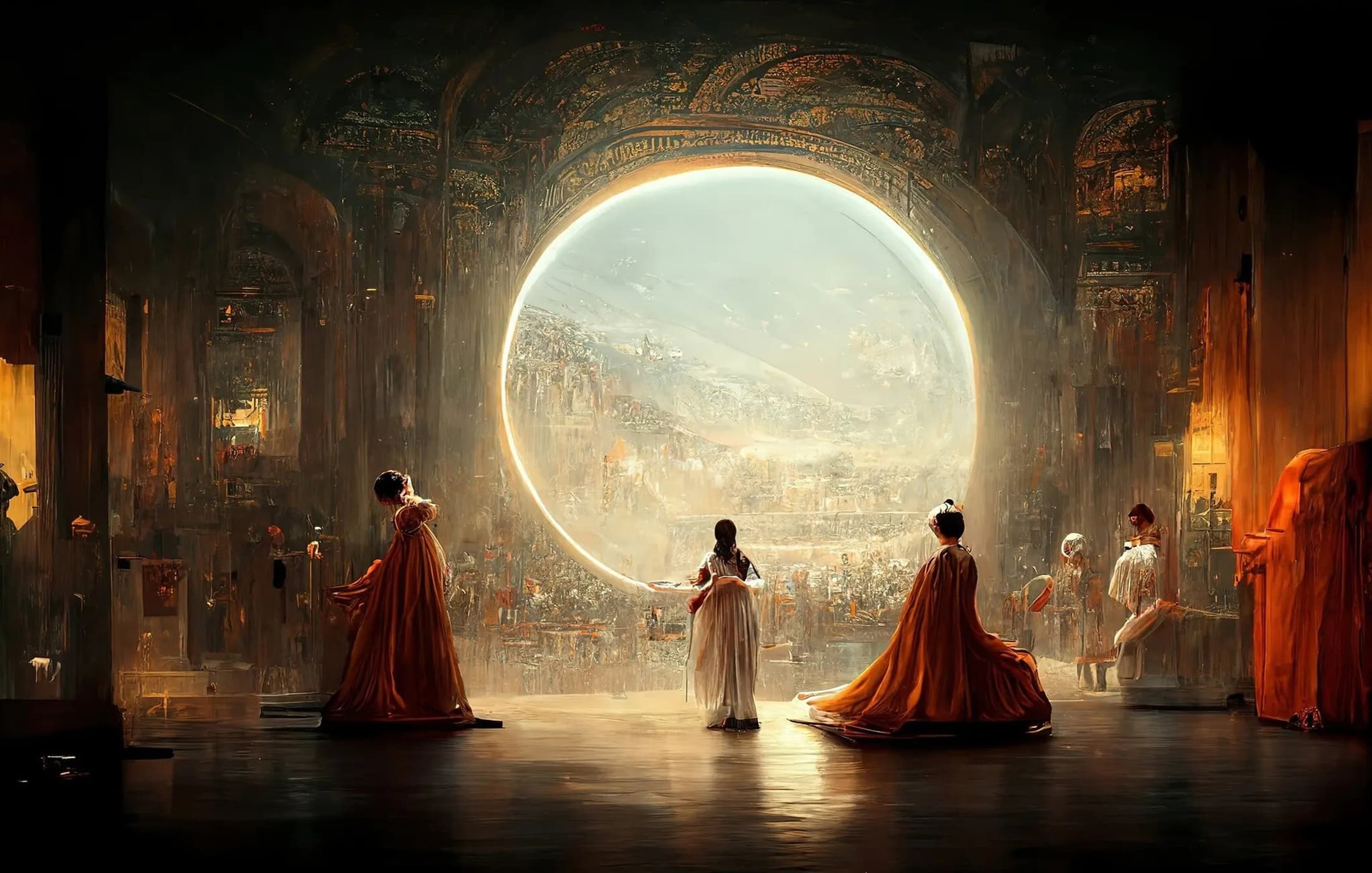
If abstract creativity tests aren’t convincing, just look at what AI is doing in practice. Creative AI systems have already produced artworks, literature, and strategies that rival human creations. A striking example occurred in 2022 at the Colorado State Fair’s fine art competition. An artwork titled “Théâtre D’opéra Spatial” – a dreamy, hyper-detailed scene that looks like a cross between a Baroque painting and a sci-fi movie still – took home the first-place blue ribbon in the digital art category. The twist? The piece was generated by the AI tool Midjourney, guided by a human user’s prompts.
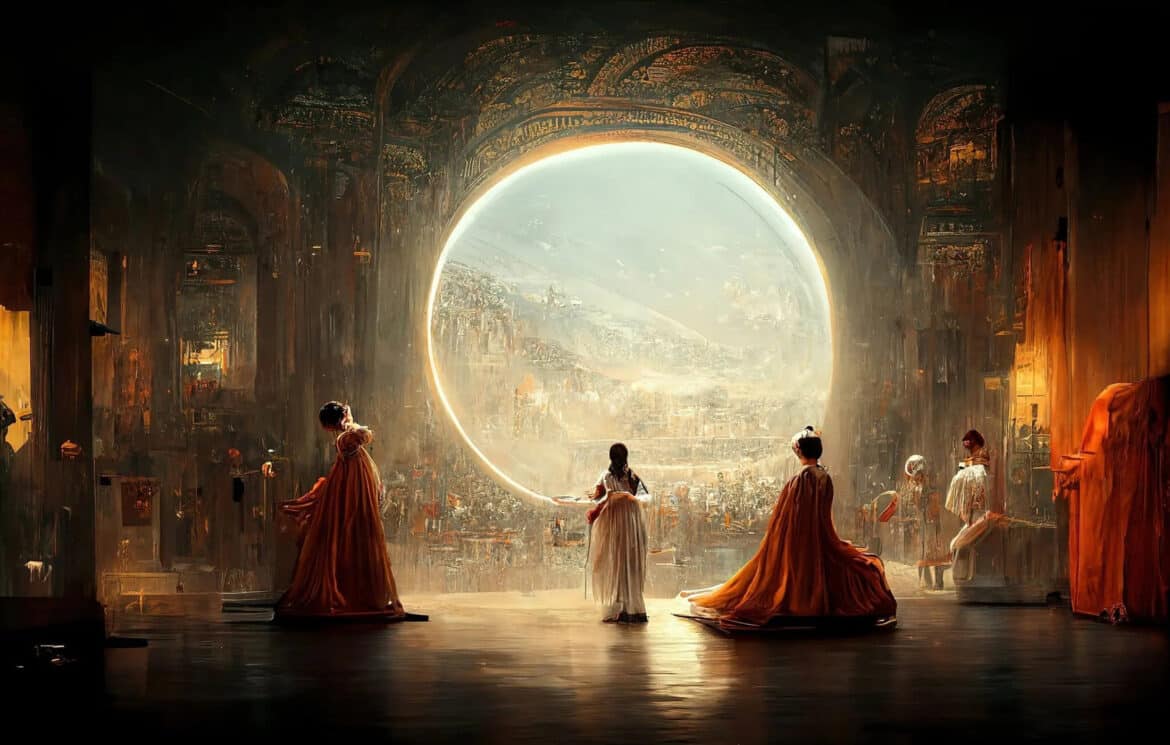
The state fair judges, who were experienced art professionals, did not realize the piece was AI-generated when they awarded it the top prize. Even after learning the truth, one judge remarked that they “would have awarded [the] work the prize regardless” – essentially, the AI art was that compelling on its own merits. This incident sparked heated discussions in the art community. Some artists were upset, seeing it as “pretty freaking unfair” that an AI-assisted work could beat human artists. But from a creativity standpoint, it was a wake-up call: an AI acting through a human proxy had produced something novel and impactful enough to win a creative contest. And it’s not just visual art.
In literature and poetry, AI is making inroads too. Researchers in 2021 found that people could not reliably distinguish AI-written poetry from human-written poetry. In their experiment, participants read a mix of poems – some by humans, some by an AI – and tried to guess which was which. The results showed that our ability to tell machine creativity from human creativity can be shockingly poor. When an AI can mimic the style of a Maya Angelou well enough that readers can’t tell the difference, it challenges our notions of a unique human “voice.” Similarly, AI language models have penned short stories and even news articles. While these often still require human editing, the raw creative spark – the invention of characters, plots, phrases – is increasingly coming from the machine. An AI-coauthored short story might not win a Pulitzer (yet), but it can certainly pass for a competent piece of writing in many cases. This begs the question: if we can’t tell AI-generated art or writing apart from human-made, on what basis can we claim humans have an innate creative edge?
Even in fields like music and games, AI has displayed flashes of creativity that command respect. DeepMind’s AlphaGo AI famously demonstrated “creative” play in the game of Go, inventing strategies that human grandmasters had never conceived in the game’s thousands of years of history. In the legendary 2016 match against Lee Sedol, AlphaGo made a move (known as Move 37) that was so unorthodox yet effective, it took everyone by surprise. Veteran Go commentator Michael Redmond called it “unique” and highly creative, noting no human would have played that move. Lee Sedol himself, initially skeptical about calling a machine creative, changed his view after that move. “I thought AlphaGo was merely a calculation machine,” Lee said, “But when I saw this move, I changed my mind. Surely, AlphaGo is creative.” (I wrote more about this in my 2022 article: “Magical” Emergent Behaviours in AI: A Security Perspective). This moment has since been highlighted as possibly the first glimpse of machine creativity in a realm (Go strategy) that requires intuition and imagination. AlphaGo’s creative move paid off – it helped secure a victory and overturned centuries of conventional wisdom in Go. If even in a complex, aesthetic activity like Go strategy an AI can surprise and surpass human creativity, it underscores that the scope of machine creativity is broadening.
Beyond games, we’ve seen AI designing products, composing music, and more. In one project, an AI system collaborated with acclaimed music producer Alex Da Kid to create a song that made it onto the charts. In design, companies like Autodesk have used AI algorithms to come up with novel chair designs and engineering components that no human might have sketched – yet they work and even possess a certain creative flair in their ergonomics. And consider scientific creativity: AIs are being used to propose new mathematical conjectures and molecular designs. While these are highly technical domains, the essence is the same – generating new ideas that advance the field. It’s telling that Scientific American noted how an AI helped Dutch researchers discover an unusual antibiotic by creatively sifting through chemical space, finding a molecule unlike any existing antibiotic. Such an invention process, mixing vast knowledge with leaps of intuition (or at least probabilistic jumps), was traditionally the hallmark of human scientists.
All these examples drive home the point: AI can recreate and even rival the creative outputs of humans in many domains. Paintings, poems, strategic game plays, musical compositions, product designs – the list keeps growing. We humans pride ourselves on creative achievements, from the Sistine Chapel ceiling to Hamlet to the theory of relativity. Yet AI is showing it can operate in those same imaginative arenas, if not at Michelangelo’s level yet, at least well enough to raise eyebrows and win prizes. Which brings us to an uncomfortable realization: maybe we are not as endlessly inventive as we like to believe.
Humans: Creative Geniuses or Master Synthesizers?
Part of the mystique around human creativity is the idea that we magically pull completely original ideas out of thin air. But cognitive science and the history of innovation suggest something a bit less mystical is often at play. Human creativity usually builds on what came before – we remix, we reframe, we make new connections between existing ideas. There’s even a saying: “All creativity is a remix.” When a novelist writes a groundbreaking story, they’re drawing on a lifetime of reading and experiences; when a scientist formulates a revolutionary theory, it’s often by synthesizing disparate findings in a novel way. Truly revolutionary leaps – ideas that seem to have no precursor at all – are exceedingly rare.
In fact, renowned AI researcher and cognitive scientist Margaret A. Boden has categorized creativity into three types: combinational, exploratory, and transformational. The first two, combinational and exploratory creativity, cover the vast majority of what we do in everyday life and even in most art and science. Combinational creativity is taking familiar ideas and merging them in new ways. Exploratory creativity means tinkering within an established style or conceptual space to create something different but still grounded in known structures (like composing a new song in an existing musical genre or inventing a new gadget using known scientific principles). According to Boden, these forms of creativity aren’t a million miles away from what generative AI does: an algorithm trained on millions of human examples can recombine elements or explore variations to produce “novel works in the same style as millions of others in the training data”, a kind of “synthetic creativity.”
Think about it – when you ask an image generator AI for “a painting of a city floating in the sky in Van Gogh’s style,” it is combining concepts (city + sky + floating, etc.) and exploring within the learned style of Van Gogh. It’s not painting something 100% unprecedented, but neither are most human artists. An illustrator who adopts Van Gogh’s style to paint a new scene is essentially doing combinational/exploratory creativity as well. Both AI and humans excel at this iterative, combinatorial creativity. And with its vast memory and speed, an AI can churn through combinations and associations much faster than we can. That is one reason AI models like GPT-4 shine in divergent thinking tasks – they have ingested more examples and semantic connections than any single human, and they can mash up ideas in milliseconds.
In the Alternate Uses Task mentioned earlier, one key to being creative is retrieving remote associations – thinking of uses for a brick that aren’t obvious. The AI’s huge training corpus gives it a flat associative horizon, meaning it can pull in far-flung references (maybe something it read about coral reefs or ancient architecture) to suggest a wildly original use for a brick. Humans, by contrast, are limited by what they’ve been exposed to and by cognitive biases that favor the familiar. As researchers noted, current AIs have “a vast memory and the ability to quickly access large databases,” so one might expect them to outperform humans in making remote associations – and thus in generating original ideas. That expectation appears to be borne out by the data.
What about the third type of creativity, transformational creativity? This is the really profound kind – the kind of earth-shattering originality that changes the rules of the game. In art, think of the invention of Cubism; in science, Einstein’s theory of relativity; in music, Beethoven’s leap from classical to romantic expression. Transformational creativity is “generating ideas beyond existing structures and styles to create something entirely original”. Boden and others have argued that this form of creativity might be a bridge too far for AI, at least as we know it. It requires not just remixing what exists, but altering the very frameworks by which ideas are generated. Interestingly, even among humans this is exceedingly rare – only a handful of individuals in history are credited with creativity at this paradigm-shifting level. Albert Einstein is often cited as an example in science; artists like Picasso or innovators like Ada Lovelace in computing could be others. The vast majority of us – even very smart, creative people – operate within known paradigms and build incrementally.
So when I say “humans are not as creative as we think,” it means that most human creativity is incremental. We give ourselves credit for big imaginations, but day to day, we’re usually doing small twists on the familiar. The startling implication of recent AI advances is that if creativity largely boils down to synthesizing existing ideas with minor novel tweaks, machines can do that too – and do it at scale. A telling comment from the 2024 divergent thinking study was that humans might have been self-censoring their answers to keep them realistic. The AI had no such inhibition and just spewed lots of unusual ideas. In a sense, our very humanness – concern for practicality or feeling silly – can limit our creative output on such tests, whereas the machine, without ego or fear, freely combines absurd things to find original solutions. Sometimes, that’s actually what creativity requires: freedom to roam mentally.
None of this is to say human creativity is unimpressive – far from it. It’s to demystify creativity as a quasi-mystical ability. Human minds are powerful, but they are also bounded by experience and cognitive structure. We remix what we know. Now that we’ve built AI that can absorb a tremendous breadth of knowledge and mimic the remixing process, it’s no wonder AI is starting to look creative. The playing field is being leveled, at least for combinational and exploratory creativity. Our moat wasn’t as deep as we assumed, because it turns out the moat could be crossed with enough data and clever algorithms.
The Best of the Best: Top-Tier Creativity vs. AI
Earlier, we noted that while average humans might be losing out to AI on creativity tasks, the most creative humans still hold an edge – at least for now. This nuance is important. Based on the previous study I mentioned, if you compare a creative genius to the AI, the genius wins; compare an average Joe to the AI, the AI wins. This suggests that human creativity might follow a long-tail distribution – a small fraction of people are exceptionally inventive, and their gifts are not yet(!) matched by machines. These are the Einsteins, the Shakespeares, the Marie Curies, the people who seem to have an almost otherworldly ability to create or discover the radically new.
There’s a comforting thought here: perhaps true creativity – the kind that changes paradigms – remains a human forte. The AI can remix a billion images to make a new painting, but it didn’t invent the concept of painting in the first place. The AI can churn out melodic variations, but it didn’t conceive Rock and Roll from scratch. One might argue that all of the AI’s creativity is derivative by nature: it’s trained on human creations, so everything it produces, however novel-seeming, is a complex remix of what people have done before. Meanwhile, a human genius can, in theory, break completely new ground with an insight that isn’t obviously traceable to prior art.
However, even this last bastion is not guaranteed to hold forever. It’s conceivable that future AIs (or human-AI hybrids) could achieve transformational creativity. For instance, consider AlphaGo’s surprising move again – within the domain of Go, that move upended established wisdom and opened players’ eyes to new possibilities. It was derivative in that AlphaGo learned by studying human games and playing itself, but the outcome was something no human taught it to do. If one day an AI in a research lab formulates a groundbreaking theory of physics that humans hadn’t entertained, or an AI art system develops an entirely new artistic style that doesn’t mimic any known genre, we’ll have to concede that machines can do transformational creativity too. Already, we’ve seen hints: for example, AlphaZero (the descendant of AlphaGo) learned chess from scratch and ended up devising strategies that astonished grandmasters, feeling fresh and unorthodox compared to centuries of human chess play. Some grandmasters called AlphaZero’s style “alien” in its creativity – it wasn’t taught human chess principles; it figured out its own.
So while the peak of the creative mountain is still human territory, the slope leading up to it is increasingly populated by AIs. And the gap at the summit might be narrowing. It’s a bit humbling: perhaps we aren’t special snowflakes of innovation so much as middling problem-solvers who occasionally hit on something brilliant – something an advanced pattern-spotting machine might also hit on with enough training. As one creative AI researcher mused, “We have to rethink what we mean by creativity” in light of these studies. If an AI can write a half-decent sonnet and suggest a cure for a disease and design a cool chair, all in one afternoon, the definition of creative talent has to expand beyond just “something only humans can do.”
Can Creativity Detect an ASI?
Given how far AI creativity has come, relying on it as a signal for artificial superintelligence (ASI) would be a dangerous strategy. Some futurists have imagined that perhaps a telltale sign of a machine achieving true, general intelligence beyond human would be a sudden explosion of creativity – a flurry of inventions, artworks, and ideas no human could come up with. The thought is that creativity = intelligence, so an ASI would necessarily out-create us in dazzling ways. While an ASI might indeed be extremely creative, the problem is we might not recognize its creations for what they are, or we might mistake a merely very good AI for a true ASI based on creative output.
First, as we’ve explored, even current AIs can generate outputs that appear highly creative by human standards. They surprise us with novel ideas, sometimes to the point we’d call those ideas ingenious. So, if we were using creativity as a yardstick for advanced intelligence, we’d have to acknowledge that GPT-4-level AI has already crossed that threshold on some metrics (e.g., divergent thinking scores). But GPT-4, impressive as it is, is not an ASI (it has many limitations and doesn’t vastly exceed human intelligence across the board). In other words, creative output alone isn’t a reliable indicator of a truly superintelligent machine. A relatively narrow AI can be programmed or trained to excel at creative tasks without possessing a human-like understanding or self-awareness. Creativity can be narrow. For example, you could have an AI that is a master at composing music – producing symphonies that rival Mozart – yet it might be useless at every other task and certainly not “smarter” than a human in a general sense.
Secondly, consider the flip side: if a genuine ASI did emerge and was far beyond us, its most novel ideas might be incomprehensible to human observers. Historically, when a genius-level human comes up with something truly revolutionary, it often takes the rest of us years or decades to catch up (think of how long it took for Einstein’s ideas or certain modern art movements to be appreciated). Now imagine an intelligence hundreds or thousands of times beyond human – the creations of such a mind might look like gibberish or random noise to us, at least initially. We might fail to see the creativity simply because we lack the frame of reference to understand it. As a thought experiment: if you gave a medieval peasant an iPhone, would they see it as an astounding invention or just a shiny rock? If an ASI handed us a blueprint for a warp drive, could we even recognize its brilliance without the intermediate scientific knowledge? Thus, using our subjective judgment of creativity as a “test” for ASI is unreliable – the ASI’s creativity might either be too subtle or too beyond us to register.
There’s also the aspect of autonomy and agency. One of the arguments in the Lovelace Test (mentioned above) was that an AI isn’t truly creative unless it originates something without human prompting. Current AIs, however clever, still largely act as tools guided by human prompts and goals. As the 2024 Arkansas study authors noted, “AI, unlike humans, does not have agency” – it’s “dependent on the assistance of a human user. Therefore, the creative potential of AI is in a constant state of stagnation unless prompted” In plainer terms, an AI won’t do anything creative unless a human asks or triggers it in some way. So if we’re looking for an ASI by testing creativity, do we mean with prompts or entirely on its own initiative? An ASI might be creatively solving problems we haven’t even thought to ask, but if we never ask, we might not see it. Conversely, a non-ASI could spit out creative answers to every prompt we give, yet have no self-driven agenda or awareness – essentially a savant tool, not a self-determined intellect.
All these considerations suggest that creativity is a poor single metric to identify a truly superior AI intelligence. We can’t rely on a simplistic notion like, “If it writes an award-winning novel, it must be an ASI.” We’ve already had AI-written articles and songs win awards or go viral, and those AIs are not omniscient superintelligences, they’re just very good pattern generators. The Turing Test itself (which is about fooling humans in conversation) has been subverted by chatbots that used cheap tricks, without actually thinking. Similarly, a creativity test can be subverted by brute-force generation and training on huge datasets, without the AI necessarily understanding or transcending in a general way. An ASI, if it comes, might manifest creativity along with many other signs – but by the time it’s easily out-creating all of humanity, it will likely be obvious in other ways too (e.g. mastering science, controlling systems, etc.). In short, creativity is not the magic key to detecting an ASI, nor is it the magic wall protecting humans from AI.
Conclusion
The evidence is mounting that creativity is not an exclusively human stronghold. Our imaginative prowess – impressive as it is – can already be paralleled, and in some respects surpassed, by AI that synthesize and recombine knowledge. This realization calls for a humbling adjustment in how we view ourselves and our machines. It doesn’t mean human creativity is “dead” or that artists and innovators are obsolete. Far from it. What it means is that we are entering an era of augmented creativity, where human and AI creative efforts intertwine.
The notion that “creativity is what makes us human, and machines will never touch that” is increasingly a myth. Current AIs have demonstrated that they can regularly beat humans in creative tasks – at least those tasks we know how to measure – and they can produce artifacts that people judge as creative, whether it’s a poem, a painting, or a chess move. Humans, for all our genius, often create by building on the past, and now we’ve built tools that can do the same at extreme scale. Our creativity was never an impenetrable magic – it was a skill and a process, one that we now share with our machines
Creativity alone can no longer serve as a foolproof test of “humanness” or a clear line in the sand for AI progress.
Quantum Upside & Quantum Risk - Handled
My company - Applied Quantum - helps governments, enterprises, and investors prepare for both the upside and the risk of quantum technologies. We deliver concise board and investor briefings; demystify quantum computing, sensing, and communications; craft national and corporate strategies to capture advantage; and turn plans into delivery. We help you mitigate the quantum risk by executing crypto‑inventory, crypto‑agility implementation, PQC migration, and broader defenses against the quantum threat. We run vendor due diligence, proof‑of‑value pilots, standards and policy alignment, workforce training, and procurement support, then oversee implementation across your organization. Contact me if you want help.
Related Content