
Quantum Computing
Quantum computing hardware, modalities, architectures, companies, roadmaps, ecosystem dynamics, and the path to fault tolerance.
-
Quantum Computing for Cybersecurity Professionals
Part 1: What a Quantum Computer Is Not
The popular story of quantum computing gets the professionally important details backwards. Part 1 clears the category error, previews the cryptographic casualty list, and sets your real deadline, which arrives well before Q-Day.
Read More » -
Post-Quantum, PQC, Quantum Security
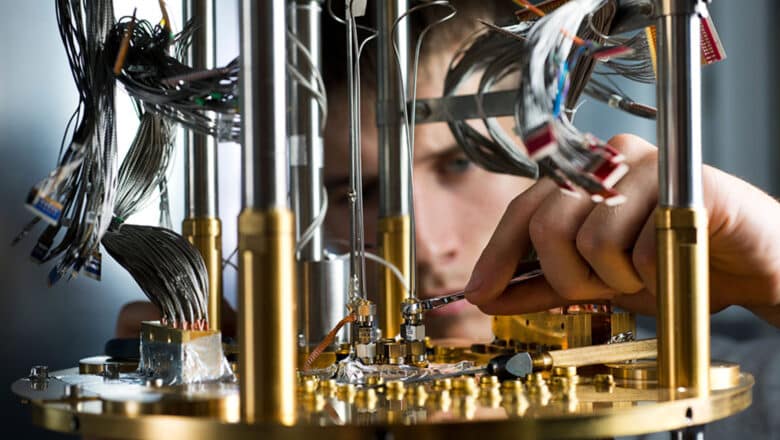
Adiabatic Quantum Computing (AQC) and Impact on Cyber
Adiabatic Quantum Computing (AQC), and its variant Quantum Annealing, are another model for quantum computation. It's a specialized subset of quantum computing focused on solving optimization problems by finding the minimum (or maximum) of a given function over a set…
Read More » -
Quantum Computing
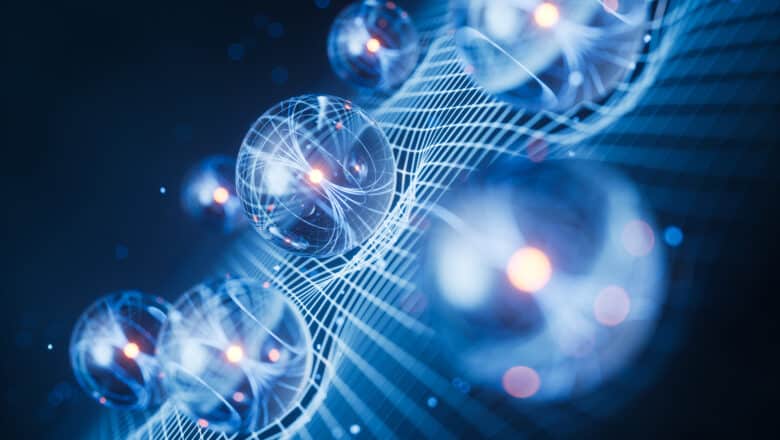
Routing Quantum Information: SWAP, iSWAP, and Moving Qubit States
Quantum computers face a unique challenge in moving quantum information between qubits. Unlike classical bits that can be shuttled freely along wires, qubits cannot be arbitrarily copied or moved due to the no-cloning theorem. To route a qubit’s state from…
Read More » -
Quantum Computing
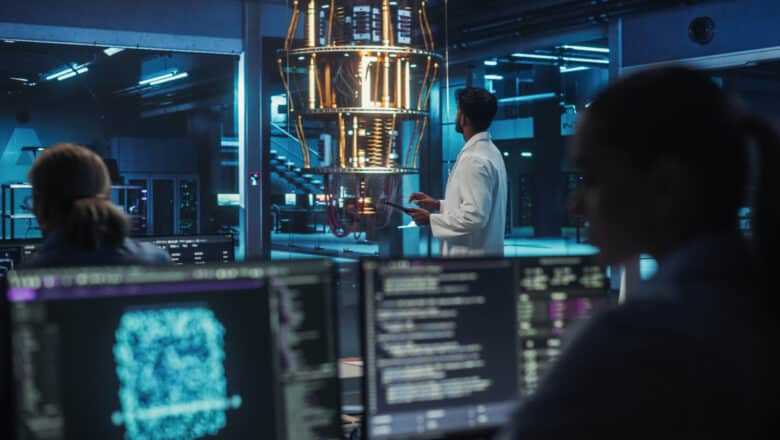
Surface Code Quantum Error Correction
Quantum error correction (QEC) is indispensable for building large-scale fault-tolerant quantum computers. Even today’s best qubits suffer error rates that would quickly corrupt any long calculation if left uncorrected. The principle of QEC is to encode a single logical qubit…
Read More » -
Quantum Computing

Quantum Supremacy vs. Quantum Advantage
In the ever-accelerating world of quantum computing, two terms have emerged as the darlings of headlines and conference keynotes: quantum supremacy and quantum advantage. If you've followed the news, you might think they're interchangeable buzzwords celebrating the dawn of a…
Read More » -
Quantum Computing
Early History of Quantum Computing
Since the early 2000s, the field of quantum computing has seen significant advancements, both in technological development and in commercialization efforts. The experimental demonstration of Shor's algorithm in 2001 proved to be one of the key catalyzing events, spurring increased…
Read More » -
Quantum Computing
The Controlled-NOT (CNOT) Gate in Quantum Computing
The CNOT gate is to quantum circuits what the XOR gate is to classical circuits: a basic building block for complex operations. By learning how the CNOT gate works and why it matters, cybersecurity experts can better appreciate how quantum…
Read More » -
Quantum Computing
Random Circuit Sampling (RCS) Benchmark
At its core, Random Circuit Sampling (RCS) is a way to test how well a quantum computer can generate the output of a complex quantum circuit. Compare the results to what an ideal quantum computer should produce. If the quantum…
Read More » -
Quantum Computing
Schrödinger’s Wave Equation
Schrödinger’s equation is essentially the master instruction set for quantum systems – the quantum-world analogue of Newton’s famous F=ma in classical physics. In short, Schrödinger’s equation is to quantum mechanics what Newton’s second law is to classical mechanics: a fundamental…
Read More » -
Quantum Computing
Beyond “Many Paths at Once”: The True Power of Quantum Computers
Quantum computers are often described with a mind-bending metaphor: they explore multiple paths simultaneously to find an answer. You might have heard people excitedly say that a quantum computer can "try all solutions at once" thanks to quantum magic. This…
Read More » -
Quantum Computing
What’s the Deal with Quantum Computing: Simple Introduction
Quantum computing holds the potential to revolutionize fields where classical computers struggle, particularly in areas involving complex quantum systems, large-scale optimization, and cryptography. The power of quantum computing lies in its ability to leverage the principles of quantum mechanics—superposition and…
Read More » -
Quantum Computing
Feynman and the Early Promise of Quantum Computing
In the early 1980s, the legendary physicist Richard Feynman imagined a new kind of computer - one that operates on the weird rules of quantum mechanics rather than classical physics. Frustrated by how clumsy ordinary computers were at simulating the…
Read More » -
Quantum Computing
Quantum Parallelism in Quantum Computing: Demystifying the “All-at-Once” Myth
Quantum parallelism is often described in almost mystical terms – exponential computations happening in parallel in the multiverse! – but as we’ve explored, it boils down to the concrete physics of superposition and interference. A quantum computer superposes many states…
Read More » -
Quantum Computing
Why Do Quantum Computers Look So Weird?
The intricate giant chandelier of copper tubes, wires, and shielding often leaves people puzzled and curious. This image of a quantum computer is quite striking and unlike any classical computer we've seen before. This unique appearance is not just for…
Read More » -
Quantum Computing
Quantum Computing Use Cases
In the early 1900s, when theoretical physicist Max Planck first introduced the idea of quantized energy levels, he probably didn’t foresee his work eventually leading to machines that could solve problems faster than a caffeine-fueled mathematician on a deadline. Legend…
Read More »


